0115 big data workflow from data feeds to actionable intelligence ppt slide
Try Before you Buy Download Free Sample Product
Audience
Editable
of Time
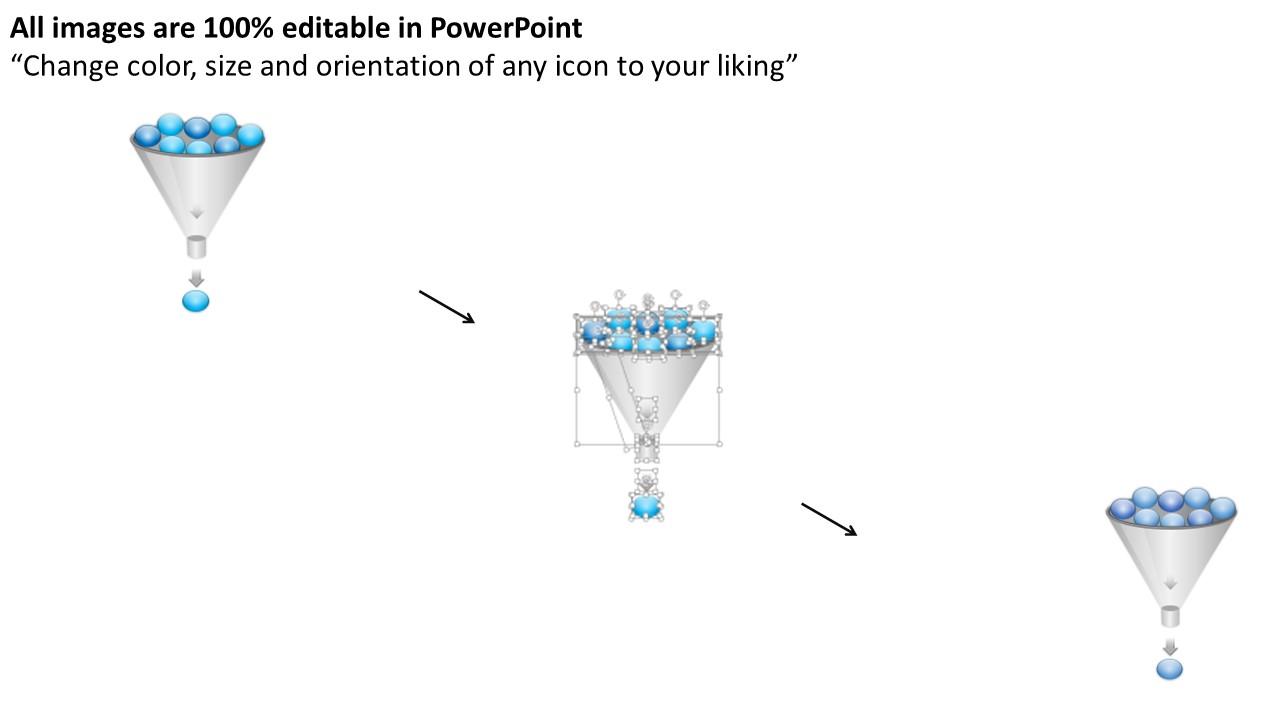
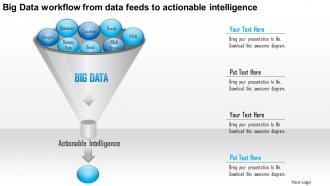
Data visualization is the key to actionable insights. This concept can further be explained with our big data workflow from data feeds to actionable intelligence PowerPoint design slide. Visualization allows you to take your complex findings and present them in a way that is informative and engaging to all stakeholders and a strong understanding of data science is required for that visualization to be successful. Our slide has been designed with a graphic of workflow funnel diagram. This diagram contains the data feeds to actionable intelligence. This PPT can be used for data workflow related topics in any data technology based presentation. We should ensure results are delivered as actionable, impactful insights to act upon in business and in life. Through the use of our slide show you can collect masses of data and find a trend within the data which allows the businesses to move much more quickly, smoothly, and efficiently. So, just download the PPT visual in your presentation and then attract the attention of your audience. Bury the hatchet with our 0115 Big Data Workflow From Data Feeds To Actionable Intelligence Ppt Slide. They help extend a hand of friendship.
People who downloaded this PowerPoint presentation also viewed the following :
0115 big data workflow from data feeds to actionable intelligence ppt slide with all 5 slides:
Our 0115 Big Data Workflow From Data Feeds To Actionable Intelligence Ppt Slide bring customers to your doors. You will become the destination of choice.
FAQs for 0115 big data workflow from data feeds to actionable
A typical big data workflow includes data ingestion, storage, processing, analysis, and visualization stages. These interconnected phases streamline operations by automating data collection, enabling scalable storage solutions, and delivering real-time insights, with many organizations finding that structured workflows reduce processing time and enhance decision-making capabilities across departments.
Data ingestion techniques vary significantly across industries based on data volume, velocity, and regulatory requirements, with financial services using real-time streaming for trading data, healthcare employing batch processing for patient records, and retail leveraging hybrid approaches for inventory management. These industry-specific methods enable organizations to optimize data flow, ensure compliance, and deliver faster analytics, ultimately enhancing operational efficiency and competitive advantage.
Data preprocessing enhances data quality by cleaning inconsistencies, removing duplicates, handling missing values, standardizing formats, and filtering irrelevant information. Through systematic preprocessing workflows, organizations in healthcare, finance, and retail streamline analysis accuracy, reduce computational overhead, and enable more reliable insights, ultimately delivering faster decision-making capabilities and competitive analytical advantages.
Organizations ensure data governance throughout big data workflows by implementing automated policy enforcement, establishing clear data lineage tracking, and deploying role-based access controls at every stage. These governance frameworks streamline compliance monitoring, enhance data quality validation, and maintain security protocols, with many financial services and healthcare institutions finding that integrated governance tools ultimately deliver regulatory compliance and operational transparency across complex data pipelines.
Big data security best practices include encryption at rest and in transit, role-based access controls, regular security audits, data masking, and compliance monitoring. These measures streamline protection by minimizing unauthorized access, ensuring regulatory compliance, and maintaining data integrity, with many financial services and healthcare organizations finding that layered security approaches ultimately deliver both robust protection and operational confidence.
Machine learning models integrate into big data workflows by processing vast datasets for pattern recognition, predictive analytics, and automated decision-making across collection, storage, and analysis phases. These models enable organizations in healthcare, finance, and retail to streamline operations, enhance customer targeting, and optimize resource allocation, ultimately delivering faster insights and competitive advantages in increasingly data-driven markets.
Big data processing relies on tools like Apache Hadoop, Spark, Kafka, Elasticsearch, and cloud platforms such as AWS and Azure. These technologies streamline data ingestion, processing, and analytics by enabling distributed computing, real-time streaming, and scalable storage, with many organizations finding that this strategic combination delivers faster insights, reduced infrastructure costs, and enhanced competitive advantage.
Real-time data integration transforms big data workflows by enabling immediate processing, reducing latency from hours to seconds, and supporting instant decision-making capabilities. Through streaming analytics and continuous data pipelines, organizations in financial services, healthcare, and retail can detect fraud instantly, monitor patient conditions continuously, and personalize customer experiences dynamically, ultimately delivering competitive advantages through faster responses.
Big data workflow success metrics include data processing speed, accuracy rates, system uptime, cost per data unit processed, and time-to-insight delivery. These measurements enable organizations to optimize resource allocation, enhance operational efficiency, and accelerate decision-making processes, with many enterprises finding that balanced scorecards ultimately deliver competitive advantage and improved business outcomes.
Visualization tools enhance big data insights by transforming complex datasets into intuitive charts, graphs, and interactive dashboards, enabling faster pattern recognition and decision-making. Through platforms like Tableau and Power BI, organizations streamline data interpretation, identify trends more efficiently, and communicate findings across teams, ultimately delivering improved strategic planning and competitive advantage in data-driven environments.
Organizations face challenges including infrastructure limitations, data quality inconsistencies, processing bottlenecks, talent shortages, and integration complexities when scaling big data workflows. These obstacles can significantly impact operational efficiency, with many enterprises finding that strategic investments in cloud platforms, automated data governance, and cross-functional training ultimately deliver streamlined processing and competitive advantage.
Organizations leverage cloud computing to optimize big data processes through scalable storage solutions, distributed processing frameworks, and automated resource allocation that reduces infrastructure costs. Cloud platforms enable seamless data integration across multiple sources while providing advanced analytics tools, with many enterprises finding that hybrid cloud approaches deliver enhanced computational power, faster processing speeds, and improved operational efficiency for complex data workflows.
Collaboration among teams improves big data workflow by enabling cross-functional expertise sharing, streamlined data pipelines, faster problem resolution, and unified quality standards across the organization. When data scientists, engineers, and business analysts work together seamlessly, organizations achieve more accurate insights, reduced processing bottlenecks, and accelerated decision-making capabilities, ultimately delivering competitive advantage.
Ethical considerations include obtaining informed consent, ensuring data anonymization, implementing robust security measures, maintaining transparency in data usage, and providing individuals control over their information. These practices help organizations comply with regulations like GDPR while building customer trust, with many companies finding that ethical data handling ultimately delivers competitive advantage and sustainable business growth.
AI and IoT significantly transform big data workflows by enabling real-time data collection, automated processing, and predictive analytics capabilities. Through machine learning algorithms and connected sensors, organizations streamline data ingestion, enhance pattern recognition, and accelerate decision-making processes, with industries like manufacturing and healthcare finding that these technologies deliver faster insights, reduced operational costs, and improved competitive advantage.
-
Designs have enough space to add content.
-
Appreciate the research and its presentable format.