0314 faq human thinking process

Rating:
100%
0314 faq human thinking process
Slide 1 of 5
Favourites Favourites

Try Before you Buy Download Free Sample Product

Audience Impress Your
Audience
Editable 100%
Editable
Time Save Hours
of Time
The Biggest Sale is ending soon in
0
0
:
0
0
:
0
0
Rating:
100%
Instantaneous download in simple and straightforward steps. Absolutely modifiable size and orientation of PPT infographics. Change the text as to suit the context in any number of words. High resolution PPT images with no pixelation on wide screen projection. Add in between your own PPT slides or run seamlessly with Google slides. Ideal for product marketers, consultants, project managers etc.

People who downloaded this PowerPoint presentation also viewed the following :

Content of this Powerpoint Presentation

Description:

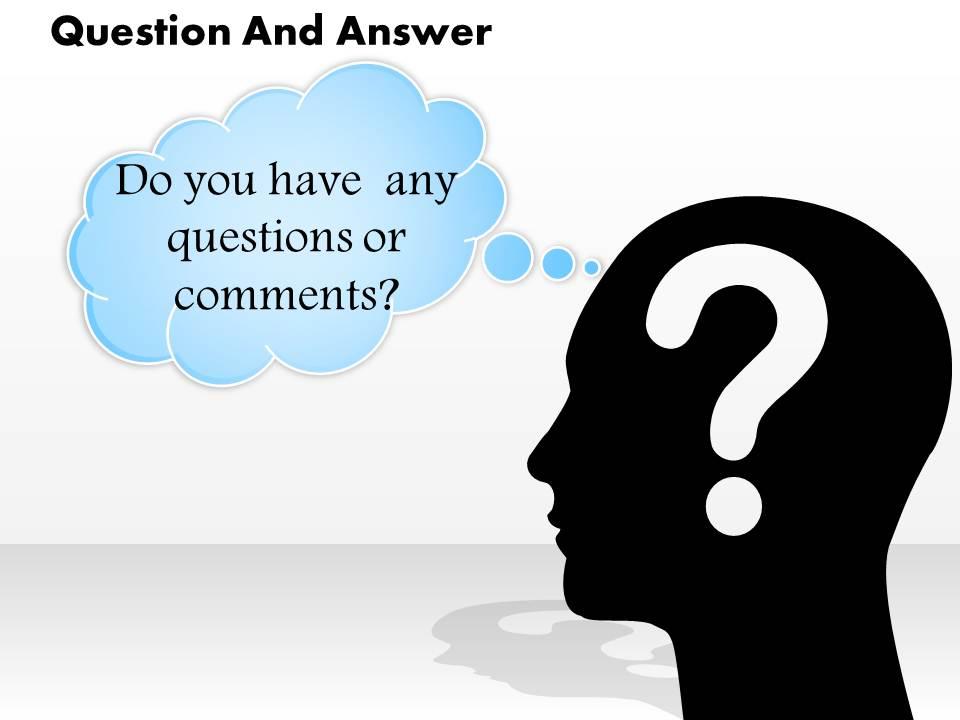
The image depicts a visual metaphor for a question and answer session, typically used in presentations or educational settings to engage with the audience. At the top left, there is a speech bubble with the words "Question And Answer" in bold, signifying the title of the slide or the section of the presentation. Below in a larger cloud-like thought bubble, the text reads "Do you have any questions or comments?" suggesting an invitation from the presenter for the audience to interact by asking questions or providing feedback. The silhouette of a person's head is shown in profile with a question mark inside, representing contemplation or the process of thinking, which complements the Q&A theme by symbolizing the curiosity or confusion the audience might have. The design is simple but effective in conveying its message.

Use Cases:

Considering the communicative nature of this visual, such a slide can be seamlessly integrated into various industry presentations to encourage audience engagement and to clarify any misunderstandings:

1. Education:

Use: To encourage students to ask questions after a lecture or class

Presenter: Teacher or Professor

Audience: Students

2. Corporate Training:

Use: To solicit questions following employee training sessions

Presenter: Corporate Trainer

Audience: Employees

3. Healthcare:

Use: To invite questions at the end of a medical presentation or seminar

Presenter: Healthcare Professional

Audience: Patients or Medical Staff

4. Technology:

Use: For software or product demos where the audience can inquire about features

Presenter: Product Manager or Engineer

Audience: Potential clients or users

5. Business Conferences

Use: After keynote speeches to open dialogue with the audience

Presenter: Keynote Speaker

Audience: Conference Participants

6. Town Hall Meetings

Use: To gather community feedback and questions regarding local issues

Presenter: Local Officials or Community Leaders

Audience: Community Members

7. Research and Development:

Use: In academic or industry conferences to address queries about research findings

Presenter: Scientist or Researcher

Audience: Peers or Stakeholders

FAQs for 0314 faq

The key stages of the human thinking process include perception, attention, memory retrieval, analysis, synthesis, and decision-making. These cognitive phases work together by filtering information, drawing on past experiences, and evaluating options, with many organizations finding that understanding these stages enhances team collaboration, strategic planning, and problem-solving capabilities, ultimately delivering better business outcomes.

Cognitive biases influence decision-making by distorting information processing, creating mental shortcuts that bypass rational analysis, and reinforcing pre-existing beliefs through selective attention. These psychological patterns significantly impact business environments, with organizations in finance, healthcare, and retail finding that understanding biases like confirmation bias and anchoring ultimately enhances strategic planning and competitive advantage.

Emotional intelligence significantly influences human thinking by regulating decision-making processes, enhancing social reasoning, and filtering cognitive responses through emotional awareness and empathy. This integration enables individuals to make more balanced judgments, navigate complex interpersonal situations more effectively, and process information while considering both logical and emotional factors, ultimately delivering better outcomes in professional environments and personal relationships.

Environmental factors significantly influence cognitive function through lighting, noise levels, temperature, space design, and air quality, directly impacting concentration, creativity, and decision-making abilities. Research shows that well-lit, organized workspaces enhance productivity by reducing mental fatigue, while natural elements and optimal temperatures facilitate clearer thinking, with many organizations finding that strategic environmental design ultimately delivers improved performance and employee satisfaction.

Critical thinking enhances problem-solving by enabling systematic analysis, objective evaluation of evidence, identification of assumptions, and consideration of multiple perspectives before reaching conclusions. Through structured reasoning and logical assessment, professionals in fields like healthcare, finance, and engineering make more informed decisions, reduce costly errors, and develop innovative solutions, ultimately delivering better outcomes and competitive advantage in increasingly complex business environments.

Creativity profoundly enhances human thought by expanding problem-solving capabilities, enabling innovative connections between disparate concepts, and fostering adaptive thinking patterns that drive breakthrough solutions. This cognitive flexibility transforms how organizations approach challenges, with companies in design, technology, and healthcare finding that creative thinking processes accelerate innovation, improve strategic decision-making, and ultimately deliver competitive advantages in increasingly complex business environments.

Different cultures shape thinking through distinct communication styles, social hierarchies, educational approaches, problem-solving methods, and value systems that prioritize individual versus collective decision-making. These cultural frameworks influence how organizations approach strategic planning, team collaboration, and customer engagement, with many multinational companies finding that culturally-aware thinking processes enhance global market penetration and drive more effective cross-cultural business outcomes.

Techniques to enhance analytical thinking include breaking complex problems into smaller components, questioning assumptions systematically, examining evidence from multiple perspectives, practicing pattern recognition, and developing structured decision-making frameworks. These approaches strengthen cognitive abilities by encouraging deeper evaluation, reducing cognitive biases, and improving logical reasoning skills, with many professionals finding that consistent practice in data interpretation and critical questioning ultimately delivers more effective problem-solving capabilities and strategic decision-making advantages.

Memory fundamentally shapes our thinking processes by providing the foundational knowledge, experiences, and patterns that inform our decision-making, problem-solving, and cognitive responses. Through working memory, long-term storage, and retrieval systems, individuals can connect new information with existing knowledge, recognize familiar patterns, and apply learned strategies across different situations, ultimately enabling more sophisticated reasoning and faster cognitive processing in increasingly complex environments.

Intuition and logical reasoning work as complementary cognitive processes, with intuition providing rapid pattern recognition and emotional insights while logical reasoning delivers systematic analysis and evidence-based conclusions. This strategic combination enhances decision-making across industries, with many executives finding that integrating both approaches streamlines problem-solving, accelerates innovation, and ultimately delivers more balanced outcomes than relying on either process alone.

Distractions significantly fragment our cognitive processes by interrupting attention spans, reducing working memory capacity, and forcing the brain to constantly switch between tasks. This mental multitasking creates cognitive overload that diminishes problem-solving abilities and decision-making quality, with many professionals finding that minimizing interruptions enhances focus and ultimately delivers improved productivity and strategic thinking outcomes.

Language significantly influences thought patterns by providing conceptual frameworks, vocabulary for abstract ideas, and cultural perspectives that shape reasoning processes. Through linguistic structures, metaphors, and semantic categories, speakers of different languages often approach problem-solving, memory formation, and decision-making differently, with many cognitive scientists finding that multilingual individuals demonstrate enhanced mental flexibility and creative thinking capabilities.

Mindfulness practices enhance cognitive functions by improving attention span, reducing mental clutter, and strengthening neural pathways associated with focus and memory. These techniques help professionals maintain sharper decision-making abilities, better emotional regulation, and enhanced problem-solving skills, with many organizations finding that mindfulness training ultimately delivers improved productivity and strategic thinking capabilities.

Metacognition is our ability to think about and monitor our own thinking processes, enabling us to understand how we learn, solve problems, and make decisions. This self-awareness enhances learning efficiency, improves decision-making accuracy, and enables strategic thinking, with many professionals and organizations finding that metacognitive skills ultimately deliver better performance and competitive advantage.

Age and life experiences significantly influence thinking by enhancing pattern recognition, emotional regulation, and decision-making frameworks through accumulated knowledge and neural development. While younger individuals often demonstrate faster processing and cognitive flexibility, older adults leverage experiential wisdom and contextual understanding, with many organizations finding that diverse age groups deliver complementary thinking styles, ultimately enhancing problem-solving capabilities and strategic outcomes.

Ratings and Reviews

100% of 100
Write a review
Most Relevant Reviews
  1. 100%

    by Callum Gonzalez

    Design layout is very impressive.
  2. 100%

    by Duncan Berry

    Informative presentations that are easily editable.

2 Item(s)

per page: