0514 reflective cycle powerpoint presentation
Try Before you Buy Download Free Sample Product
Audience
Editable
of Time
Our 0514 Reflective Cycle Powerpoint Presentation are handy to have around, They give you the advantage of convenience.
People who downloaded this PowerPoint presentation also viewed the following :
0514 reflective cycle powerpoint presentation with all 5 slides:
Use our 0514 Reflective Cycle Powerpoint Presentation for electioneering. They will bag votes in your favour.
FAQs for 0514 reflective
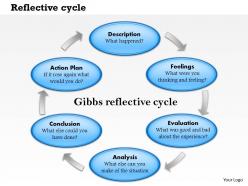
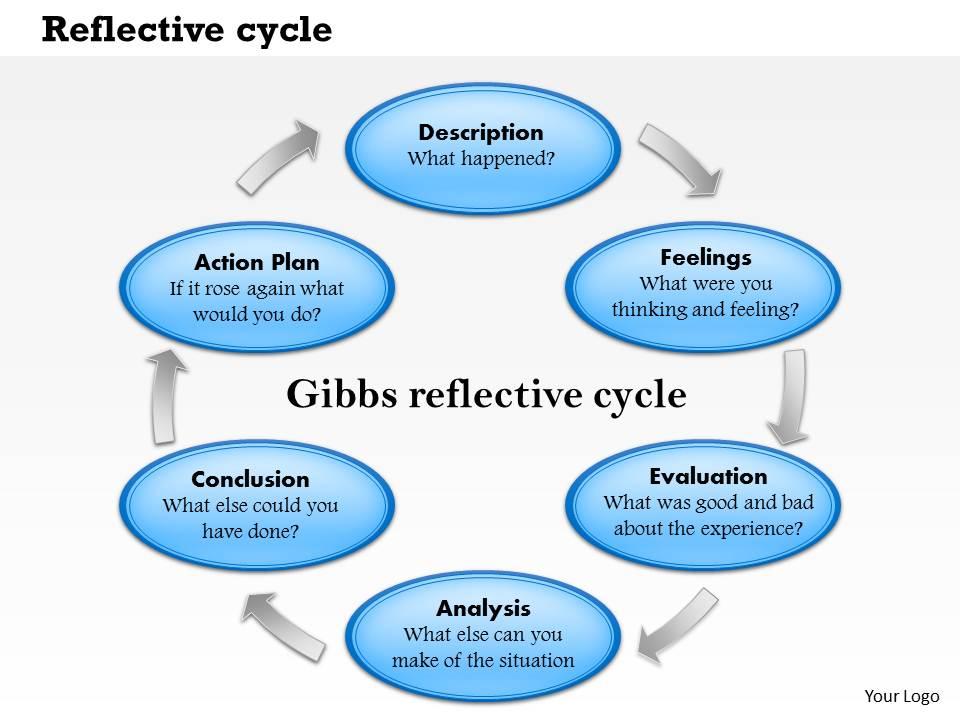
The Reflective Cycle comprises six interconnected stages: description, feelings, evaluation, analysis, conclusion, and action planning, creating a continuous loop for systematic learning improvement. These stages work sequentially by encouraging professionals to document experiences, process emotions, assess outcomes, and identify improvement strategies, with many organizations finding that this structured approach enhances decision-making capabilities and operational effectiveness.
The Reflective Cycle enhances student learning by encouraging systematic analysis of experiences, identifying knowledge gaps, and developing critical thinking skills through structured self-assessment. Educational institutions apply this through peer reviews, project debriefs, and portfolio assessments, with many teachers finding that students demonstrate improved problem-solving abilities and deeper understanding of subject matter.
Professionals can utilize the Reflective Cycle for continuous improvement by systematically analyzing experiences, identifying strengths and weaknesses, setting development goals, and implementing strategic changes to their approach. Through regular reflection on project outcomes, client interactions, and team collaborations, professionals in consulting, healthcare, and education enhance decision-making skills, strengthen stakeholder relationships, and accelerate career advancement, ultimately delivering superior performance and competitive advantage.
The Reflective Cycle emphasizes structured experiential learning through observation, analysis, and application phases, while Gibbs' model focuses on emotional processing and Kolb's emphasizes learning styles and concrete experiences. These frameworks complement each other across educational institutions, healthcare organizations, and corporate training programs, with many professionals finding that combining elements from different models enhances skill development, decision-making capabilities, and ultimately delivers more comprehensive personal and organizational growth.
Emotional intelligence enables deeper self-awareness during reflection, helping individuals recognize emotional triggers, biases, and reactions that influence their experiences and decisions. Through enhanced emotional regulation and empathy, professionals can objectively analyze situations, understand multiple perspectives, and develop more thoughtful action plans, with many organizations finding that emotionally intelligent reflection leads to improved relationships and strategic outcomes.
Incorporating the Reflective Cycle into team discussions enhances collaboration by encouraging structured analysis of experiences, open feedback sharing, and collective problem-solving through systematic evaluation phases. This approach enables teams to identify communication gaps, leverage diverse perspectives, and develop innovative solutions more effectively, with many organizations finding that regular reflective sessions ultimately deliver stronger project outcomes and improved team dynamics.
Common challenges include lack of time for deep reflection, difficulty being honest about mistakes, struggling with emotional responses to failures, and uncertainty about implementing insights effectively. Organizations can overcome these by creating structured reflection periods, fostering psychological safety that encourages honest self-assessment, and providing mentorship programs that guide employees through systematic evaluation processes, ultimately delivering enhanced learning outcomes and improved decision-making capabilities across teams.
Technology facilitates the Reflective Cycle through digital journals, AI-powered analytics, progress tracking dashboards, collaborative platforms, and automated reminder systems. These tools streamline documentation and analysis by capturing real-time experiences, identifying patterns through data visualization, and enabling structured reflection frameworks, with many professionals in healthcare, education, and corporate training finding that integrated platforms ultimately enhance self-awareness and accelerate skill development.
Effective journaling during the Reflective Cycle includes setting regular writing schedules, asking specific questions about experiences, documenting both successes and challenges, focusing on emotional responses, and identifying actionable insights. These approaches enhance self-awareness by encouraging deeper analysis, pattern recognition, and strategic planning, with many professionals finding that structured reflection ultimately delivers improved decision-making and accelerated personal development.
The Reflective Cycle adapts across cultural contexts by incorporating culturally specific values, communication styles, and learning preferences into each phase of reflection. Organizations in collectivist cultures might emphasize group reflection and consensus-building, while individualistic environments focus on personal accountability, with many global institutions finding that culturally adapted reflection frameworks enhance cross-cultural team effectiveness and inclusive decision-making processes.
The Reflective Cycle significantly enhances critical thinking by encouraging systematic analysis, questioning assumptions, and evaluating evidence through structured stages of description, analysis, and action planning. Through this iterative process, professionals in healthcare, education, and business develop deeper analytical capabilities, improved decision-making skills, and strategic problem-solving approaches, ultimately delivering enhanced performance and competitive advantage in increasingly complex organizational environments.
Educators can assess Reflective Cycle effectiveness through structured reflection journals, peer feedback sessions, portfolio assessments, self-evaluation rubrics, and observational data tracking student growth patterns. These assessment methods enable institutions to measure deeper learning outcomes, critical thinking development, and metacognitive skills enhancement, with many educational organizations finding that systematic reflection tracking ultimately delivers improved academic performance and stronger analytical capabilities.
The Reflective Cycle supports mental health in high-pressure environments by providing structured processing of stressful experiences, identifying emotional triggers, and developing healthier coping mechanisms through systematic self-analysis. Healthcare professionals, financial traders, and emergency responders increasingly use reflective frameworks to reduce burnout, enhance emotional resilience, and maintain performance sustainability, ultimately delivering improved job satisfaction and reduced workplace stress.
Healthcare organizations like Mayo Clinic and Kaiser Permanente integrate reflective cycles into medical training through structured case reviews, peer feedback sessions, and continuous improvement protocols. These systematic approaches enhance clinical decision-making, reduce errors, and improve patient outcomes, with many healthcare institutions finding that regular reflection cycles ultimately deliver better care quality and operational efficiency.
The Reflective Cycle enhances leadership skills by encouraging systematic analysis of experiences, identifying strengths and weaknesses, and developing strategic responses to challenges. Through structured reflection on decision-making processes, emerging professionals in sectors like healthcare, consulting, and management can accelerate their growth, improve emotional intelligence, and build confidence, ultimately delivering more effective leadership capabilities and competitive advantage in their careers.
-
Designs have enough space to add content.
-
Commendable slides with attractive designs. Extremely pleased with the fact that they are easy to modify. Great work!