3 days agenda of corporate team meeting

Rating:
100%
3 days agenda of corporate team meeting
Slide 1 of 2
Favourites Favourites

Try Before you Buy Download Free Sample Product

Audience Impress Your
Audience
Editable 100%
Editable
Time Save Hours
of Time
The Biggest Sale is ending soon in
0
0
:
0
0
:
0
0
Rating:
100%
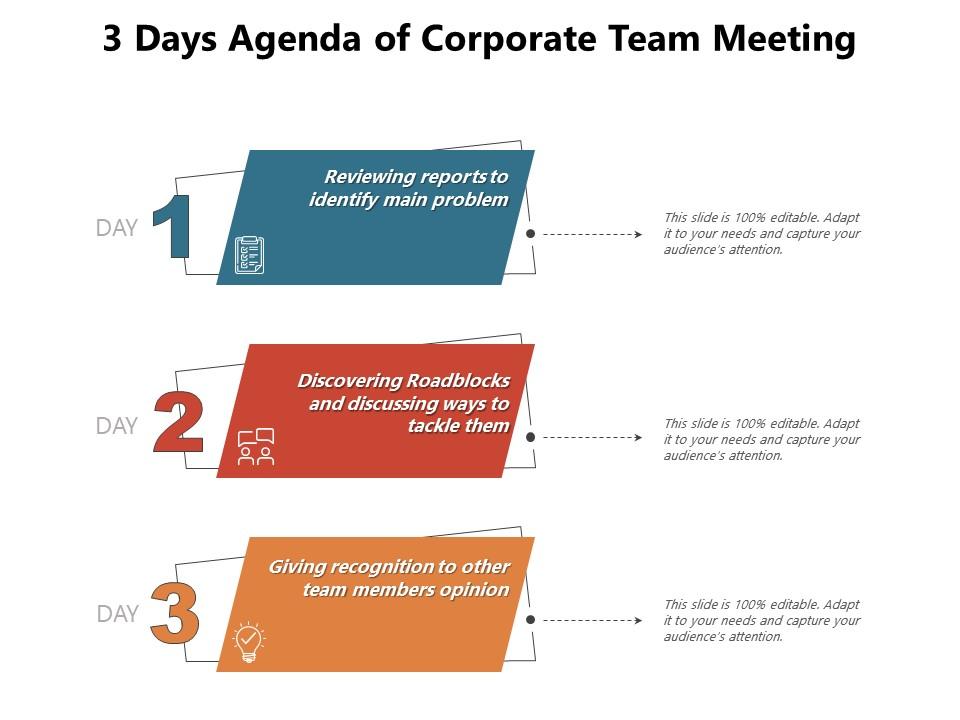
Presenting this set of slides with name 3 Days Agenda Of Corporate Team Meeting. This is a three stage process. The stages in this process are Reviewing Reports, Discovering Roadblocks, Team Members Opinion. This is a completely editable PowerPoint presentation and is available for immediate download. Download now and impress your audience.

FAQs for 3 days agenda of

Essential components include meeting objectives, time allocations, participant roles, discussion topics, decision points, and action item tracking. These elements enhance meeting productivity by establishing clear expectations, maintaining focus, and ensuring accountability, with many organizations finding that structured agendas reduce meeting time by 25% while improving outcomes.

A well-structured agenda enhances team productivity by establishing clear objectives, allocating specific time frames, prioritizing discussion topics, and defining expected outcomes for each item. This strategic approach streamlines decision-making processes, minimizes off-topic conversations, and ensures comprehensive coverage of critical issues, with many organizations finding that structured meetings reduce duration by 30% while significantly improving actionable results.

Effective agenda prioritization strategies include time-boxing critical items first, categorizing by urgency and impact, using weighted scoring systems, stakeholder input collection, and strategic alignment assessment. These approaches streamline meeting flow by addressing high-stakes decisions early, allocating appropriate discussion time, and ensuring resource-intensive topics receive adequate attention, with many organizations finding that structured prioritization reduces meeting duration while enhancing decision quality.

Meeting agendas can be tailored by adjusting time allocation, participant roles, and structural flow to match specific objectives, with brainstorming sessions emphasizing open discussion blocks and creative exercises, while decision-making meetings prioritize data review and voting mechanisms. Organizations across sectors find that strategic agenda customization streamlines outcomes, reduces meeting fatigue, and ultimately delivers faster resolutions and enhanced team productivity.

Time management plays a crucial role in creating effective meeting agendas by ensuring realistic time allocation for each topic, preventing discussions from running over, and maintaining participant engagement throughout the session. Strategic time planning enables organizations to cover essential agenda items comprehensively while respecting attendees' schedules, ultimately delivering more productive meetings and better business outcomes.

Technology streamlines meeting agenda creation and sharing through automated scheduling tools, collaborative platforms like Microsoft Teams and Slack, AI-powered agenda generators, and cloud-based document systems. These solutions enhance efficiency by eliminating manual coordination, enabling real-time collaboration, and ensuring seamless distribution, with many organizations finding that digital workflows reduce preparation time while improving meeting outcomes and participant engagement.

Common pitfalls include overloading agendas with too many topics, failing to allocate realistic time estimates, lacking clear objectives for each item, and not distributing materials in advance. These issues often result in unproductive discussions, rushed decisions, and participant frustration, with many organizations finding that streamlined agendas with focused objectives ultimately deliver better engagement and actionable outcomes.

Feedback from team members can be incorporated through post-meeting surveys, dedicated agenda review sessions, rotating agenda-setting responsibilities, and regular one-on-one discussions with participants. Many organizations find that implementing feedback collection tools, establishing quarterly agenda planning meetings, and creating collaborative agenda templates enables more inclusive meetings, enhances team engagement, and ultimately delivers stronger business outcomes.

Creating flexible yet focused meeting agendas requires setting clear primary objectives while building in time buffers, designating optional discussion items that can be moved if needed, and establishing decision-making criteria upfront. Successful organizations often use timeboxed segments with built-in flexibility points, enabling teams to dive deeper into critical issues while maintaining overall meeting momentum and ensuring key decisions aren't rushed or postponed.

Visual elements enhance meeting agendas through clear section headers, color coding, icons, bullet points, and time indicators that improve readability and navigation. These design features streamline information processing, reduce meeting preparation time, and enable participants to quickly identify priorities, ultimately delivering more focused discussions and better meeting outcomes across organizations.

Distributing agendas in advance enables participants to prepare thoroughly, review relevant materials, and formulate meaningful contributions, while streamlining meeting efficiency and reducing time wastage. This strategic approach enhances decision-making quality, ensures focused discussions, and ultimately delivers more productive outcomes, with many organizations finding that advance preparation significantly improves meeting effectiveness and participant engagement.

Remote and hybrid agendas require enhanced structure with clear time allocations, technology checkpoints, and interactive elements to maintain engagement across formats. They should include designated breaks for connectivity issues, specific video/audio protocols, and collaborative segments using digital tools, with many organizations finding that shorter, more focused agenda items and explicit participation guidelines deliver better outcomes than traditional in-person structures.

Corporate cultures significantly influence meeting agendas through formality levels, decision-making approaches, communication styles, and hierarchical structures. Traditional organizations often favor structured, formal agendas with clear protocols, while collaborative cultures emphasize open discussion formats and shared leadership, with many companies finding that aligning agenda structure with cultural values enhances engagement and productivity.

Effective agenda techniques include time-boxed discussion segments, interactive breakout sessions, rotating facilitators, pre-meeting input collection, and strategic question prompts that encourage diverse perspectives. These approaches streamline participation by distributing speaking opportunities, incorporating collaborative elements, and creating structured dialogue frameworks, with many organizations finding that purposeful agenda design ultimately delivers higher engagement levels and more actionable meeting outcomes.

Agendas enhance accountability by assigning specific action items, deadlines, and responsible parties to each discussion point, creating clear ownership and expectations. By documenting decisions and follow-up tasks during meetings, teams can track progress more effectively, with many organizations finding that structured agendas reduce project delays and improve delivery timelines significantly.

Ratings and Reviews

100% of 100
Review Form
Write a review
Most Relevant Reviews
  1. 100%

    by George Miller

    Very unique, user-friendly presentation interface.

1 Item

per page: