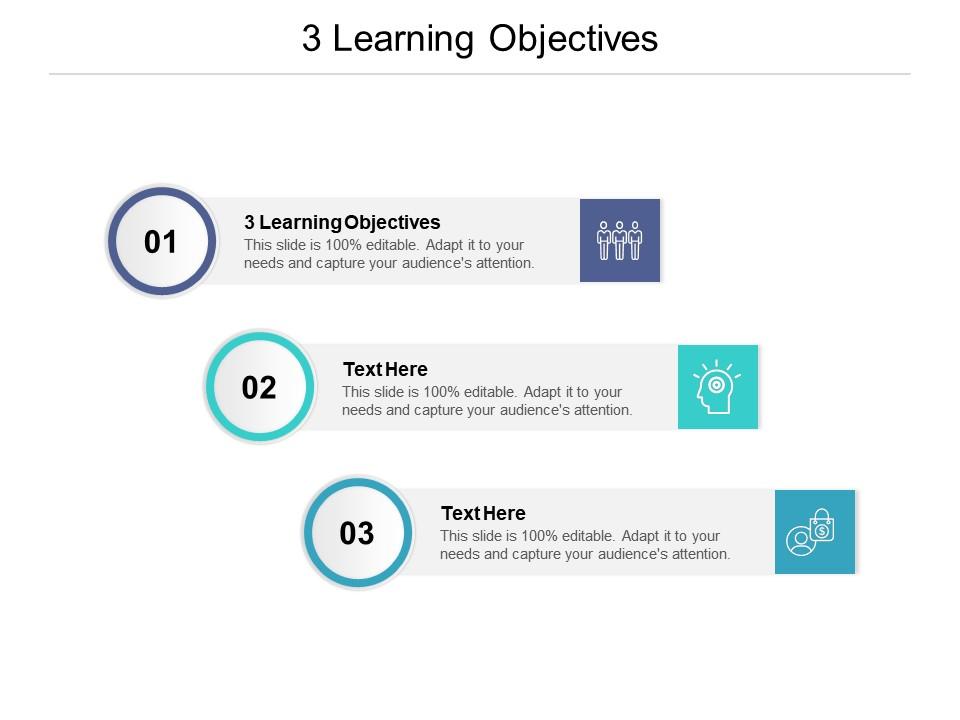
3 learning objectives ppt powerpoint presentation pictures graphic tips cpb
Try Before you Buy Download Free Sample Product
Audience
Editable
of Time
Our 3 Learning Objectives Ppt Powerpoint Presentation Pictures Graphic Tips Cpb are topically designed to provide an attractive backdrop to any subject. Use them to look like a presentation pro.
People who downloaded this PowerPoint presentation also viewed the following :
3 learning objectives ppt powerpoint presentation pictures graphic tips cpb with all 2 slides:
Use our 3 Learning Objectives Ppt Powerpoint Presentation Pictures Graphic Tips Cpb to effectively help you save your valuable time. They are readymade to fit into any presentation structure.
FAQs for 3 learning objectives ppt powerpoint presentation pictures
You'll want action verbs that are super specific - think "analyze" or "demonstrate" instead of fuzzy stuff like "understand." Most people totally bomb this next part: you need measurable outcomes. What exactly will students produce or do? The context matters too. Like, "Students will calculate percentages using real-world scenarios" hits different than "Students will learn math" (which honestly tells you nothing). Short version: someone should read your objective and immediately know what success looks like. Oh, and avoid getting too abstract - that's where things fall apart fast.
Think of learning objectives as your GPS - they show you exactly what content to include and how to organize it. Work backwards from what your audience needs to accomplish, then build everything around that. Honestly, this part can be kinda ruthless because you'll have to cut cool stuff that doesn't fit. Design activities where people can actually practice what you're teaching them. Each slide should pass the test: does this help hit my objective? If not, ditch it. The whole thing becomes way clearer when you stick to this approach.
Okay so here's the thing - when you tell people exactly what they're gonna learn, they actually pay attention. Like, instead of wondering "why am I here again?" they can see the point. Measurable objectives are clutch because you can do quick check-ins and keep everyone engaged instead of just talking at them. I always throw my learning goals up front, then circle back to them during breaks or transitions. People genuinely perk up when they realize they're making progress toward something concrete. It's honestly night and day compared to those vague "we'll explore topics" sessions that put everyone to sleep.
So basically, elementary kids get simple stuff like "find the main idea" or basic addition. Then middle/high school gets into comparing things and evaluating evidence - more thinking required. College objectives are honestly kind of ridiculous sometimes with all the fancy wording, but they're focused on synthesis and applying what you know to totally new problems. The whole thing follows this pattern where younger kids learn facts and comprehension, older students do analysis and creation. Oh, and definitely match whatever you write to where your students actually are developmentally - don't make 3rd graders "synthesize" anything!
Look, I learned this the hard way after years of terrible test-making. First thing - match your assessment to what you actually want kids to do. Like if you want them analyzing data trends, ditch the multiple choice and give them real data to work with instead. Bloom's taxonomy is your friend here (I know, sounds boring but trust me). Work backwards: write your learning goals first, then figure out how to test them. I keep a simple chart now linking each objective to its test method - saves me from those "wait, what was I even measuring?" moments later.
Honestly, digital tools can make your learning objectives way more engaging. Try embedding interactive stuff right into them - clickable scenarios, progress bars, maybe some gamified checkpoints. LMS platforms are great for this (Articulate is *chef's kiss* for this kind of thing). Analytics dashboards show you if people are actually hitting those objectives in real-time. Super helpful when you need to pivot quickly. AI can even personalize objectives based on how each person learns best. My advice? Start small. Add just one interactive element to your next objective and watch how much more people engage with it.
Ok so learning objectives are literally the backbone of everything you build. Start there first - write 3-5 specific, measurable ones before doing anything else. Then work backwards to create your activities and assessments around those goals. Without them, you're just throwing random content at students hoping something works (spoiler: it usually doesn't). They'll also save you from yourself when you want to add every cool idea you find online. I learned this the hard way my first year teaching. Trust me, having that clear direction makes course design so much easier.
Okay so the key thing is focusing on what students will actually *do* instead of what you're teaching. Skip the vague verbs like "understand" - go for concrete ones like "analyze" or "create." Also, give kids multiple ways to show what they know because honestly, some are terrible at tests but amazing at presentations or projects. I found this out when half my students failed a regular test but totally killed the hands-on alternative I gave them later. Mix up your assessments for different learning styles and backgrounds. Oh, and here's a good reality check - look at your objectives and ask yourself: could every single kid in my class actually pull this off?
Mix up your assessment game - quizzes and discussions while they're learning, then bigger stuff like projects or tests at the end. Self-reflection activities work great too, plus having students evaluate each other's work (though that can get messy sometimes). The trick is matching your assessment to what you actually want to measure. Don't throw a multiple-choice test at critical thinking skills - that's just lazy. Real-world tasks show if they can actually apply what they've learned. Variety keeps everyone engaged because honestly, the same format gets old fast.
Okay so first thing - throw those learning objectives right up front, none of that buried-in-the-middle nonsense. Write them super plain like "you'll be able to do X" instead of fancy academic speak that nobody actually reads. I'm guilty of this too but you gotta repeat them at least twice because people zone out constantly. Connect each one to something they'll actually use at work, not theoretical stuff. Oh and definitely do a wrap-up at the end showing how you hit each point. Quick reality check: have someone else read your objectives and see if they get what they're supposed to learn.
Oh man, I've seen this mess up so many projects! Don't be vague like "students will understand calculus" - that tells you nothing. Focus on what they'll actually DO, not what you're gonna teach them. Use verbs you can see happening: analyze, create, evaluate. Here's what drives me nuts though - people try to cram like three skills into one objective. Just pick one thing! Keep it simple. I always start with "learners will be able to..." then pick a verb that describes something concrete you can actually test. Way easier to measure if it's working.
Honestly, learning objectives are like your GPS for differentiation. Write clear, measurable ones first - that's your non-negotiable destination. Then get creative with how kids actually get there. Some need way more scaffolding, others are ready for extensions, but you're not just randomly handing out different worksheets (which never works anyway). You can tweak the complexity, change how they show they've mastered it, or adjust timing. The beauty is everyone's still learning the same core stuff. I always brainstorm multiple paths based on what each kid needs - their readiness level, how they learn best, all that. It's honestly the only way differentiation doesn't feel completely overwhelming.
Honestly, clear learning objectives are like having GPS for training instead of just wandering around hoping you'll end up somewhere useful. When people understand why they're learning something, they actually pay attention. Managers love it because they can tie everything back to business results. The best part? You can finally prove your training budget isn't just money down the drain - which, let's be real, it sometimes feels like without proper goals. My advice is figure out what "success" looks like first, then build backwards from there. Saves so much time and frustration later on.
Honestly, student feedback is like having a crystal ball for your learning objectives. When they're scratching their heads about concepts or can't actually use what you taught them, that's screaming "your objectives are probably too fuzzy." I've watched teachers write these beautiful-sounding goals that completely flop in practice - it happens more than you'd think! Look at where they're struggling AND where they're crushing it. If everyone's acing objective A but failing objective B every single time, you know what needs tweaking. Just start grabbing feedback after each session and tweak things before the next group rolls in.
So basically, if you match what you're teaching to what employers actually want, your grads won't be scrambling to figure out their jobs after graduation. Makes your program look way better too. Check job postings first - see what skills keep popping up and build backwards from there. Your students get transferable skills, accreditation stays happy, and honestly? Companies will actually want to hire them instead of passing them over. It's kind of a no-brainer since it keeps you competitive with other programs. Plus you're not just doing busy work anymore - everything has a real purpose.
-
Out of the box and creative design.
-
Innovative and Colorful designs.
-
Perfect template with attractive color combination.