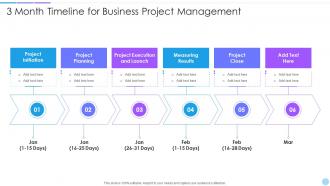
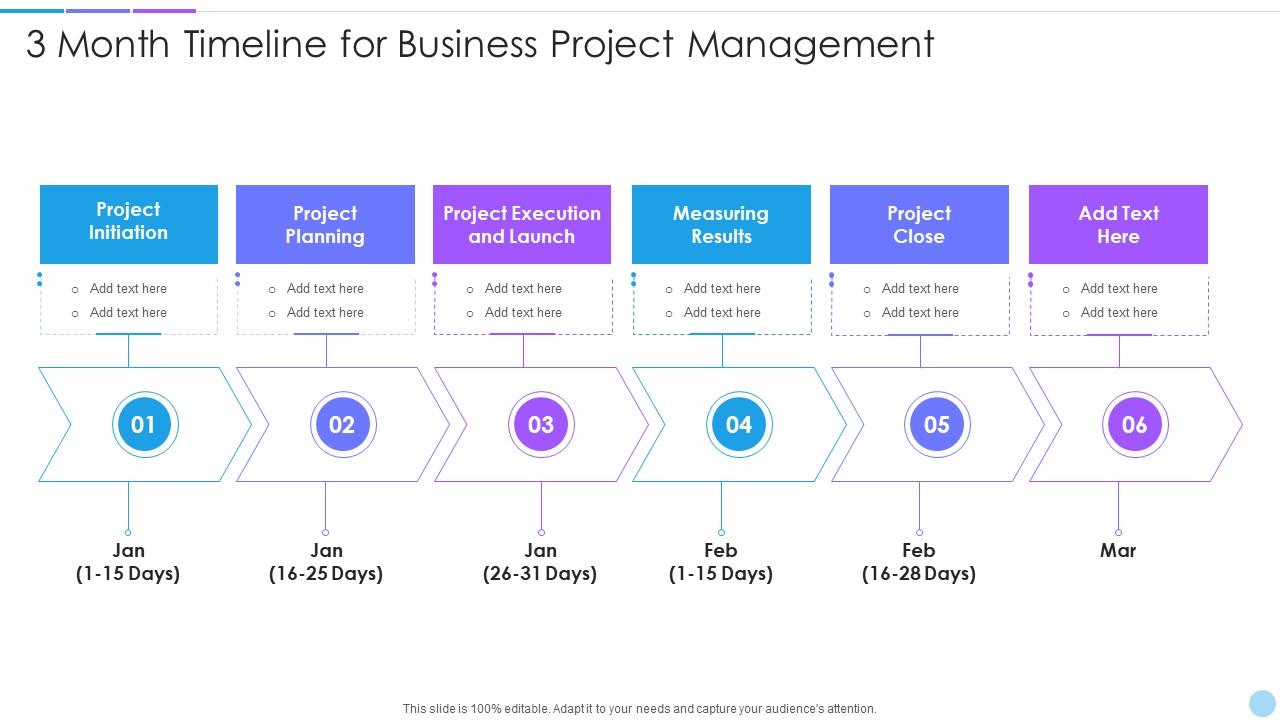
3 Month Timeline For Business Project Management
Try Before you Buy Download Free Sample Product
Audience
Editable
of Time
Our 3 Month Timeline For Business Project Management are topically designed to provide an attractive backdrop to any subject. Use them to look like a presentation pro.
People who downloaded this PowerPoint presentation also viewed the following :
3 Month Timeline For Business Project Management with all 6 slides:
Use our 3 Month Timeline For Business Project Management to effectively help you save your valuable time. They are readymade to fit into any presentation structure.
FAQs for 3 Month Timeline For
Key components of an effective business project management timeline include project milestones, task dependencies, resource allocation schedules, critical path identification, and buffer time for contingencies. These elements work together by providing clear visibility into project progression, enabling proactive risk management, and facilitating strategic resource deployment, with many organizations finding that well-structured timelines reduce project delays by 30-40% while enhancing stakeholder communication.
Project managers can accurately estimate timelines by breaking complex projects into smaller tasks, using historical data from similar projects, consulting subject matter experts, and applying techniques like PERT or Monte Carlo simulations. These approaches enable more precise forecasting by accounting for dependencies, resource constraints, and potential risks, with many organizations finding that combining multiple estimation methods significantly reduces timeline variance and enhances project delivery predictability.
**INPUT**: What tools and software can enhance the creation of project management timelines? **OUTPUT**: Timeline creation tools include Microsoft Project, Asana, Trello, Gantt chart software, and cloud-based platforms like Monday.com. These technologies streamline project planning by automating scheduling, enabling real-time collaboration, and providing visual progress tracking, with many organizations finding that integrated dashboards ultimately deliver enhanced team coordination and faster project completion rates. **Word count: 54 words**
Gantt charts differ from other timeline methods by displaying task dependencies, resource allocation, and progress tracking in a horizontal bar format, while alternatives like milestone charts, Kanban boards, and calendar views focus primarily on deadlines or workflow stages. This comprehensive visualization enables project managers across industries like construction, software development, and manufacturing to identify bottlenecks, optimize schedules, and maintain accountability, ultimately delivering enhanced project control and stakeholder transparency.
Stakeholder communication ensures project timelines through regular updates, expectation alignment, early issue identification, and collaborative decision-making processes. Effective communication prevents delays by securing timely approvals, resource commitments, and scope clarifications, with many organizations finding that structured stakeholder engagement reduces project overruns and enhances delivery predictability.
Project managers can adapt timelines by implementing buffer periods, reassessing critical path dependencies, reallocating resources, and maintaining transparent stakeholder communication throughout disruptions. Through agile methodologies and scenario planning, organizations in sectors like construction, software development, and manufacturing successfully pivot schedules while preserving project scope, ultimately delivering competitive advantage through enhanced flexibility and client satisfaction.
Techniques for maintaining project timelines include regular milestone reviews, resource reallocation strategies, risk mitigation planning, stakeholder communication protocols, and buffer time management. These approaches streamline project delivery by identifying bottlenecks early, optimizing team productivity, and maintaining scope clarity, with many organizations finding that proactive timeline management ultimately delivers faster project completion and enhanced client satisfaction.
Milestones can be effectively integrated by identifying key deliverables, establishing clear completion criteria, and aligning them with critical project phases and dependencies. Strategic milestone placement enables project managers to track progress, manage stakeholder expectations, and maintain momentum, with many organizations finding that well-defined milestones enhance accountability and facilitate timely course corrections.
Best practices for prioritizing tasks include assessing critical path dependencies, evaluating resource availability, analyzing stakeholder impact, considering risk factors, and aligning with strategic objectives. These approaches streamline project execution by identifying bottlenecks early, optimizing team allocation, and maintaining focus on deliverables, with many organizations finding that systematic prioritization reduces delays and enhances overall project success rates.
Resource allocation directly impacts timeline accuracy by determining task dependencies, team capacity, and workflow efficiency across project phases. When resources are properly distributed, teams can maintain realistic scheduling expectations, avoid bottlenecks, and deliver milestones consistently, with many organizations finding that strategic resource planning reduces project delays by up to 40% while enhancing overall delivery predictability.
Key performance metrics include schedule variance, milestone completion rates, critical path analysis, resource utilization rates, and earned value measurements. These indicators enable project managers to identify delays early, optimize resource allocation, and maintain strategic alignment, with many organizations finding that consistent monitoring delivers improved project outcomes, reduced costs, and enhanced stakeholder confidence in deliverable timelines.
Project management timelines align with organizational goals through strategic milestone mapping, resource allocation based on business priorities, and regular progress reviews against key performance indicators. This alignment enables organizations to optimize project outcomes, ensure strategic initiatives receive appropriate focus and resources, and ultimately deliver measurable business value while maintaining competitive advantage.
Regular timeline reviews enable project managers to identify potential delays, resource constraints, budget overruns, and scope changes before they become critical issues. These systematic evaluations help organizations maintain project momentum, reallocate resources strategically, and communicate progress transparently to stakeholders, with many companies finding that consistent reviews ultimately deliver higher success rates and improved client satisfaction.
Effective time management principles improve project timeline accuracy by establishing realistic deadlines, prioritizing critical tasks, and implementing buffer periods for unexpected challenges. Through systematic scheduling and resource allocation, project managers can minimize delays, enhance team productivity, and deliver milestones consistently, with many organizations finding that structured time management reduces project overruns by significant margins.
Common pitfalls include underestimating task duration, failing to account for dependencies, overlooking resource constraints, inadequate buffer time allocation, and poor stakeholder communication throughout the planning phase. These challenges often derail projects across industries like construction, software development, and manufacturing, with many organizations finding that comprehensive timeline reviews and realistic scheduling ultimately deliver better project outcomes and enhanced team accountability.
-
The pricing page of this website is very sorted. I felt no pain while buying the PPTs.
-
Top Quality presentations that are easily editable.