3 months future vision and mission sustainability roadmap for multi national company

3 months future vision and mission sustainability roadmap for multi national company
Slide 1 of 2
Favourites Favourites

Try Before you Buy Download Free Sample Product

Audience Impress Your
Audience
Editable 100%
Editable
Time Save Hours
of Time
The Biggest Sale is ending soon in
0
0
:
0
0
:
0
0
Presenting 3 Months Future Vision And Mission Sustainability Roadmap For Multi National Company PowerPoint slide which is 100 percent editable. You can change the color, font size, font type, and shapes of this PPT layout according to your needs. This PPT template is compatible with Google Slides and is available in both 4,3 and 16,9 aspect ratios. This ready to use PowerPoint presentation can be downloaded in various formats like PDF, JPG, and PNG.

Content of this Powerpoint Presentation

Description:

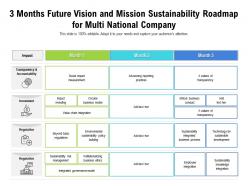
This image presents a "3 Months Future Vision and Mission Sustainability Roadmap for Multi National Company." It's a structured slide that outlines key sustainability objectives and practices to be focused on over a three-month period, divided by month and thematic area. This slide is editable and designed to capture an audience's attention.

1. Month 1 highlights "Impact," focusing on "Transparency & Accountability" and "Social impact measurement" as its key targets. The "Investment" section suggests concentrating on "Impact investing" and "Circular business model," with a further aim of "Value chain integration." Under "Regulation," the focus is on going "Beyond basic regulations" and building an "Environmental sustainability policy."

2. Month 2 emphasizes "Advancing reporting practices" under "Impact," suggesting enhancement in communication regarding sustainability efforts. Although two fields are left for the presenter to customize, "Investment" and "Regulation" do not have specific goals outlined.

3. Month 3 outlines the continuation of promoting "A culture of transparency," "Ethical business conduct," and allowing for additional text in the "Impact" area. "Investment" suggests adding a new goal, whereas "Regulation" focuses on "Sustainability integrated business process," "Technology for sustainable development," "Institutionalizing business ethics," "Employee integration," and "Sustainability knowledge integration."

Use Cases:

Here are 7 industries where such a sustainability roadmap is applicable:

1. Manufacturing:

Use: Implementing sustainable practices in production processes

Presenter: Sustainability Officer

Audience: Company stakeholders

2. Technology:

Use: Developing sustainable tech and reducing environmental impact

Presenter: Chief Technology Officer

Audience: Investors and employees

3. Finance:

Use: Advocating for impact investing and transparent financial reporting

Presenter: Chief Financial Officer

Audience: Shareholders and regulatory bodies

4. Energy:

Use: Transitioning to greener sources and sustainable policy development

Presenter: Energy Strategy Director

Audience: Policy makers and industry regulators

5. Retail:

Use: Establishing a sustainable value chain and ethical sourcing

Presenter: Head of Corporate Social Responsibility

Audience: Suppliers and customers

6. Healthcare:

Use: Promoting sustainability in healthcare operations and investments

Presenter: Healthcare Administrator

Audience: Healthcare staff and community leaders

7. Agriculture:

Use: Encouraging sustainable farming practices and investment in green tech

Presenter: Head of Agricultural Development

Audience: Farmers and agricultural business partners

FAQs for 3 months future vision and mission sustainability roadmap for

Key components of an effective sustainability roadmap include baseline assessments, measurable targets, implementation timelines, stakeholder engagement strategies, and progress monitoring systems. These elements work together by establishing clear starting points, defining specific environmental goals, and creating accountability frameworks, with many organizations finding that comprehensive roadmaps streamline resource allocation while delivering competitive advantage in increasingly sustainability-focused markets.

Organizations can assess current sustainability practices through comprehensive audits covering energy consumption, waste management, supply chain impacts, carbon footprint measurement, and stakeholder engagement levels. This baseline assessment enables companies across manufacturing, retail, and financial services to identify improvement opportunities, set measurable targets, and prioritize initiatives that deliver both environmental benefits and operational cost savings while ensuring strategic alignment with business objectives.

Stakeholders provide crucial insights, expertise, and accountability measures that shape comprehensive sustainability roadmaps through their diverse perspectives on environmental impact, operational constraints, and strategic priorities. Effective input gathering involves structured surveys, collaborative workshops, regular consultation sessions, and digital feedback platforms, with many organizations finding that inclusive stakeholder engagement ultimately delivers more realistic implementation timelines and stronger organizational buy-in.

Companies set measurable sustainability goals by establishing baseline measurements, defining specific reduction targets with timelines, and selecting quantifiable metrics like carbon emissions, energy consumption, waste reduction percentages, and water usage. Through comprehensive tracking systems, organizations monitor progress across operational efficiency, supply chain sustainability, and resource optimization, with many finding that combining environmental KPIs with financial metrics ultimately delivers competitive advantage and stakeholder value.

Organizations face significant challenges including aligning sustainability goals with business objectives, securing adequate funding and resources, navigating complex regulatory requirements, and managing stakeholder expectations across diverse groups. These obstacles often stem from insufficient data collection capabilities, resistance to operational changes, and difficulty measuring long-term environmental impact, with many companies finding that successful implementation requires phased approaches, cross-departmental collaboration, and strategic integration of sustainability metrics into core business performance indicators.

Technology and digital tools enhance sustainability roadmaps by automating data collection, enabling real-time monitoring of environmental metrics, and providing predictive analytics for resource optimization. Through IoT sensors, AI-powered dashboards, and cloud-based platforms, organizations streamline carbon tracking, accelerate compliance reporting, and optimize energy consumption, ultimately delivering measurable environmental impact and operational cost reductions.

Best practices for maintaining relevant sustainability roadmaps include regular stakeholder engagement, continuous performance monitoring, flexible milestone structures, and periodic strategy reviews based on emerging regulations and technologies. These approaches enable organizations to adapt quickly to evolving ESG requirements, shifting market demands, and new environmental standards, with many companies finding that quarterly assessments and annual roadmap updates deliver sustained competitive advantage while ensuring long-term environmental goals remain achievable.

Businesses can balance short-term profitability with long-term sustainability by integrating cost-saving initiatives, phased implementation strategies, and stakeholder engagement into their roadmaps. Through energy efficiency programs, waste reduction measures, and sustainable supply chain partnerships, companies streamline operations while building competitive advantage, with many organizations finding that sustainability investments ultimately deliver both immediate cost benefits and enhanced market positioning.

Organizations can engage employees in sustainability initiatives through comprehensive training programs, green team formations, sustainability-focused performance metrics, regular communication campaigns, and incentive systems that reward eco-friendly behaviors. These strategies streamline adoption by creating ownership, enhancing awareness, and integrating environmental goals into daily operations, with many companies finding that employee-driven initiatives deliver significantly higher participation rates and ultimately stronger sustainability outcomes.

A sustainability roadmap aligns with regulatory requirements through systematic compliance mapping, stakeholder engagement, regular monitoring frameworks, and integration with existing management systems. Organizations in manufacturing, energy, and finance increasingly embed regulatory checkpoints directly into their sustainability milestones, ensuring proactive compliance while delivering competitive advantages through enhanced transparency, reduced operational risks, and streamlined reporting processes.

Successful sustainability roadmaps include Unilever's Sustainable Living Plan, Microsoft's carbon-negative commitment, IKEA's circular business model transformation, Patagonia's supply chain transparency initiatives, and Interface Inc.'s Mission Zero waste elimination strategy. These comprehensive approaches demonstrate how organizations across retail, technology, and manufacturing sectors streamline operations, reduce costs, and enhance brand reputation, with many companies finding that structured sustainability frameworks ultimately deliver competitive advantage and long-term resilience.

Organizations effectively communicate their sustainability roadmaps through transparent reporting, digital platforms, stakeholder engagement events, and clear visual storytelling that highlights measurable goals and progress milestones. These communication strategies enhance brand reputation, build stakeholder trust, and demonstrate accountability, with companies like Unilever and Microsoft finding that consistent, authentic sustainability messaging drives customer loyalty and investor confidence while positioning them competitively.

Supply chain management serves as a cornerstone of sustainability roadmaps by controlling resource consumption, waste generation, carbon emissions, and ethical sourcing practices throughout the entire value chain. Companies optimize through supplier partnerships with sustainability criteria, circular economy principles, transportation efficiency improvements, and digital tracking systems, with organizations in manufacturing, retail, and food services finding that these strategic integrations deliver cost reductions, enhanced brand reputation, and competitive advantage while meeting increasingly stringent environmental regulations.

Organizations integrate circular economy principles by redesigning processes for waste reduction, resource reuse, and closed-loop systems, while implementing sustainable sourcing, product lifecycle extension, and regenerative practices. These strategic approaches streamline operations through cost savings, enhanced resource efficiency, and regulatory compliance, with manufacturing and retail sectors finding that circular strategies ultimately deliver competitive advantage and long-term resilience.

Financial considerations for sustainability roadmaps include upfront capital investments, operational cost changes, regulatory compliance expenses, risk mitigation costs, and potential revenue opportunities from green initiatives. These investments often deliver long-term cost savings through energy efficiency, waste reduction, and operational streamlining, with many organizations finding that strategic sustainability planning ultimately enhances profitability while reducing financial risks.

Ratings and Reviews

0% of 100
Review Form
Write a review
Most Relevant Reviews

No Reviews