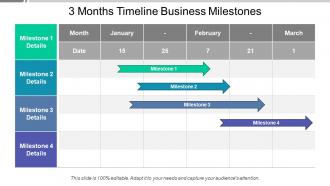
3 months timeline business milestones
Try Before you Buy Download Free Sample Product
Audience
Editable
of Time
3 Months Timeline Business Milestones presentation template has designed professionally by the team of SlideTeam to provide you with an outstanding business timeline presentation that will thrill your client as well as impress management. Every entrepreneur draws up business plans for the new project which include marketing, pricing, financial, and other projections so you can take help of business plan timeline PowerPoint slide to discuss any business plan. You can discuss short-term as well as long-term milestones with the help of a business milestone PPT template. By using 90 days business milestone slide, you can illustrate the plan into practical, with real budgets, deadlines, and management responsibilities too. You can easily implement your plan with the help of timeline milestone presentation template. You can take help of business milestone implementation PPT to explain the list of specific actions that need to take to implement the milestone plan and manage it. Every action considered as a milestone and due to this business plan becomes a real plan. Advance your cause with our 3 Months Timeline Business Milestones. They will bolster the force of your conviction.
People who downloaded this PowerPoint presentation also viewed the following :
3 months timeline business milestones with all 5 slides:
Lead the charge with our 3 Months Timeline Business Milestones. Your team will rally around your views.
FAQs for 3 months
Honestly, just focus on proving people will actually pay for your thing. Get your MVP validated in 3 months - sounds obvious but you'd be shocked how many people skip this part. By month 6, land your first 10 customers. Also work on unit economics that don't bleed money and maybe hire 1-2 solid people. I'd say don't get caught up in scaling yet, that's putting the cart before the horse. Build a sales process you can repeat without losing your mind. Track progress monthly and pivot when the numbers aren't lying to you.
Work backwards from where you want to be in 2-3 years, then chop it into quarterly pieces. Make sure your short-term stuff actually builds toward the bigger picture. Be super specific - "increase revenue" tells you nothing, but "hit $50K monthly recurring revenue by Q2" gives you something real to chase. Honestly, most people set unrealistic timelines then get discouraged. Don't do that to yourself. Write these down somewhere visible (not buried in some app you never open), check in monthly, and tweak as needed. You'll learn what works as you go.
Milestones are basically proof you can actually pull off what you're promising investors. Hit your revenue targets, user growth numbers, product launches - whatever shows you're not just another startup with big dreams and zero execution. Map out chunks of 3-6 months so you've got consistent wins to show off when fundraising time comes around. Honestly, investors see so many "game-changing ideas" that never go anywhere. Your milestones are what separate you from that pile. They validate your market assumptions and show real traction, which reduces the risk factor that keeps VCs up at night.
Honestly, think of it like a GPS for your business - shows you where you've been and where you're going. You'll start noticing patterns and can actually tell what's working vs what just feels productive (those busy-work tasks we all love to hate). Setting realistic future goals becomes way easier when you can see your actual track record. Oh, and it's great for celebrating wins too - we forget to do that enough. I'd update it monthly and loop your team in on the big stuff so everyone knows what's happening.
So for milestone timelines, I'd probably start with Asana or Monday.com - they're super collaborative and your team can actually jump in and update stuff. ClickUp's solid too. Microsoft Project is like the nuclear option if you need heavy-duty features, but honestly? It's way overkill for most situations. Sometimes the simplest solution wins - Google Sheets or even Trello can do the job perfectly fine. My buddy's startup literally runs everything off a shared spreadsheet and it works great for them. Bottom line: pick whatever your team won't ignore. The fanciest tool means nothing if nobody uses it.
Quarterly reviews are a must, but I'd throw in monthly check-ins too. Things move so damn fast now - January goals can look ridiculous by summer. Monthly stuff should be quick pulse checks: roadblocks? New opportunities? Save the heavy lifting for quarterly when you're actually shifting timelines or pivoting completely. Honestly, waiting for annual planning is how you end up chasing dead-end targets for months. Oh, and set that recurring invite today before you forget. Trust me on that one.
Biggest mistake? Making milestones way too vague or completely unrealistic - like "increase sales" or "launch in 2 weeks" when you need 2 months. Also, don't obsess over revenue for every single one. Mix in other wins your team can celebrate. Keep it to 3-5 per quarter, otherwise everything feels meaningless. They should actually tie back to where you're trying to go as a business (not just random deadlines you picked). Oh, and leave room to pivot - trust me, stuff always changes. Make them clear enough that everyone knows exactly what "done" looks like.
Honestly, milestones are like having a GPS for your project - everyone knows where they're going and when they'll get there. Break big scary tasks into smaller wins every 2-3 weeks. Your team gets those little dopamine hits from finishing stuff (I'm weirdly addicted to crossing things off lists too). Plus you can actually see if something's going sideways before it becomes a disaster. People stay way more motivated when they're not staring at some massive deadline months away. It's basically tricking your brain into thinking everything's manageable, which... it kinda works.
Honestly, visual timelines are a game changer for keeping stakeholders engaged. People actually look at them instead of zoning out during meetings. I mean, who wants to read through paragraphs of project updates? A simple Gantt chart shows dependencies super clearly and helps everyone see how their work connects. You'll catch scheduling conflicts way earlier too. When things inevitably get delayed, it's so much easier to explain what's happening visually rather than just throwing text at people. Even something basic beats those boring status emails every time. Trust me on this one.
You'll know when things are actually working if your key numbers keep climbing week after week. Revenue, customers, whatever you're tracking - it should show real trends, not just random good days. I learned this the hard way watching my old team pop champagne over one decent week that meant nothing. Give it 2-3 solid measurement cycles before you celebrate. Also, check your team's vibe - if everyone's panicking about targets, that's telling you something. Numbers don't lie, but stressed teams usually do.
Yeah, definitely customize your milestones for your specific industry. SaaS companies obsess over user growth and feature launches. Manufacturing? They're all about production capacity and supply chain stuff. Healthcare is honestly a nightmare with all the compliance hoops - I don't know how they keep track of everything. Talk to people who've been in your industry forever, they'll tell you what actually matters. Check out what your competitors are measuring too. Things like funding cycles, seasonal trends, regulatory deadlines - that's the real stuff that'll make or break you. I'd start with maybe 3-5 categories that fit your business model, then work backwards from there.
Look, you've gotta bake feedback collection right into your milestone schedule from day one. Otherwise you're just guessing what people want. Catching issues early saves you from expensive headaches later - trust me on this one. Your timelines get way more realistic too because you're working with actual user needs, not assumptions. Plus customers love feeling heard when their ideas shape your roadmap. It helps you focus on features that actually matter instead of those "wow this seemed brilliant at 2am" mistakes. Short version: scheduled feedback = less pain.
For service businesses, forget about production numbers - you're dealing with relationships and processes instead. Track stuff like how fast you're landing new clients, how long projects take, and whether people stick around. Maybe aim for "get 5 new clients this quarter" or "cut turnaround time by 20%." Honestly, measuring service quality is way trickier than counting widgets, but that makes good milestones even more crucial. Figure out where you actually interact with clients, then set concrete goals around making those moments better. It's messier than manufacturing but totally doable.
Track both types of metrics - leading ones predict what's coming (like website traffic, pipeline stuff) and lagging ones show what already happened (revenue, retention rates). Conversion rates are honestly where the magic happens because they don't lie. Pick maybe 3-5 that actually matter for your specific goal, not just numbers that sound impressive. Oh and set up a dashboard you'll genuinely look at weekly - I've made too many fancy ones I never checked. Each metric needs a target and deadline or you're just collecting data for no reason.
Think of your milestones like GPS directions - you reroute when there's traffic, right? I check market conditions monthly (or more if things are crazy) and adjust targets accordingly. Learned this during COVID when literally half our goals went out the window overnight. Build in buffer time from day one. Some milestones are non-negotiable, but dates and numbers? Those can flex. When markets shift, focus on what still makes sense and ditch or delay the rest. Oh, and definitely keep your team in the loop - nothing worse than everyone working toward different goals.
No Reviews