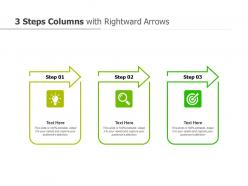
3 steps columns with rightward arrows

Slide 1 of 5
Favourites Favourites

Try Before you Buy Download Free Sample Product

Audience Impress Your
Audience
Editable 100%
Editable
Time Save Hours
of Time
The Biggest Sale is ending soon in
0
0
:
0
0
:
0
0
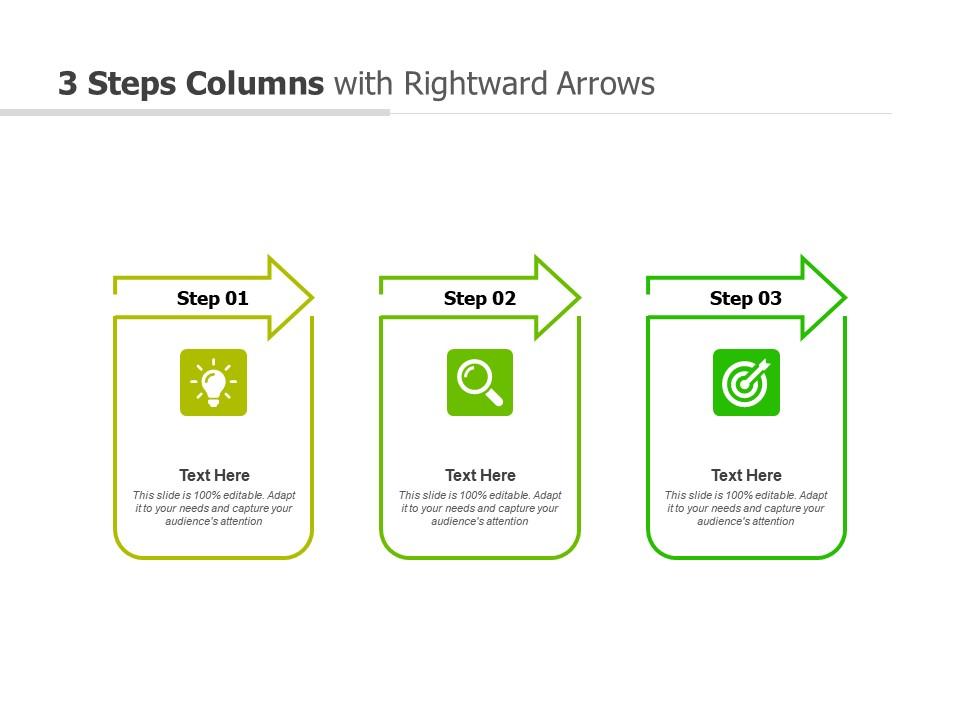
Presenting this set of slides with name 3 Steps Columns With Rightward Arrows. This is a three stage process. The stages in this process are 3 Columns, Vertical Columns, Business. This is a completely editable PowerPoint presentation and is available for immediate download. Download now and impress your audience.

People who downloaded this PowerPoint presentation also viewed the following :

FAQs for 3 steps columns

Key components of an effective process flow diagram include clear start/end points, standardized symbols, decision points, process steps, and directional arrows. These elements streamline workflow visualization by eliminating ambiguity, enhancing team communication, and identifying bottlenecks, with many organizations finding that well-structured diagrams reduce process errors and accelerate training across departments.

Visual elements enhance process flow understanding by incorporating color coding, icons, flowcharts, diagrams, and infographics that simplify complex workflows into digestible formats. These design components streamline comprehension by reducing cognitive load, highlighting critical decision points, and creating intuitive navigation paths, with many organizations finding that visual process documentation accelerates employee training and improves operational efficiency.

**INPUT**: What tools are best suited for creating process flow templates? **OUTPUT**: Process flow template tools include Microsoft Visio, Lucidchart, Draw.io, Creately, and specialized PowerPoint template collections like SlideTeam's offerings. These platforms streamline workflow documentation by providing drag-and-drop functionality, collaborative editing capabilities, and industry-specific templates, with many organizations finding that pre-designed templates significantly reduce creation time while ensuring professional consistency. [Word count: 54 words]

**INPUT**: How do you determine the starting and ending points of a process flow? **OUTPUT**: Starting points are determined by identifying trigger events, customer requests, or system inputs that initiate the process, while ending points represent final deliverables, completed outcomes, or customer handoffs. These boundaries help organizations streamline workflows by clearly defining scope, with many businesses finding that well-defined start and end points enhance operational efficiency and accountability.

Stakeholder input is crucial for defining accurate, comprehensive process flows, as different participants provide unique perspectives on workflows, pain points, decision criteria, and interdependencies. Through collaborative sessions with end-users, managers, and cross-functional teams, organizations capture real-world complexities and requirements, ultimately delivering more effective processes that enhance operational efficiency and stakeholder buy-in.

Process flows serve as diagnostic tools for continuous improvement by mapping current workflows, identifying bottlenecks, redundancies, and inefficiencies across operations. Through systematic analysis of these visual representations, organizations can pinpoint improvement opportunities, streamline handoffs, eliminate waste, and optimize resource allocation, with many manufacturing and service companies finding that regular process flow reviews drive significant operational efficiency gains and cost reductions.

Key metrics for assessing process flow efficiency include cycle time, throughput rate, resource utilization, error rates, and cost per transaction. These measurements enable organizations to identify bottlenecks, optimize resource allocation, and streamline operations, with many manufacturing and service companies finding that comprehensive metric tracking ultimately delivers faster turnaround times and enhanced operational performance.

Bottlenecks are identified through process mapping, performance metrics analysis, resource utilization tracking, and workflow observation to pinpoint constraint points. Through data analytics and stakeholder feedback, organizations streamline operations by measuring cycle times, identifying resource limitations, and analyzing queue buildup, with many finding that systematic bottleneck identification delivers faster throughput and enhanced operational efficiency.

Common pitfalls include overcomplicating workflows, ignoring stakeholder input, failing to define clear decision points, skipping validation steps, and neglecting regular updates. These design flaws streamline efficiency by creating bottlenecks, reducing accountability, and hampering scalability, with many organizations finding that thorough planning and iterative testing ultimately delivers smoother operations and better outcomes.

Industries adapt process flows through sector-specific customizations, regulatory compliance requirements, customer journey optimization, and operational scale adjustments. Manufacturing emphasizes lean production and quality control checkpoints, while healthcare prioritizes patient safety protocols and documentation standards, and financial services focus on risk assessment and regulatory reporting, ultimately delivering enhanced efficiency and competitive advantage.

**INPUT**: What strategies can be employed to ensure process flows are easily understood by all stakeholders? **OUTPUT**: Effective process flow strategies include visual mapping with standardized symbols, clear role definitions, step-by-step documentation, regular stakeholder reviews, and interactive training sessions. These approaches streamline communication by eliminating ambiguity, enhancing cross-functional collaboration, and ensuring consistent interpretation, with many organizations finding that visual clarity ultimately delivers faster implementation and reduced operational errors.

Process flows aid regulatory compliance by standardizing procedures, documenting audit trails, and ensuring consistent adherence to required protocols across operations. Industries like healthcare, financial services, and pharmaceuticals leverage these visual frameworks to streamline compliance monitoring, reduce regulatory risks, and demonstrate accountability during inspections, ultimately delivering operational transparency and competitive advantage.

**INPUT**: What are the best practices for revising and updating process flow templates? **OUTPUT**: Best practices for revising process flow templates include regular stakeholder feedback collection, performance metric analysis, cross-departmental collaboration reviews, version control implementation, and continuous improvement integration. These practices streamline template accuracy by identifying bottlenecks, enhancing operational efficiency, and ensuring scalability, with many organizations finding that systematic revision cycles ultimately deliver improved workflow consistency and competitive advantage.

Process flows facilitate cross-functional collaboration by providing visual clarity of interdependencies, standardizing handoff procedures, and establishing clear accountability across departments. These frameworks enable teams to identify bottlenecks together, streamline communication protocols, and align on shared objectives, with many organizations finding that visual process mapping reduces project timelines while enhancing transparency and coordination.

Digital transformation revolutionizes traditional process flows by automating manual tasks, eliminating paper-based bottlenecks, and enabling real-time data integration across departments. Through cloud platforms and AI-powered analytics, organizations streamline operations, reduce processing times by up to 70%, and enhance decision-making capabilities, ultimately delivering improved customer experiences and significant competitive advantages.

Ratings and Reviews

0% of 100
Write a review
Most Relevant Reviews

No Reviews