3cs strategic framework for process innovation ppt design

Rating:
100%
3cs strategic framework for process innovation ppt design
Slide 1 of 5
Favourites Favourites

Try Before you Buy Download Free Sample Product

Audience Impress Your
Audience
Editable 100%
Editable
Time Save Hours
of Time
The Biggest Sale is ending soon in
0
0
:
0
0
:
0
0
Rating:
100%
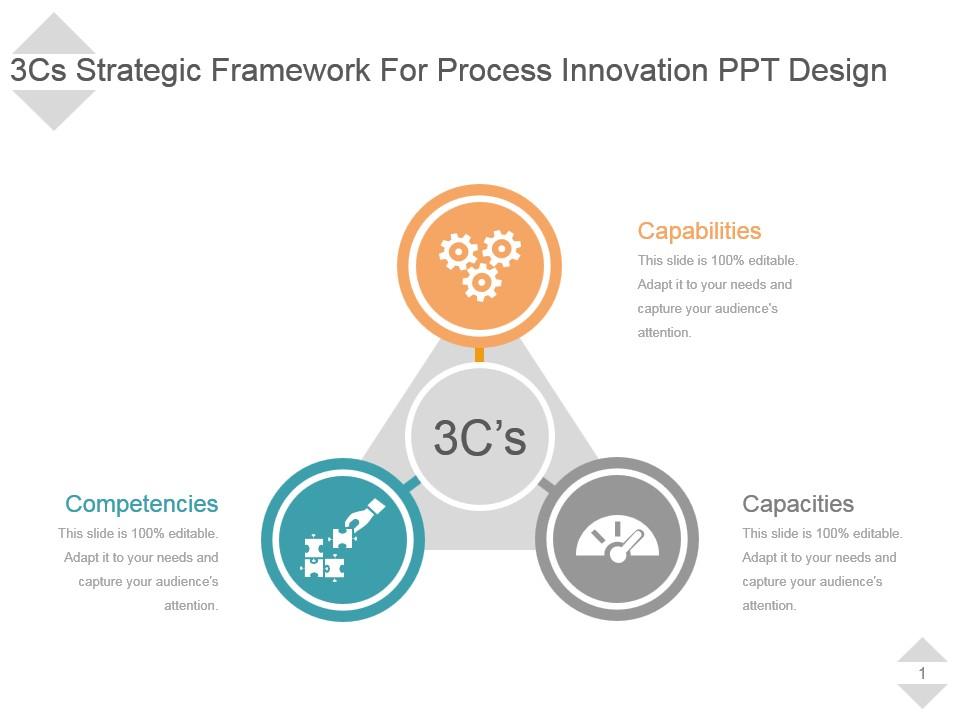
Presenting 3cs strategic framework for process innovation ppt design. Presenting 3cs strategic framework for process innovation ppt design. This is a 3cs strategic framework for process innovation ppt design. This is three stage process. The stages in this process are competencies, capabilities, capacities.

Content of this Powerpoint Presentation

Description:

This PowerPoint slide presents the "3Cs Strategic Framework For Process Innovation," which is a model to guide organizations in developing the necessary competencies, capabilities, and capacities for innovative process improvements. In this model, each "C" stands for a key area of focus: Competencies, Capabilities, and Capacities.

The text elements of each section indicate that the slide is fully editable, allowing presenters to customize the content according to their needs and audience. The term "Competencies" is accompanied by an icon representing skills or tools, suggesting a focus on the skills and knowledge required to drive innovation. "Capabilities" features a gear icon, which typically symbolizes the machinery or technical ability required in a process. The "Capacities" section includes a gauge icon, possibly indicative of the measurement of how much innovation the organization can handle or produce.

The color scheme is a soft palette of grey, blue, and orange, with each circle intertwined, showing the interconnected nature of these elements in fostering an environment conducive to process innovation.

Use Cases:

Here are seven industries where this strategic framework can be effectively applied:

1. Technology:

Use: To illustrate the strategic areas to focus on for innovative technology development and production.

Presenter: Chief Technology Officer.

Audience: Technology team and R&D department.

2. Healthcare:

Use: For discussing ways to innovate patient care and healthcare processes.

Presenter: Healthcare administrator or senior medical staff.

Audience: Hospital management and medical staff.

3. Manufacturing:

Use: To showcase strategies for improving manufacturing processes and efficiencies.

Presenter: Operations Manager.

Audience: Plant managers and process engineers.

4. Finance:

Use: To explain necessary competencies for financial innovation and product development.

Presenter: Head of Product Development.

Audience: Finance professionals and bank employees.

5. Education:

Use: For developing and implementing new teaching methods and educational technologies.

Presenter: Dean or Educational Consultant.

Audience: Educators and academic administrators.

6. Retail:

Use: To map out improvement areas in customer service, supply chain, and inventory management.

Presenter: Retail Operations Director.

Audience: Store managers and operations teams.

7. Consulting:

Use: In providing clients with a clear process framework for achieving operational excellence.

Presenter: Senior Consultant.

Audience: Corporate clients and stakeholders.

FAQs for 3cs strategic framework for process

The 3Cs Framework comprises Company (internal capabilities and resources), Customers (market needs and segments), and Competitors (competitive landscape and positioning). This strategic model enables organizations to assess their competitive advantage by analyzing internal strengths, customer demands, and market competition simultaneously, ultimately delivering comprehensive insights for strategic planning and business positioning.

The 3Cs Framework enhances marketing efforts by analyzing customers through market research and segmentation, evaluating competitors via positioning analysis and differentiation strategies, and assessing company capabilities including brand strengths and resource allocation. This strategic combination enables organizations to identify market gaps, develop targeted campaigns, and create compelling value propositions, ultimately delivering more effective customer engagement and sustainable competitive advantage.

The 3Cs Framework aids in understanding customer needs by analyzing customer behavior patterns, preferences, and pain points alongside competitor offerings and company capabilities. This strategic analysis enables businesses to identify unmet market demands, anticipate evolving expectations, and develop targeted solutions, with many organizations finding that this comprehensive approach delivers enhanced customer satisfaction and competitive differentiation.

Competition analysis forms the "Competitors" pillar of the 3Cs Framework, working alongside Company and Customer analysis to create comprehensive strategic insights. Through systematic competitor evaluation, organizations assess market positioning, pricing strategies, and competitive advantages, while identifying gaps and opportunities that inform product development, market entry decisions, and differentiation strategies, ultimately delivering enhanced competitive positioning.

Collaboration enables organizations to leverage diverse perspectives when analyzing customers, competitors, and company capabilities within the 3Cs Framework, ensuring comprehensive strategic insights through cross-functional input, shared market intelligence, and collective problem-solving. This collaborative approach streamlines decision-making by integrating sales feedback, competitive intelligence, and operational expertise, ultimately delivering more robust strategies and enhanced competitive advantage across industries.

Yes, the 3Cs Framework adapts effectively to digital marketing by analyzing customers through data analytics and social listening, competitors via SEO analysis and digital presence monitoring, and company capabilities including technology infrastructure and digital resources. This strategic combination enables businesses to identify market gaps, optimize online positioning, and develop targeted campaigns, with many organizations finding that digital adaptation delivers enhanced customer targeting, competitive differentiation, and measurable ROI across multiple channels.

Startups can leverage the 3Cs Framework by systematically analyzing customers, competitors, and company capabilities to identify strategic growth opportunities and market positioning advantages. This comprehensive approach enables emerging businesses to optimize resource allocation, differentiate their offerings, and scale efficiently, with many technology and service startups finding that regular 3Cs assessments accelerate market penetration and sustainable expansion.

Common pitfalls when implementing the 3Cs Framework include insufficient competitor research, overestimating company capabilities, misreading customer needs, treating each C in isolation, and failing to adapt insights into actionable strategies. Many organizations find that superficial analysis or static assessments limit effectiveness, while successful implementations require continuous monitoring, cross-functional collaboration, and regular framework updates to maintain competitive advantage.

The 3Cs Framework promotes innovation by fostering **Creativity** through diverse perspectives and brainstorming, encouraging **Collaboration** across departments and teams, and building **Culture** that rewards experimentation and risk-taking. This strategic combination enables organizations to streamline idea generation, enhance cross-functional problem-solving, and ultimately deliver breakthrough solutions, with many companies finding that systematic innovation approaches accelerate competitive advantage.

Success metrics for the 3Cs Framework include customer satisfaction scores, market share growth, competitive positioning analysis, operational efficiency ratios, and brand differentiation measurements. These metrics enable organizations to track performance across all three dimensions simultaneously, with companies in retail, financial services, and manufacturing finding that balanced scorecards combining customer feedback, competitive benchmarking, and internal capability assessments deliver comprehensive strategic insights.

The 3Cs Framework intersects with SWOT and PESTLE by providing focused competitive intelligence that enhances their strategic analysis, with Customer insights informing market opportunities, Company assessment strengthening internal evaluation, and Competitor analysis deepening competitive positioning. This strategic combination enables organizations to develop more comprehensive strategies, with many finding that integrating these frameworks delivers enhanced market understanding and ultimately stronger competitive advantage in increasingly complex business environments.

The 3Cs Framework applies across retail, technology, healthcare, financial services, and manufacturing industries, where understanding customers, competitors, and company capabilities drives strategic decisions. Technology companies leverage it for product positioning, while retail and financial institutions use it to enhance customer experiences and competitive differentiation, ultimately delivering strategic advantage in increasingly dynamic markets.

Businesses should revisit the 3Cs Framework quarterly or semi-annually, with additional reviews triggered by major market shifts, competitive moves, or internal changes. This regular assessment enables organizations to adapt their strategies proactively, maintain competitive positioning, and capitalize on emerging opportunities, with many companies finding that consistent framework reviews deliver enhanced market responsiveness and sustained strategic advantage.

**INPUT**: What tools or resources can help in analyzing the components of the 3Cs Framework? **OUTPUT**: Tools for analyzing the 3Cs Framework include SWOT analysis, Porter's Five Forces, customer surveys, competitive intelligence platforms, and market research databases. These resources enable organizations to systematically evaluate company strengths, customer needs, and competitor positioning, with many businesses finding that combining multiple analytical approaches delivers deeper strategic insights and sustainable competitive advantage. [Word count: 54]

The 3Cs Framework addresses consumer behavior changes by systematically analyzing customers, competitors, and company capabilities to identify shifting preferences, purchasing patterns, and market expectations. This strategic approach enables organizations to adapt their value propositions, service delivery, and competitive positioning in response to evolving consumer demands, ultimately delivering enhanced customer experiences and sustainable competitive advantage.

Ratings and Reviews

100% of 100
Write a review
Most Relevant Reviews
  1. 100%

    by Donte Duncan

    Best Representation of topics, really appreciable.
  2. 100%

    by Noah Hernandez

    Presentation Design is very nice, good work with the content as well.

2 Item(s)

per page: