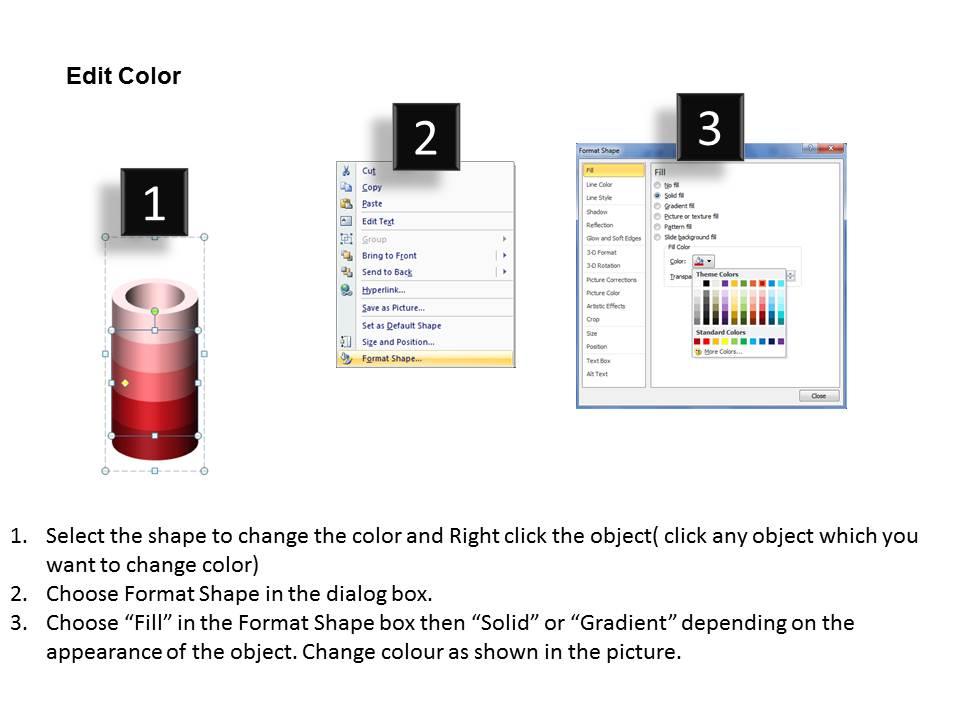
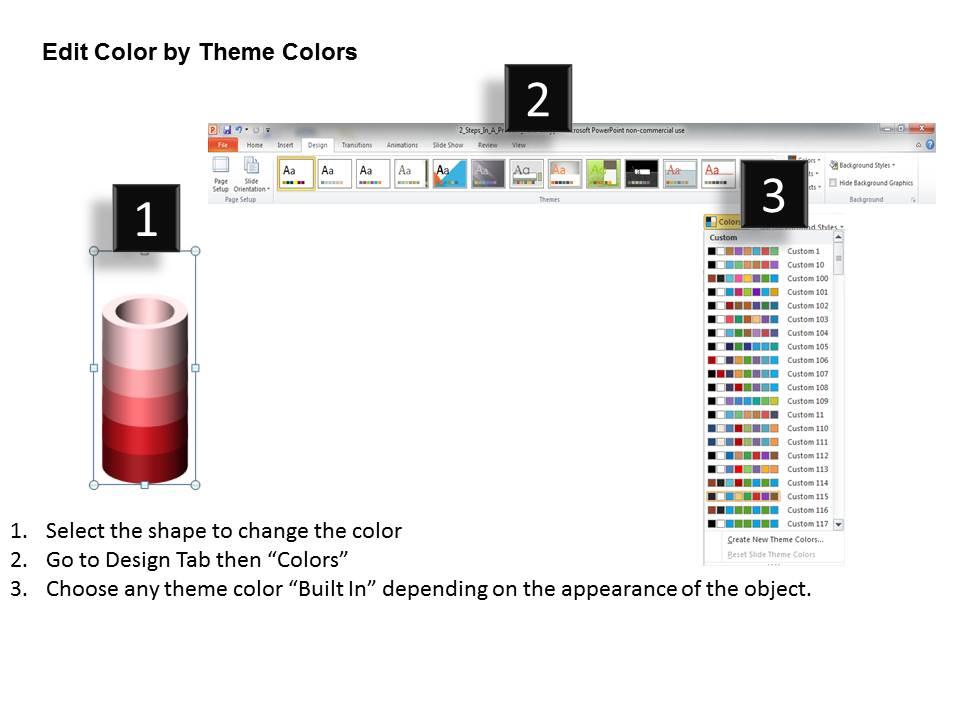
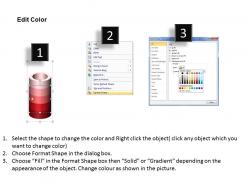
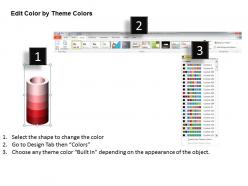
3d cylinder shapes powerpoint template slide
Try Before you Buy Download Free Sample Product
Audience
Editable
of Time
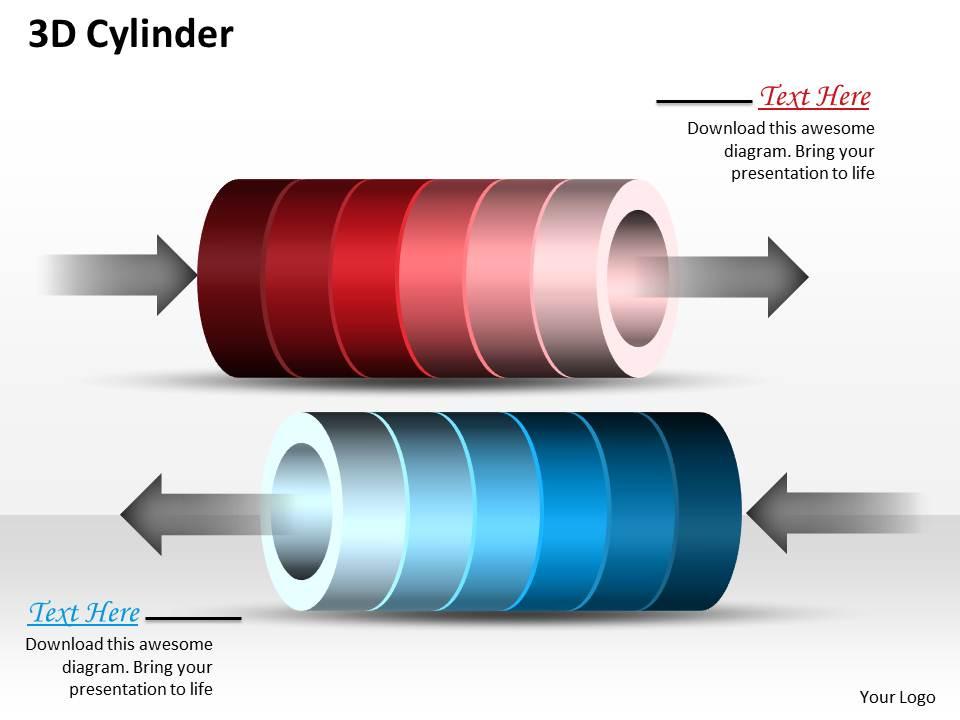
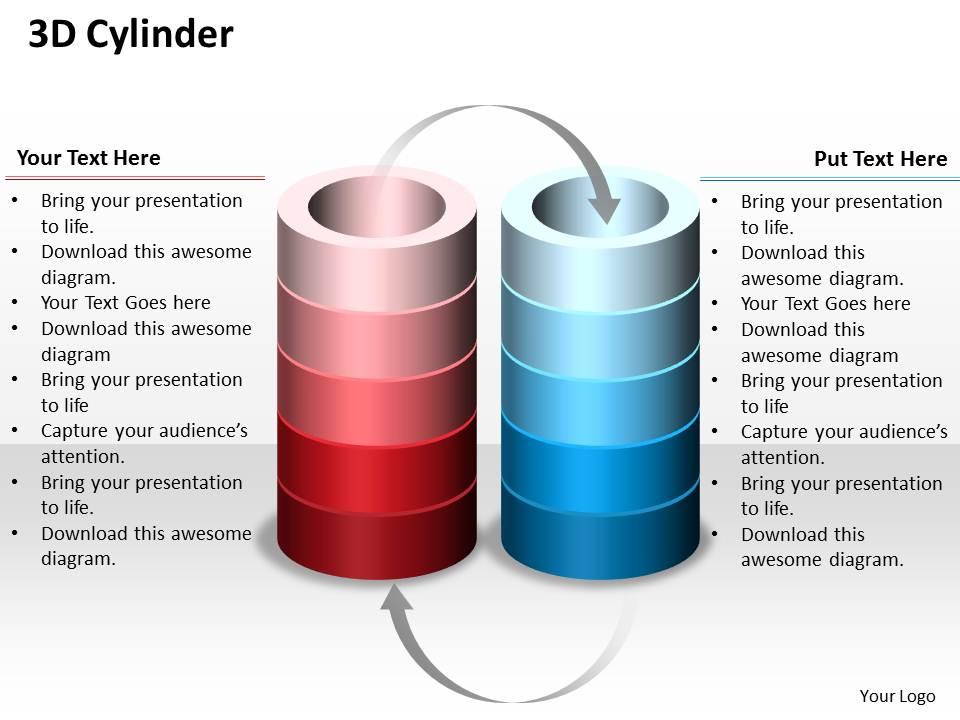
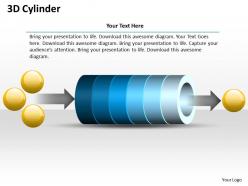
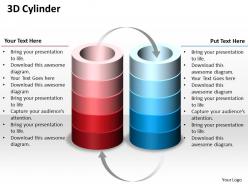
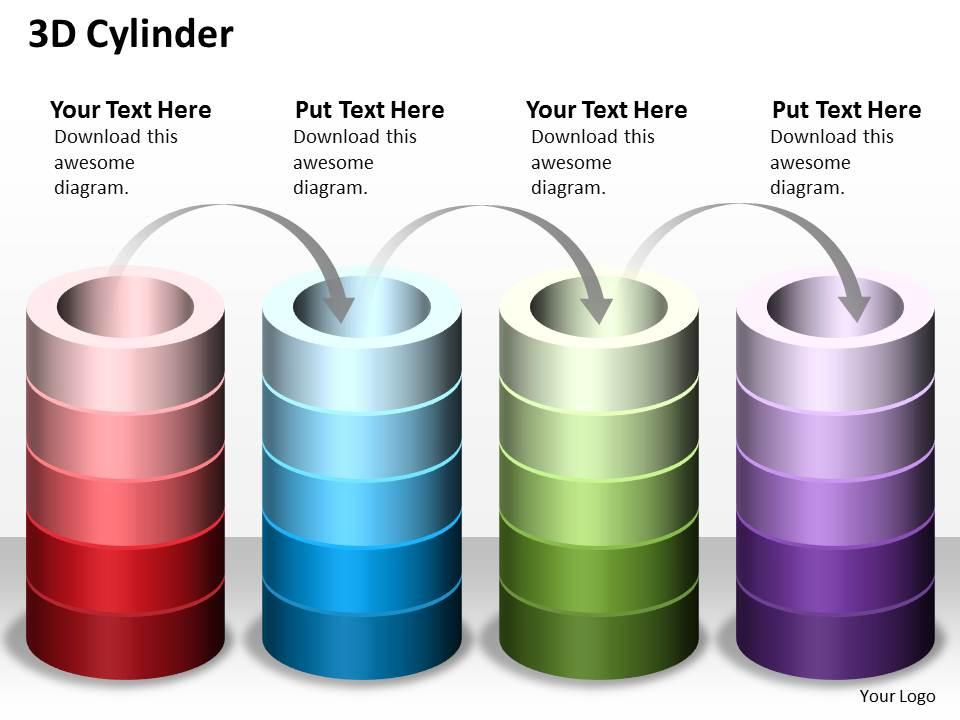
Introducing one of our most recognised and popular tool that can easily fit into any presentation to display the process and other business information describing a source and a targeted point in an extremely influential manner. 3D cylinder shapes PPT design diagram comprises of a horizontal tunnel formed with 3D cylinder and you can utilise it as a concept layout or metaphor for your business presentations. The flow of information in these backgrounds will simply amaze the viewers and enable them to easily grasp and memorise the concepts without having the need to jot down each and every point. Apart from this, these illustrations can greatly support you in the process of making vital business decisions and plans. Also, they are capable of guiding the audience about the stepwise functioning of a process to achieve the end objective. Hence, the entire appearance of your reports can be modified to form an amazing looking presentation with these commendable graphics. Move from the fringes to the centre with our 3D Cylinder Shapes Powerpoint Template Slide. They allow you to stake your claim.
People who downloaded this PowerPoint presentation also viewed the following :
3d cylinder shapes powerpoint template slide with all 8 slides:
Coast along with our 3D Cylinder Shapes Powerpoint Template Slide. Your thoughts will move along steadily.
FAQs for 3d cylinder shapes
The volume of a 3D cylinder is calculated using V = πr²h, where r represents the radius and h represents the height, while surface area uses SA = 2πr² + 2πrh, combining the areas of both circular bases and the curved surface. These mathematical formulas enable engineers, architects, and manufacturers to optimize material usage, determine storage capacities, and streamline production processes across industries like construction and packaging, ultimately delivering precise measurements for efficient resource allocation.
A cylinder's aspect ratio significantly affects stability through center of gravity positioning, base-to-height proportions, and resistance to tipping forces. In manufacturing, shipping containers, storage tanks, and architectural columns demonstrate how lower aspect ratios enhance structural integrity, while many industries find that optimizing these proportions delivers improved safety margins, reduced material costs, and enhanced operational reliability in dynamic environments.
3D cylinder shapes are extensively utilized in manufacturing, automotive, aerospace, construction, and energy sectors due to their structural efficiency and versatility. These industries leverage cylindrical designs for pipelines, storage tanks, engine components, and structural supports because cylinders distribute stress evenly, maximize volume-to-surface ratios, and streamline manufacturing processes, ultimately delivering cost efficiency and enhanced performance.
The radius and height are fundamental parameters that determine a cylinder's volume, surface area, and structural properties, with radius having quadratic impact on volume while height provides linear scaling. These measurements enable engineers, architects, and designers to calculate material requirements, optimize space utilization, and ensure structural integrity across applications from storage tanks to architectural columns, ultimately delivering precise specifications for manufacturing and construction projects.
3D cylinders offer superior structural integrity compared to angular shapes because their curved surfaces distribute stress evenly without concentrated pressure points, while rectangular or triangular forms create stress concentrations at corners and edges. This uniform load distribution makes cylinders ideal for pressure vessels, storage tanks, and architectural columns, with many engineering applications in aerospace, construction, and manufacturing finding that cylindrical designs deliver enhanced durability and material efficiency.
**INPUT**: What software tools are available for modeling and visualizing 3D cylinder shapes? **OUTPUT**: 3D cylinder modeling software includes AutoCAD, SolidWorks, Blender, SketchUp, Fusion 360, and Maya, each offering specialized capabilities for different applications. These tools streamline design workflows by enabling precise dimensional control, realistic rendering, and seamless integration with manufacturing processes, with many engineering firms and design studios finding that strategic software selection ultimately delivers faster project completion and enhanced client presentations.
3D printing technology creates intricate cylindrical designs through layer-by-layer additive manufacturing, precision toolpath planning, multi-material extrusion, and advanced support structures that enable complex geometries. Manufacturing companies, medical device firms, and aerospace industries leverage these capabilities to produce customized pipes, medical implants, and engine components with internal channels and surface textures previously impossible through traditional machining methods.
Rendering 3D cylinder shapes presents challenges including polygon optimization for curved surfaces, texture mapping distortion around edges, lighting calculation complexity for smooth normals, and performance bottlenecks with high-detail models. Game developers and animation studios address these through adaptive tessellation, UV unwrapping techniques, and level-of-detail systems, ultimately delivering smoother visuals while maintaining frame rates.
Transformations are applied to 3D cylinders through matrix operations that modify vertex coordinates, including scaling matrices for size adjustments, rotation matrices for orientation changes, and translation matrices for positional shifts. These mathematical operations enable game developers, CAD engineers, and animation studios to create dynamic cylinder objects in virtual environments, architectural visualizations, and product simulations, ultimately delivering enhanced visual realism and interactive experiences.
Hollow cylinders offer superior strength-to-weight ratios, reduced material costs, and enhanced heat dissipation, while solid cylinders provide maximum structural integrity and simpler manufacturing processes. In automotive and aerospace applications, hollow designs enable significant weight reduction without compromising performance, whereas heavy machinery and construction equipment often benefit from solid cylinders' robust load-bearing capabilities, ultimately delivering optimized efficiency based on specific operational requirements.
Surface textures and materials significantly transform a 3D cylinder's aesthetic by influencing light reflection, visual depth, and tactile perception through variations in roughness, glossiness, and pattern complexity. Different materials like metal, wood, glass, or fabric create distinct visual personalities, with smooth surfaces appearing modern and sleek while textured surfaces add organic warmth, ultimately enabling designers to match cylindrical elements to specific brand identities and user experiences.
3D cylinders serve as fundamental structural and aesthetic elements in architectural design, enabling curved walls, columns, towers, atriums, and rotundas that maximize space efficiency while creating visual flow. These cylindrical forms allow architects to optimize natural light distribution, enhance acoustic properties, and create seamless transitions between spaces, with many commercial buildings and residential projects finding that curved elements reduce material waste while delivering distinctive visual appeal and improved functionality.
Environmental considerations when producing cylindrical products include material selection, energy consumption during manufacturing, waste generation, transportation efficiency, and end-of-life recyclability. These factors increasingly influence production decisions, with manufacturers in automotive, packaging, and construction industries finding that sustainable cylindrical designs reduce material waste, optimize shipping density, and enhance recyclability, ultimately delivering cost savings and competitive advantage in environmentally-conscious markets.
Cylindrical shapes enhance user experience through ergonomic grip comfort, intuitive rolling interactions, natural hand positioning, smooth tactile feedback, and visual simplicity that reduces cognitive load. In product design, these geometric forms streamline manufacturing processes while delivering superior functionality across industries like automotive, consumer electronics, and medical devices, ultimately creating more accessible and user-friendly products.
Educational resources for learning about 3D cylinder applications include engineering textbooks, CAD software tutorials, online mathematics courses, virtual reality modeling programs, and industry-specific training modules. These resources enhance understanding by combining theoretical foundations, hands-on design experience, and real-world case studies from manufacturing, architecture, and mechanical engineering, with many educational institutions finding that interactive 3D modeling significantly accelerates comprehension and practical application skills.
-
Professional and unique presentations.
-
Attractive design and informative presentation.