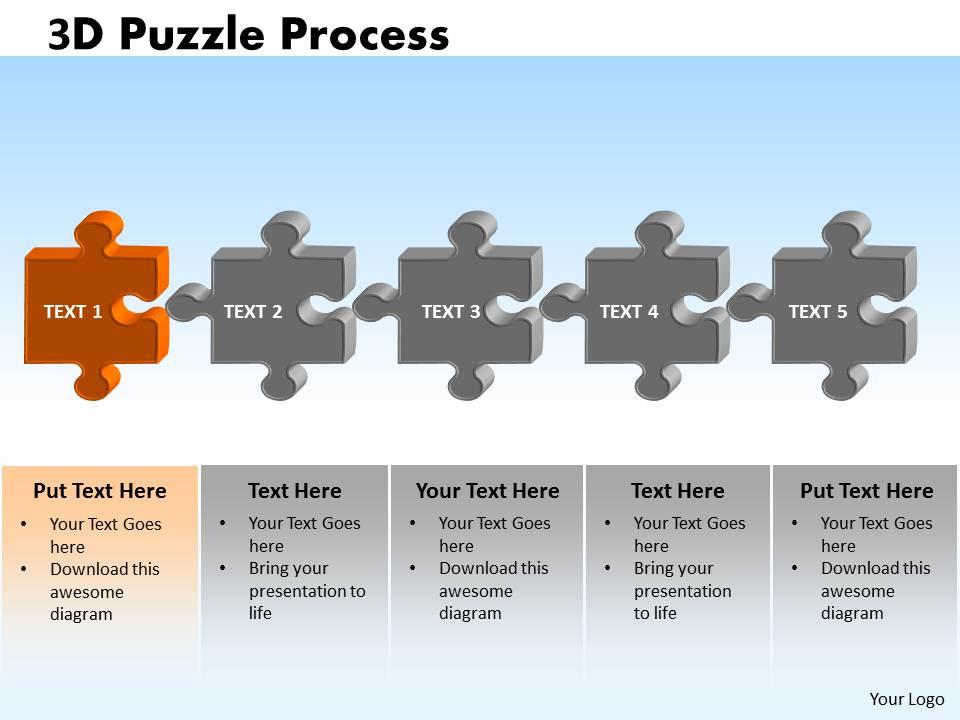
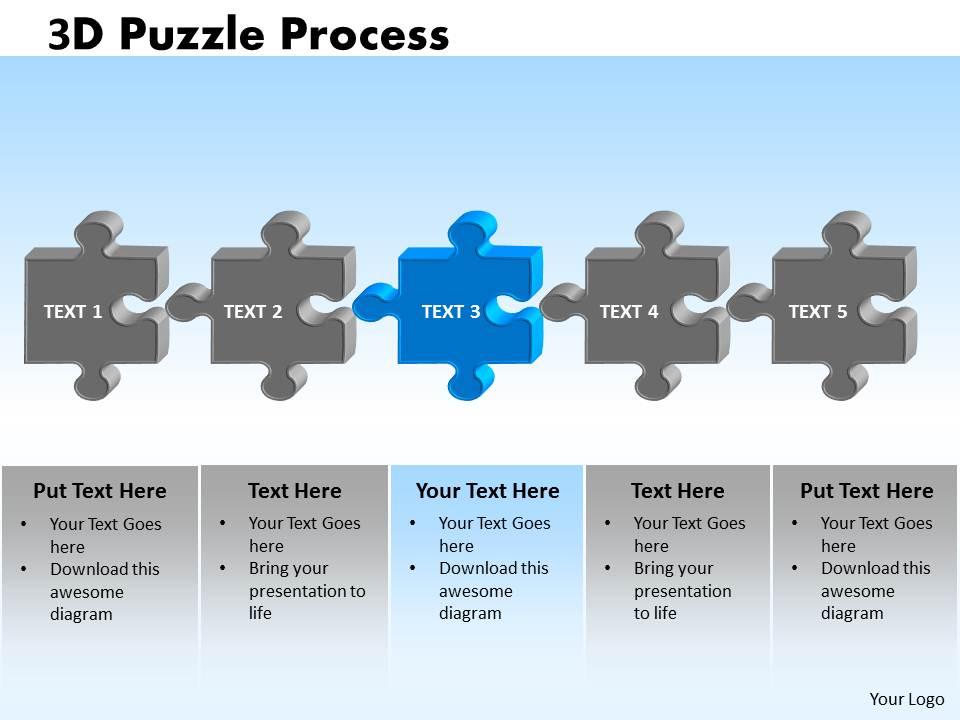
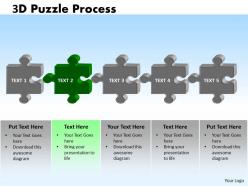
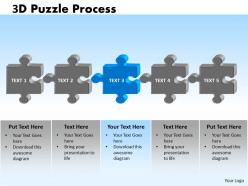
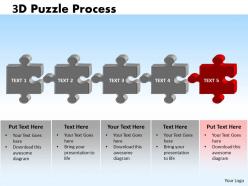
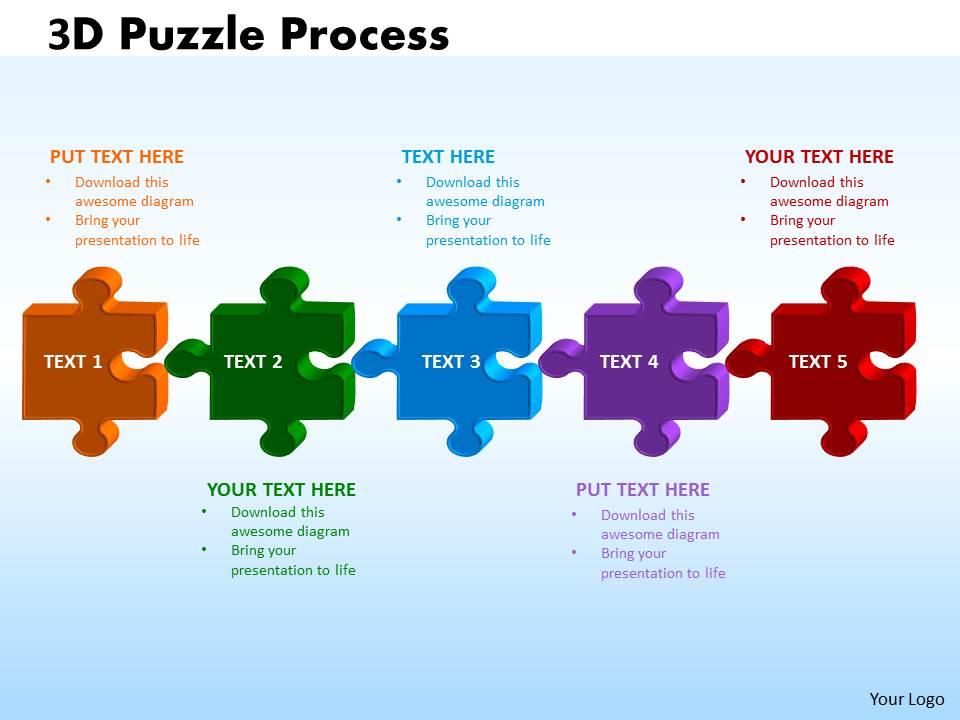
3d puzzle process
Try Before you Buy Download Free Sample Product
Audience
Editable
of Time
Over ten thousand designs of 3D Puzzle Process are ready made and waiting to fit your needs.
People who downloaded this PowerPoint presentation also viewed the following :
3d puzzle process with all 9 slides:
Answer any enquiry with our 3D Puzzle Process. Have the facts ready by your side.
FAQs for
**INPUT**: What are the key benefits of engaging in 3D puzzle assembly as a cognitive exercise? **OUTPUT**: 3D puzzle assembly enhances spatial reasoning, problem-solving skills, memory retention, fine motor coordination, and concentration abilities through hands-on manipulation of complex structures. These cognitive exercises strengthen neural pathways by requiring visual processing, strategic planning, and sustained attention, with many educators and therapists finding that regular assembly activities ultimately deliver improved focus and enhanced three-dimensional thinking capabilities.
Assembling 3D puzzles enhances spatial awareness by requiring mental rotation, depth perception, and dimensional visualization while simultaneously developing problem-solving skills through pattern recognition, logical sequencing, and strategic planning. These cognitive exercises strengthen neural pathways responsible for spatial reasoning and analytical thinking, with educators and therapists finding that regular 3D puzzle assembly significantly improves mathematical comprehension, engineering aptitude, and overall cognitive flexibility.
High-quality 3D puzzles commonly use precision-cut cardboard, engineered plastics, wooden components, foam-backed pieces, and specialized adhesives for structural integrity. These materials enable manufacturers to create increasingly complex designs with enhanced durability and visual appeal, with many educational institutions and entertainment companies finding that premium materials significantly improve user engagement and long-term product satisfaction.
Different age groups approach 3D puzzle challenges uniquely, with children viewing them as playful exploration, teens seeking complexity validation, adults appreciating strategic problem-solving, and seniors valuing cognitive engagement. These varying perspectives create diverse market opportunities, with manufacturers increasingly designing age-specific difficulty levels and themes, ultimately delivering enhanced user experiences while fostering intergenerational bonding through shared puzzle-solving activities.
Effective 3D puzzle organization involves sorting pieces by color, pattern, and edge characteristics, creating designated workspace zones, and using shallow containers or trays for different sections. These systematic approaches streamline assembly by minimizing search time, reducing frustration, and maintaining momentum throughout the building process, ultimately delivering a more enjoyable and efficient puzzle-solving experience.
Technology has revolutionized 3D puzzle design through computer-aided modeling, precision laser cutting, and advanced materials engineering, enabling intricate interlocking mechanisms and complex geometric structures. These innovations streamline manufacturing processes while enhancing puzzle complexity, with educational institutions and entertainment companies finding that digital design tools ultimately deliver more engaging experiences and reduced production costs.
Popular 3D puzzle themes include architectural landmarks, fantasy castles, vehicles and transportation, famous monuments, and intricate mechanical models. These categories appeal to diverse interests by combining educational value with hands-on engagement, with many manufacturers finding that architectural puzzles like Big Ben or Eiffel Tower replicas deliver both nostalgic appeal and display-worthy results.
3D puzzle assembly enhances team collaboration by requiring clear communication, strategic planning, and shared problem-solving, while naturally developing leadership roles and patient coordination among colleagues. Corporate teams find that these activities break down departmental silos, improve cross-functional relationships, and build trust through non-competitive cooperation, ultimately delivering stronger workplace dynamics and enhanced project management skills.
Solo 3D puzzle assembly benefits from creating dedicated workspace organization, breaking complex sections into manageable segments, and maintaining detailed progress documentation to track component placement. Group assembly enhances the experience through collaborative problem-solving, task delegation based on individual strengths, and shared celebration of milestones, with many puzzle enthusiasts finding that alternating between solo focus sessions and group brainstorming ultimately delivers faster completion and greater satisfaction.
Beginners should select 3D puzzles by considering piece count, complexity level, assembly time, and personal interests like architecture, vehicles, or landmarks. Starting with 50-100 piece models featuring clear instructions and sturdy materials enables skill development, while choosing themes that resonate personally—such as famous buildings for architecture enthusiasts or vintage cars for automotive fans—ultimately delivers sustained engagement and successful completion experiences.
Yes, completing 3D puzzles delivers significant psychological benefits including enhanced spatial reasoning, improved problem-solving skills, reduced stress levels, increased focus, and boosted self-confidence through achievement. These cognitive activities engage multiple brain regions simultaneously, with many individuals finding that regular puzzle assembly improves memory retention, patience development, and mindfulness practice, ultimately delivering mental clarity and emotional satisfaction.
Color and design significantly influence 3D puzzle appeal by creating visual interest, brand recognition, and emotional connection, while simultaneously affecting difficulty through contrast levels, pattern complexity, and piece differentiation. Vibrant designs with clear color boundaries enhance assembly guidance and user engagement, with many puzzle enthusiasts finding that well-designed color schemes ultimately deliver both aesthetic satisfaction and optimal challenge balance.
Common misconceptions include that 3D puzzles are impossibly complex, require advanced spatial skills, or are only suitable for experts. While these puzzles present challenges, many beginners find that starting with simpler architectural models, following systematic assembly approaches, and utilizing clear instruction guides makes them surprisingly accessible, ultimately delivering enhanced problem-solving abilities and satisfying creative outcomes.
Regular engagement with 3D puzzles enhances cognitive flexibility, spatial reasoning, fine motor control, and problem-solving skills through hands-on manipulation and visual-spatial processing. These activities strengthen neural pathways while maintaining hand-eye coordination, with many older adults finding that consistent puzzle practice helps preserve dexterity and mental acuity, ultimately delivering sustained cognitive engagement and physical coordination benefits throughout aging.
3D puzzle production presents both challenges and opportunities, with environmental impacts including plastic manufacturing, packaging waste, and transportation emissions, while sustainable alternatives feature recycled materials, biodegradable components, and minimal packaging. Consumers can make eco-friendly choices by selecting puzzles from manufacturers prioritizing sustainable materials, supporting local producers to reduce shipping impacts, and choosing durable designs for long-term use, ultimately delivering environmental benefits while maintaining engaging experiences.
-
Visually stunning presentation, love the content.
-
Unique design & color.