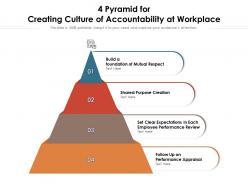
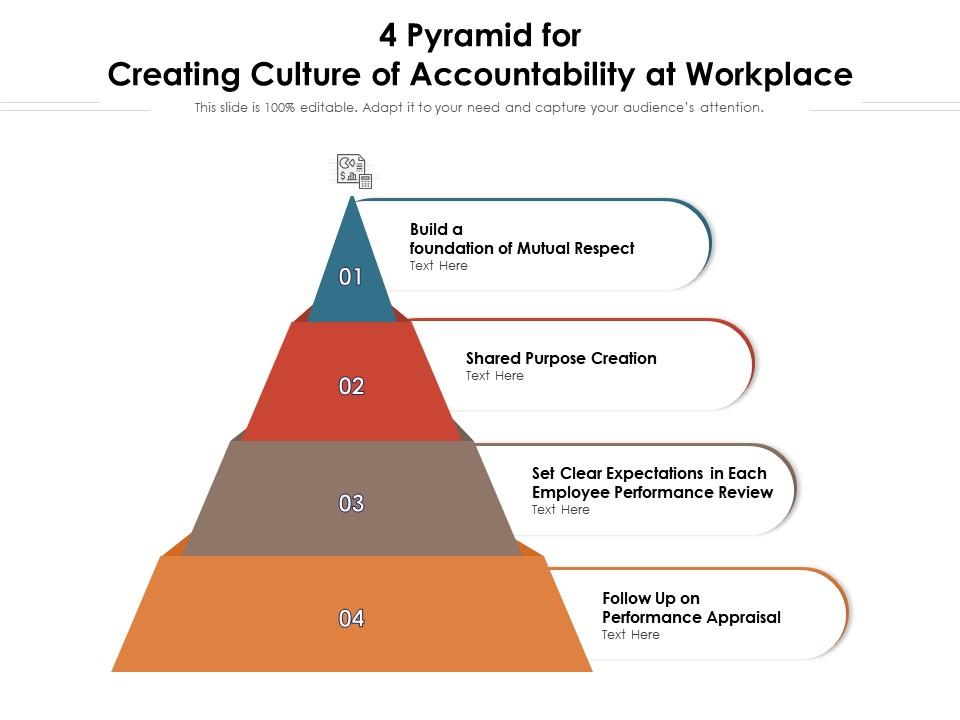
4 pyramid for creating culture of accountability at workplace
Try Before you Buy Download Free Sample Product
Audience
Editable
of Time
Our 4 Pyramid For Creating Culture Of Accountability At Workplace are topically designed to provide an attractive backdrop to any subject. Use them to look like a presentation pro.
People who downloaded this PowerPoint presentation also viewed the following :
4 pyramid for creating culture of accountability at workplace with all 2 slides:
Use our 4 Pyramid For Creating Culture Of Accountability At Workplace to effectively help you save your valuable time. They are readymade to fit into any presentation structure.
FAQs for 4 pyramid for creating culture of
Accountability drives effective team collaboration by establishing clear expectations, fostering trust through reliable follow-through, and ensuring shared responsibility for outcomes. When team members consistently deliver on commitments and transparently communicate progress, organizations experience improved project timelines, enhanced problem-solving capabilities, and stronger collective performance, with many finding that accountability frameworks ultimately create competitive advantage through seamless execution.
Leaders foster accountability by establishing clear expectations, implementing regular performance reviews, creating transparent communication channels, and modeling accountable behavior themselves. Through consistent feedback systems, recognition programs, and ownership-based goal setting, organizations streamline responsibility frameworks while enhancing trust, with many companies finding that empowered employees deliver improved results and stronger team cohesion.
Common workplace accountability barriers include unclear expectations, lack of consequences, poor communication systems, blame culture, and insufficient tracking mechanisms. Organizations overcome these challenges by establishing clear performance metrics, implementing regular feedback loops, and creating psychological safety where employees feel comfortable owning mistakes, ultimately delivering improved performance and stronger team dynamics.
**INPUT**: How can accountability be measured and tracked in a project management setting? **OUTPUT**: Accountability in project management can be measured through milestone tracking, performance dashboards, regular progress reviews, task completion rates, and stakeholder feedback mechanisms. These tools enable project managers to monitor individual contributions, identify bottlenecks early, and maintain transparency across teams, with many organizations finding that systematic accountability tracking reduces project delays while enhancing team performance and client satisfaction. [Word count: 58 words]
Strategies include setting clear expectations and measurable goals, implementing regular check-ins and progress reviews, creating transparent reporting systems, and establishing consequences for both success and failure. Through peer accountability partnerships and collaborative goal-setting, organizations enhance individual ownership while building trust, with many teams finding that shared responsibility frameworks ultimately deliver improved performance and stronger workplace culture.
Accountability enhances employee engagement and motivation by creating clear expectations, fostering ownership of outcomes, and establishing transparent performance standards that drive personal investment in results. When organizations implement structured accountability frameworks, employees experience greater autonomy, recognition for achievements, and meaningful feedback loops, ultimately delivering higher job satisfaction and productivity across teams.
Accountability varies significantly across organizational cultures, with hierarchical structures emphasizing top-down responsibility while collaborative environments distribute ownership more broadly among teams and individuals. Industries like healthcare and finance maintain strict compliance-focused accountability due to regulatory requirements, whereas creative sectors often embrace more flexible, outcome-based approaches that prioritize innovation and results over rigid processes.
**INPUT**: What tools and frameworks are available to support accountability in remote teams? **OUTPUT**: Remote team accountability tools include project management platforms like Asana and Trello, time tracking software, regular check-in frameworks, goal-setting systems, and performance dashboards. These technologies streamline oversight by enabling transparent progress tracking, automated reporting, and structured communication protocols, with many organizations finding that strategic combinations ultimately deliver enhanced productivity and stronger team cohesion. **Word count**: 58 words
**INPUT**: How can accountability be integrated into performance management systems? **OUTPUT**: Accountability integrates into performance management through clear goal-setting frameworks, regular progress tracking, transparent feedback mechanisms, and consequence-linked outcomes that directly tie individual contributions to organizational results. Many companies find that combining real-time performance dashboards with structured review cycles enables managers to address issues proactively while recognizing achievements, ultimately creating a culture where employees take ownership of their responsibilities and deliver measurable business impact. [Word count: 60 words]
Lack of accountability in business operations leads to decreased productivity, poor decision-making, erosion of trust, missed deadlines, and declining quality standards. These consequences ultimately result in reduced profitability, damaged client relationships, and weakened competitive positioning, with many organizations finding that accountability gaps create cascading operational inefficiencies across departments.
Accountability significantly enhances decision-making processes by encouraging thorough analysis, reducing impulsive choices, and promoting data-driven evaluations before implementation. When employees know they'll be held responsible for outcomes, organizations see more strategic thinking, collaborative input-seeking, and comprehensive risk assessment, with many companies finding that accountable teams make faster, more informed decisions that ultimately deliver better business results.
Accountability enhances customer satisfaction by ensuring transparent communication, prompt issue resolution, reliable service delivery, and consistent follow-through on commitments. When businesses take ownership of mistakes and proactively address concerns, customers experience improved trust and loyalty, with many organizations finding that accountable practices ultimately deliver stronger relationships, reduced churn, and competitive advantage in customer retention.
Storytelling promotes accountability by creating emotional connections, illustrating consequences of actions, and making abstract concepts tangible through relatable narratives. Through case studies and real-world scenarios, organizations enhance learning retention, demonstrate best practices, and foster personal responsibility, with many training programs finding that story-driven content significantly improves behavioral change and performance outcomes.
Feedback serves as accountability's foundation by establishing clear performance expectations, providing regular progress assessments, and creating opportunities for course correction before issues escalate. Through structured feedback systems, organizations enable managers to address gaps immediately, recognize achievements consistently, and maintain transparent communication channels, with many companies finding that regular feedback cycles significantly enhance employee ownership, reduce performance surprises, and ultimately strengthen workplace accountability culture.
Organizations can leverage project management software, real-time dashboards, automated reporting systems, and collaborative platforms to enhance project accountability through transparent tracking, milestone monitoring, and performance analytics. These technologies enable teams to identify bottlenecks early, streamline communication workflows, and maintain comprehensive audit trails, ultimately delivering improved project outcomes and stakeholder confidence.
-
Design layout is very impressive.
-
Visually stunning presentation, love the content.
-
Unique research projects to present in meeting.
-
Topic best represented with attractive design.