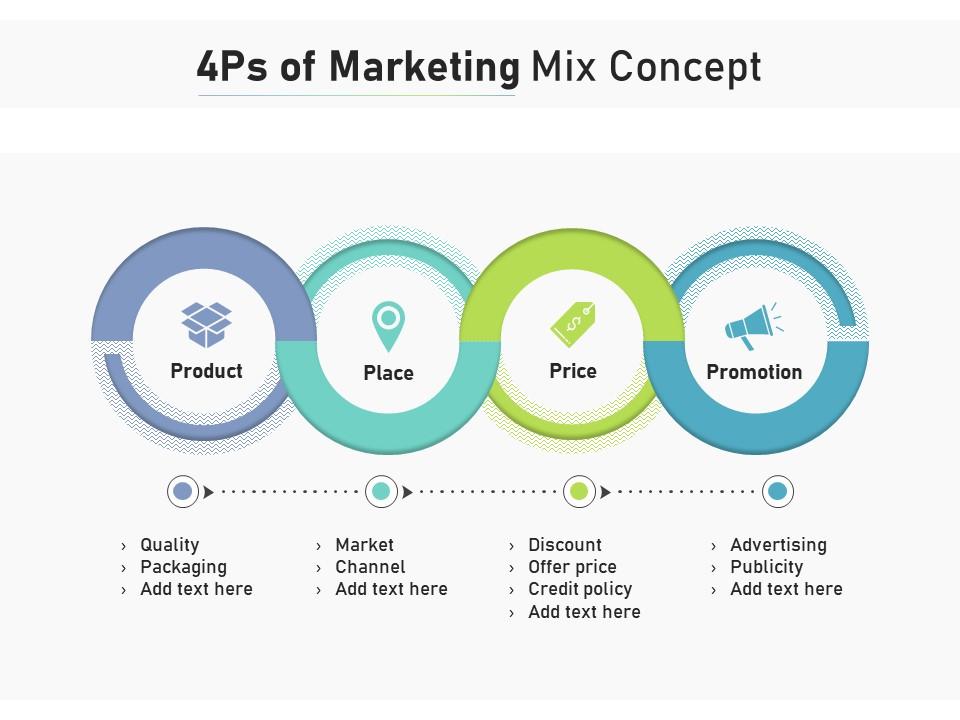
4ps of marketing mix concept
Try Before you Buy Download Free Sample Product
Audience
Editable
of Time
Our 4ps Of Marketing Mix Concept are topically designed to provide an attractive backdrop to any subject. Use them to look like a presentation pro.
People who downloaded this PowerPoint presentation also viewed the following :
4ps of marketing mix concept with all 2 slides:
Use our 4ps Of Marketing Mix Concept to effectively help you save your valuable time. They are readymade to fit into any presentation structure.
FAQs for 4ps of
The fundamental components of the 4Ps marketing mix include Product (features, quality, branding), Price (strategy, positioning, discounts), Place (distribution channels, locations), and Promotion (advertising, sales, public relations). These strategic elements work together by aligning offerings with customer needs, optimizing market reach, and driving competitive advantage, with many organizations finding that integrated 4Ps approaches deliver enhanced customer experiences and increased market share.
Product differentiation significantly enhances a brand's market position by creating unique value propositions, reducing direct competition, and enabling premium pricing strategies. Through distinctive features, superior quality, or innovative design, companies like Apple with smartphones or Tesla with electric vehicles establish competitive advantages, build customer loyalty, and ultimately command greater market share while justifying higher profit margins.
Pricing strategies significantly influence consumer perceptions by signaling quality, exclusivity, and value positioning, while psychological pricing, competitive pricing, and premium positioning directly shape purchase decisions. Through strategic price points, businesses can enhance brand perception, accelerate customer acquisition, and drive market segmentation, with many retailers finding that dynamic pricing approaches ultimately deliver improved profit margins and stronger competitive advantage.
Place ensures products reach target consumers through strategic distribution channels, retail locations, online platforms, e-commerce sites, and direct sales approaches. This distribution strategy streamlines market access by reducing geographical barriers, optimizing inventory placement, and enhancing customer convenience, with many retailers finding that multi-channel approaches ultimately deliver broader market penetration and competitive advantage.
Promotional strategies differ significantly between channels, with digital marketing enabling targeted social media campaigns, personalized email marketing, influencer partnerships, and real-time analytics, while traditional marketing relies on television ads, print media, radio spots, and direct mail. Digital channels deliver precise audience targeting, immediate feedback, and cost-effective reach, whereas traditional channels provide broader market penetration and established credibility, with many organizations finding that strategic integration of both approaches maximizes promotional effectiveness.
Effective market research methods include customer surveys, focus groups, competitor analysis, sales data analytics, and social media monitoring to inform pricing, product development, promotion strategies, and distribution decisions. These approaches enable businesses to understand consumer preferences, market positioning opportunities, and channel effectiveness across retail, healthcare, and technology sectors, ultimately delivering targeted marketing strategies and competitive advantage.
Seasonal trends significantly influence pricing strategies by creating demand fluctuations, competitive pressures, and inventory management challenges that require dynamic adjustments. Through strategic seasonal pricing, businesses across retail, hospitality, and fashion industries enhance revenue optimization, improve inventory turnover, and maximize market penetration, while ultimately delivering competitive advantage in an increasingly demand-driven marketplace.
Companies should consider target customer preferences, product characteristics, market coverage requirements, cost efficiency, and competitive positioning when selecting distribution channels. These factors work together to determine optimal reach, with retail businesses finding that strategic channel combinations—such as direct sales, partnerships, and digital platforms—ultimately deliver broader market penetration and enhanced customer accessibility.
Businesses leverage the 4Ps by strategically aligning product features with market needs, optimizing pricing for value perception, selecting distribution channels that maximize reach, and crafting promotional campaigns that resonate with target audiences. This integrated approach enables companies to differentiate offerings, capture market share, and build customer loyalty, with many organizations finding that consistent 4P optimization delivers sustained competitive positioning.
Implementing a cohesive marketing mix strategy presents challenges including aligning product features with pricing strategies, coordinating promotional messages across multiple channels, ensuring distribution accessibility, and maintaining consistency during market fluctuations. Many organizations find that balancing these elements while adapting to consumer behavior changes, competitive pressures, and budget constraints requires continuous strategic adjustments, ultimately demanding cross-functional collaboration and agile resource allocation.
Small businesses can adapt the 4Ps by focusing on niche products, competitive pricing strategies, cost-effective digital promotion channels, and strategic distribution partnerships. These approaches enable startups and SMEs to maximize impact through targeted market positioning, social media marketing, and collaborative retail relationships, ultimately delivering strong customer engagement and sustainable growth despite resource constraints.
Customer feedback can significantly reshape product development, pricing strategies, distribution channels, and promotional approaches by revealing preferences, pain points, and market demands. Through surveys, reviews, and analytics, companies like Netflix and Amazon continuously refine their offerings, adjust pricing models, optimize delivery methods, and personalize marketing messages, ultimately delivering enhanced customer experiences and stronger competitive positioning.
Branding significantly shapes product quality perception by creating mental associations, emotional connections, and quality expectations that influence consumer purchasing decisions and willingness to pay premium prices. Through consistent visual identity, messaging, and customer experiences, companies like Apple and Mercedes-Benz leverage branding to enhance perceived value, differentiate from competitors, and ultimately command higher market positioning within their respective sectors.
Marketers can evaluate marketing mix effectiveness through sales revenue, market share growth, customer acquisition costs, brand awareness levels, and return on marketing investment (ROMI). These metrics enable comprehensive assessment by tracking financial performance, competitive positioning, and customer engagement, with many organizations finding that combining quantitative sales data with qualitative brand perception measurements delivers the most strategic insights for optimizing their marketing strategies.
Cultural differences significantly impact the 4Ps by requiring localized product modifications, culturally-sensitive pricing strategies, adapted distribution channels, and region-specific promotional messaging. Companies like McDonald's demonstrate this through menu customization for local tastes, while luxury brands adjust pricing models and advertising approaches across markets, ultimately delivering enhanced customer relevance and competitive advantage in diverse global landscapes.
-
Design layout is very impressive.
-
Innovative and attractive designs.
-
Excellent template with unique design.