5 key benefits of organizational improvement plan

Rating:
90%
5 key benefits of organizational improvement plan
Slide 1 of 2

or

Favourites Favourites

Try Before you Buy Download Free Sample Product

Audience Impress Your
Audience
Editable 100%
Editable
Time Save Hours
of Time
The Biggest Sale is ending soon in
0
0
:
0
0
:
0
0
Rating:
90%
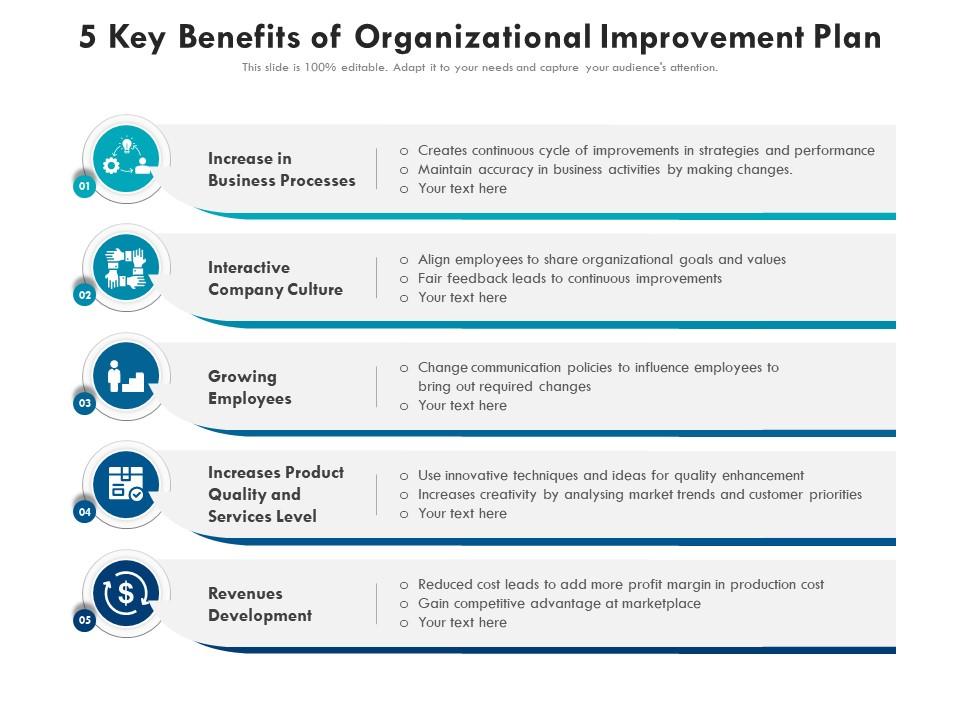
Introducing our premium set of slides with 5 Key Benefits Of Organizational Improvement Plan. Elucidate the five stages and present information using this PPT slide. This is a completely adaptable PowerPoint template design that can be used to interpret topics like Increase In Business Processes, Interactive Company Culture, Growing Employees, Increases Product Quality And Services Level, Revenues Development. So download instantly and tailor it with your information.

FAQs for 5 key benefits of

Key components of an effective Organizational Improvement Plan include clear performance metrics, stakeholder engagement strategies, resource allocation frameworks, timeline specifications, and accountability structures. These elements work together by establishing measurable objectives, securing leadership buy-in, and creating systematic implementation pathways, with many organizations finding that comprehensive plans ultimately deliver enhanced operational efficiency and sustainable competitive advantage.

Organizations can identify improvement areas through comprehensive data analysis, employee feedback surveys, performance metrics evaluation, customer satisfaction assessments, and operational audits. These diagnostic approaches enable businesses to pinpoint inefficiencies across departments, processes, and systems, with many companies finding that combining quantitative data with qualitative insights delivers the most actionable improvement strategies.

Employee feedback serves as a foundational data source for organizational improvement plans, providing insights into operational inefficiencies, process bottlenecks, workplace culture gaps, and customer service challenges that leadership might otherwise overlook. Through structured surveys, focus groups, and digital feedback platforms, organizations can identify specific improvement opportunities, prioritize resource allocation more effectively, and ensure proposed changes address real workplace needs, ultimately delivering higher employee engagement and sustainable operational enhancements.

Data analytics informs Organizational Improvement Plans by identifying performance gaps, predicting operational bottlenecks, and measuring initiative effectiveness through comprehensive metrics analysis. Through advanced analytics platforms, organizations streamline resource allocation, enhance employee productivity, and accelerate decision-making processes, with many companies finding that data-driven improvements deliver measurable ROI and sustainable competitive advantage.

Key metrics include employee engagement scores, productivity indicators, customer satisfaction ratings, financial performance measures, and process efficiency benchmarks. Organizations typically track these through quarterly surveys, operational dashboards, and performance reviews, with many finding that combining leading indicators like training completion rates with lagging indicators such as revenue growth delivers comprehensive insights into transformation success.

Leadership can support Organizational Improvement Plans by securing adequate resources, communicating clear vision and expectations, actively participating in training programs, and consistently modeling desired behaviors throughout implementation phases. Through transparent communication channels, regular progress reviews, and recognition of early adopters, leaders demonstrate commitment while building organizational buy-in, ultimately creating sustainable change momentum across all departments and operational levels.

Best practices include establishing clear communication channels, securing leadership commitment, implementing phased rollouts, providing comprehensive training, and monitoring progress through measurable metrics. These approaches streamline adoption by minimizing resistance, ensuring stakeholder alignment, and maintaining operational continuity, with many organizations finding that involving employees in the change process ultimately delivers higher success rates and sustainable improvements.

Cultural factors significantly influence Organizational Improvement Plans by affecting employee buy-in, communication patterns, resistance to change, and leadership receptivity across all organizational levels. Organizations with collaborative cultures, like those in progressive tech companies and forward-thinking healthcare systems, find that cultural alignment accelerates implementation timelines, enhances stakeholder engagement, and ultimately delivers sustained operational improvements and competitive advantage.

Effective communication strategies for organizational improvement plans include transparent leadership messaging, regular progress updates, two-way feedback channels, department-specific briefings, and celebrating early wins. These approaches enhance employee buy-in by addressing concerns proactively, maintaining momentum through visible progress tracking, and fostering collaboration, with many organizations finding that consistent, multi-channel communication significantly reduces resistance and accelerates implementation success.

Organizations ensure improvement initiatives align with business goals by establishing clear strategic frameworks, conducting regular alignment assessments, involving key stakeholders in planning processes, and implementing robust tracking mechanisms. Through systematic goal-setting and performance measurement, companies across sectors like manufacturing and healthcare streamline resource allocation, enhance operational efficiency, and accelerate decision-making, ultimately delivering measurable outcomes that support long-term competitive advantage.

Common pitfalls include lack of employee engagement, unrealistic timelines, insufficient resource allocation, poor communication strategies, and absence of measurable metrics. These challenges can derail improvement initiatives, with many organizations finding that addressing stakeholder concerns early, establishing clear accountability structures, and maintaining consistent leadership support ultimately delivers sustainable transformation and competitive advantage.

Cross-department collaboration can be facilitated through shared goal-setting, regular inter-departmental meetings, collaborative project teams, integrated communication platforms, and cross-functional training programs. These approaches streamline information flow, break down silos, and align diverse teams toward common objectives, with many organizations finding that structured collaboration frameworks ultimately enhance operational efficiency and accelerate improvement initiatives across all departments.

Training and development serves as the foundation for improvement plan execution by equipping employees with necessary skills, ensuring consistent implementation methodologies, and building organizational change capacity. Through targeted programs, companies enhance technical competencies, foster collaborative problem-solving abilities, and accelerate adoption rates, with many organizations finding that comprehensive training reduces resistance while ultimately delivering sustainable improvements and competitive advantage.

Organizations sustain improvements through continuous monitoring systems, regular performance reviews, employee training programs, leadership commitment, and adaptive management practices. These mechanisms enable companies to maintain momentum by embedding changes into organizational culture, adjusting strategies based on feedback, and ensuring accountability, with many finding that sustained leadership engagement and systematic measurement ultimately deliver lasting competitive advantage.

External factors to consider include market competition, regulatory changes, economic conditions, technological advancements, and industry trends. These elements significantly influence strategic planning by affecting resource allocation, compliance requirements, and competitive positioning, with many organizations finding that proactive assessment of external pressures ultimately delivers better adaptation strategies and sustainable growth.

Ratings and Reviews

90% of 100
Review Form
Write a review
Most Relevant Reviews
  1. 100%

    by Johnson Morris

    Visually stunning presentation, love the content.
  2. 100%

    by Edgardo Chapman

    Best way of representation of the topic.
  3. 80%

    by Smith Gomez

    Great product with effective design. Helped a lot in our corporate presentations. Easy to edit and stunning visuals.
  4. 80%

    by Columbus Vasquez

    Informative presentations that are easily editable.

4 Item(s)

per page: