5 level email marketing funnel
Try Before you Buy Download Free Sample Product
Audience
Editable
of Time
Corroborate your thoughts with our 5 Level Email Marketing Funnel. Convince the audience to go along.
People who downloaded this PowerPoint presentation also viewed the following :
Content of this Powerpoint Presentation
Description:
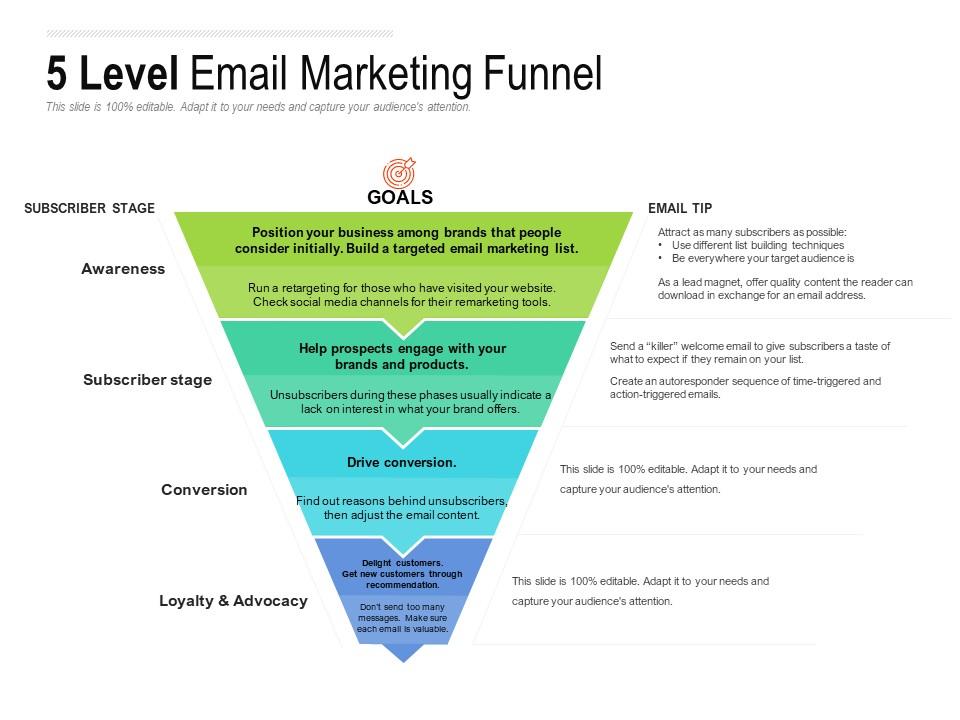
This image presents a slide from a presentation on the "5 Level Email Marketing Funnel," offering a strategic framework for managing email marketing campaigns across different stages of subscriber engagement.
The "GOALS" section is about positioning the business among brands that consumers initially consider and suggests building a targeted email marketing list. It stresses the importance of re-targeting those who have visited the website and leveraging social media for remarketing.
The "SUBSCRIBER STAGE" has four levels:
1. Awareness: It recommends re-targeting past website visitors and checking social media channels for remarketing tools.
2. Subscriber stage: Advising on ways to engage prospects with the brand and products to foster interest and avoid unsubscriptions.
3. The "Conversion" stage is about driving conversions and understanding why subscribers may opt out, adjusting email content accordingly.
4. Finally, "Loyalty & Advocacy" encourages delighting customers, earning new customers through recommendations, and being mindful of sending valuable emails without overwhelming subscribers.
The EMAIL TIP to the right provides additional guidance:
1. Attract as many subscribers as possible through various list-building techniques and presence where the audience is.
2. Offer quality content as a lead magnet.
3. Send a solid welcome email to set clear expectations.
4. Develop an autoresponder sequence with time-triggered and action-triggered emails for consistent engagement.
Use Cases:
This slide is applicable to various industries that engage in email marketing strategies:
1. E-commerce:
Use: Email marketing for customer acquisition and retention.
Presenter: Marketing manager
Audience: Marketing team
2. SaaS (Software as a Service):
Use: User engagement and feature updates.
Presenter: Customer success manager
Audience: Product users and subscribers
3. Retail:
Use: Promotions and loyalty program updates.
Presenter: Retail marketing director
Audience: Store managers and sales team
4. Finance:
Use: Service updates and financial advice distribution.
Presenter: Digital marketing strategist
Audience: Clients and investors
5. Travel & Tourism:
Use: Offer announcements and travel advisories.
Presenter: Marketing lead
Audience: Travel agents and potential clients
6. Real Estate:
Use: Property listings and market updates.
Presenter: Real estate agency marketer
Audience: Property buyers and sellers
7. Healthcare:
Use: Health tips and clinic service updates.
Presenter: Clinic marketing coordinator
Audience: Patients and healthcare partners
5 level email marketing funnel with all 2 slides:
Go at it eagerly with our 5 Level Email Marketing Funnel. Your enthusiasm will be contagious.
FAQs for 5 level
The five key stages include awareness building, interest nurturing, consideration guidance, conversion optimization, and retention enhancement. These stages work by attracting subscribers through valuable content, educating prospects about solutions, addressing specific pain points with targeted messaging, driving purchase decisions, and fostering long-term customer relationships, ultimately delivering higher engagement rates and increased revenue growth.
Personalized content enhances each funnel level by delivering targeted messaging based on subscriber behavior, preferences, and purchase history, creating more relevant experiences throughout their journey. This strategic approach increases open rates, click-through rates, and conversions at every stage, with many businesses finding that personalized emails generate significantly higher engagement and revenue compared to generic campaigns.
**INPUT**: What metrics should be tracked at each stage of the funnel to measure effectiveness? **OUTPUT**: Key metrics include open rates and click-through rates for awareness, engagement rates and social shares for interest, conversion rates and cost-per-lead for consideration, purchase conversion rates and average order value for intent, and customer lifetime value and retention rates for action. These metrics enable businesses to optimize each stage systematically, with many organizations finding that tracking these comprehensive indicators delivers enhanced campaign performance and ultimately stronger ROI across their entire marketing ecosystem. [Word count: 60]
Segmentation optimizes email marketing funnels by delivering personalized content based on subscriber behavior, demographics, purchase history, and engagement levels at each stage. Through targeted messaging, businesses enhance open rates, click-through rates, and conversions while reducing unsubscribes, with many organizations finding that segmented campaigns generate significantly higher revenue than broad, generic approaches.
Educational content emails, welcome series, industry insights, blog post newsletters, and thought leadership pieces are most effective at the awareness stage. These emails establish credibility by providing valuable information without aggressive selling, with many businesses finding that informative content builds trust and positions their brand as an industry authority, ultimately nurturing prospects toward deeper engagement.
Automation streamlines email funnels by triggering personalized messages based on subscriber behavior, segmenting audiences automatically, and scheduling campaigns across all five levels without manual intervention. Through sophisticated automation platforms, businesses deliver targeted awareness content, nurture leads with educational sequences, and convert prospects with precision timing, while reducing operational costs and enhancing customer experiences, ultimately enabling marketers to scale campaigns efficiently.
Subject line best practices vary by funnel stage, including personalization and curiosity for awareness, value-focused messaging for interest, urgency and social proof for consideration, clear benefit statements for intent, and retention-focused relationship building for loyalty. These approaches enhance open rates, engagement, and conversions by aligning messaging with subscriber mindset, with many marketers finding that stage-appropriate subject lines significantly improve campaign performance and customer journey progression.
Effectively nurturing consideration-stage leads involves delivering targeted educational content, personalized product comparisons, case studies from relevant industries, and strategic follow-up sequences that address specific pain points. Through automated email workflows, businesses streamline lead scoring, enhance engagement with tailored messaging, and accelerate decision-making timelines, with many organizations finding that strategic nurturing increases conversion rates while building stronger customer relationships.
Strategies to reduce drop-off rates include personalized content segmentation, behavioral trigger automation, strategic timing optimization, A/B testing of subject lines and calls-to-action, and progressive value delivery at each stage. These approaches enhance engagement by delivering relevant messaging, streamlining customer journey touchpoints, and maintaining consistent brand experience, with many organizations finding that targeted personalization and automated follow-up sequences significantly improve conversion rates and customer retention throughout their marketing funnels.
A/B testing is crucial for optimizing email marketing funnels, enabling marketers to refine subject lines, content timing, personalization strategies, and call-to-action effectiveness across all five stages. Through systematic testing, organizations can enhance open rates, click-through performance, and conversion outcomes, with many businesses finding that data-driven refinements significantly improve customer journey progression and ultimately deliver higher ROI.
Customer feedback plays a crucial role in optimizing email funnel stages by identifying friction points, revealing content preferences, and highlighting timing issues across awareness, consideration, and conversion phases. Through surveys, response analytics, and behavioral data, businesses can refine messaging strategies, improve segmentation accuracy, and enhance personalization, with many organizations finding that feedback-driven optimization increases conversion rates and reduces unsubscribe rates significantly.
Retargeting techniques integrate into email marketing funnels through pixel tracking, behavioral segmentation, abandoned cart sequences, dynamic content personalization, and cross-platform synchronization. These approaches enable marketers to deliver targeted messages based on website interactions, purchase history, and engagement patterns, ultimately recovering lost prospects while nurturing existing subscribers toward conversion with personalized, timely communications.
Email marketing funnel tools include HubSpot, Mailchimp, ActiveCampaign, Klaviyo, and ConvertKit, which provide comprehensive automation and analytics capabilities. These platforms streamline campaign management by offering visual workflow builders, segmentation features, and performance tracking, enabling businesses to optimize customer journeys, enhance engagement rates, and ultimately deliver higher conversion rates across all funnel stages.
Seasonal trends and holidays significantly impact email funnel strategies by creating opportunities for timely, relevant messaging that aligns with customer buying patterns, holiday shopping behaviors, and seasonal needs. Through strategic timing adjustments, personalized holiday content, and seasonal product positioning, businesses enhance open rates, conversion rates, and customer engagement, with many retail and e-commerce organizations finding that holiday-specific funnels deliver substantially higher ROI.
Common mistakes include sending generic content without segmentation, overwhelming subscribers with excessive emails, neglecting mobile optimization, ignoring analytics data, and failing to test subject lines. These errors undermine funnel effectiveness by reducing engagement rates, increasing unsubscribes, and missing conversion opportunities, with many businesses finding that personalized, measured approaches ultimately deliver higher ROI and stronger customer relationships.
No Reviews