

5 Steps Of A Data Science Project Lifecycle




Try Before you Buy Download Free Sample Product
 Impress Your
Audience
 100%
Editable
 Save Hours
of Time


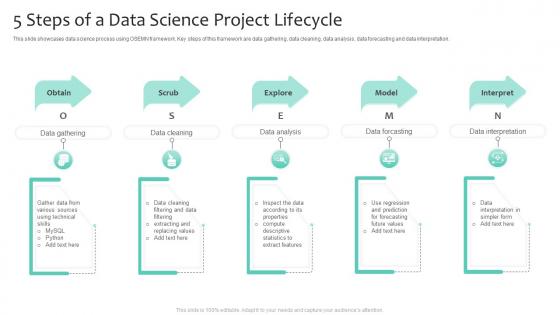
slide showcases data science process using OSEMN framework. Key steps of this framework are data gathering, data cleaning, data analysis, data forecasting and data interpretation.
People who downloaded this PowerPoint presentation also viewed the following :
5 Steps Of A Data Science Project Lifecycle with all 6 slides:
Use our 5 Steps Of A Data Science Project Lifecycle to effectively help you save your valuable time. They are readymade to fit into any presentation structure.





FAQs for 5 Steps Of A Data
The traditional data science project lifecycle includes problem definition, data collection and preparation, exploratory data analysis, model development and validation, deployment, and monitoring. These stages streamline project execution by establishing clear objectives, ensuring data quality, and enabling systematic model development, with many organizations finding that following this structured approach ultimately delivers more reliable insights and measurable business outcomes.
Effectively defining a data science problem statement requires clearly articulating the business objective, identifying specific metrics for success, understanding stakeholder requirements, and determining data constraints and available resources. This strategic foundation enables teams to align technical approaches with business goals, select appropriate methodologies, and establish realistic timelines, ultimately delivering measurable value and preventing scope creep throughout the project lifecycle.
Data collection serves as the foundation for project success by determining data quality, scope, and analytical possibilities, directly impacting model accuracy and business insights. Effective collection strategies enable organizations to build robust predictive models, minimize bias, and deliver actionable results, with many companies finding that comprehensive data gathering ultimately streamlines analysis phases and enhances competitive advantage.
Data preprocessing significantly impacts model accuracy by cleaning inconsistent data, handling missing values, normalizing features, removing outliers, and encoding categorical variables properly. These steps enhance data quality and ensure algorithms can identify meaningful patterns, with many organizations finding that thorough preprocessing improves model performance by 20-30%, ultimately delivering more reliable predictions and better business outcomes.
Common challenges during exploratory data analysis include handling missing or inconsistent data, identifying relevant patterns among numerous variables, managing large dataset volumes, dealing with data quality issues, and determining which features significantly impact outcomes. These obstacles often require iterative approaches, advanced visualization techniques, and domain expertise collaboration, with many organizations finding that investing in robust data preparation tools and cross-functional teams ultimately streamlines analysis workflows and accelerates project timelines.
Stakeholders can be engaged through regular communication touchpoints, collaborative requirement gathering, iterative feedback sessions, transparent progress reporting, and joint validation of outcomes at each lifecycle phase. This strategic involvement ensures alignment between business objectives and technical deliverables, with many organizations finding that continuous stakeholder engagement significantly reduces project risks, accelerates decision-making, and ultimately delivers more impactful data-driven solutions.
Feature selection techniques include filter methods, wrapper methods, embedded methods, univariate selection, and recursive feature elimination. These approaches streamline model performance by removing irrelevant variables, reducing overfitting, and improving computational efficiency, with many data science teams finding that strategic feature selection ultimately delivers more accurate predictions and faster model training across diverse industries.
Determining the right model involves evaluating your data type, project objectives, performance requirements, and computational constraints through systematic experimentation with multiple algorithms. Start with simpler models like linear regression or decision trees, then progress to complex ensemble methods or neural networks, with many organizations finding that cross-validation testing and business impact metrics ultimately guide optimal selection.
Model evaluation metrics vary significantly across industries, with healthcare prioritizing sensitivity and specificity for diagnostics, financial services emphasizing precision for fraud detection, and retail focusing on recall for recommendation systems. These sector-specific requirements reflect different risk tolerances and business objectives, with many organizations finding that combining multiple metrics delivers more comprehensive performance assessment, ultimately ensuring models align with strategic goals and regulatory compliance standards.
Best practices for deploying data science models include containerization, automated testing, version control, monitoring systems, and gradual rollout strategies. These approaches streamline deployment by ensuring reproducibility, maintaining model performance tracking, and enabling quick rollbacks when needed, with many organizations finding that robust deployment pipelines ultimately deliver faster iterations and more reliable business outcomes.
Model maintenance requires continuous monitoring of performance metrics, data drift detection, and regular retraining schedules to ensure accuracy over time. Organizations should establish automated pipelines for model updates, version control systems, and rollback procedures, with many financial institutions and healthcare providers finding that proactive maintenance reduces operational risks while maintaining competitive advantage through reliable predictions.
Effective communication strategies include visual storytelling through charts and infographics, translating technical metrics into business outcomes, creating executive summaries with actionable insights, and using analogies to explain complex concepts. These approaches streamline decision-making by focusing on ROI impact, operational implications, and strategic recommendations, with many organizations finding that clear data narratives ultimately enhance stakeholder buy-in and accelerate project implementation across departments.
Documentation significantly influences reproducibility by providing clear records of data sources, preprocessing steps, model parameters, analytical decisions, and environmental configurations. Through comprehensive documentation, data scientists can recreate experiments, validate findings, and build upon previous work, while stakeholders gain transparency into methodologies, ultimately enabling knowledge transfer and ensuring consistent results across teams and time periods.
Ethical considerations include data privacy protection, algorithmic bias mitigation, transparent model decision-making, informed consent protocols, and equitable outcome distribution. These frameworks enhance organizational trust by ensuring responsible data collection, fair predictive modeling, and accountable AI deployment, with many financial services and healthcare institutions finding that proactive ethical governance ultimately delivers sustainable competitive advantage and regulatory compliance.
Feedback loops can be integrated through automated model monitoring, regular stakeholder reviews, performance metric tracking, user experience analysis, and iterative model retraining. These mechanisms enable data science teams to continuously refine algorithms, adjust parameters, and enhance accuracy, with many organizations finding that systematic feedback integration delivers improved model performance, faster issue resolution, and sustained competitive advantage.
-
Understandable and informative presentation.
-
Wide collection of templates available. SlideTeam has made it easier to create presentations in just a few minutes.