5 steps problem solving process powerpoint presentation

Rating:
80%
5 steps problem solving process powerpoint presentation
Slide 1 of 5
Favourites Favourites

Try Before you Buy Download Free Sample Product

Audience Impress Your
Audience
Editable 100%
Editable
Time Save Hours
of Time
The Biggest Sale is ending soon in
0
0
:
0
0
:
0
0
Rating:
80%
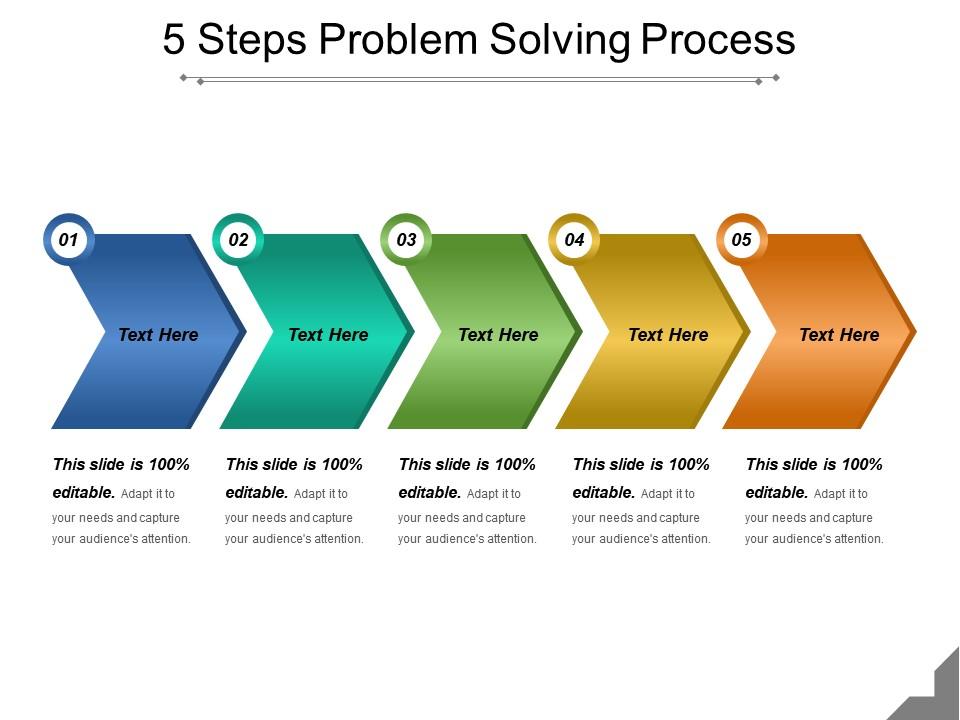
Presenting our well designed 5 steps problem-solving process PowerPoint Presentation example template design deck. The content is entirely relevant to the subject and is flexible. Reform into a pdf and a jpg format with ease. Adaptable framework with color, layout, and font size, type and text to be personalized. Execute comparisons and incorporate your data to illustrate the theory. This deck is appropriate for different students, aspiring professionals, business professional, corporate people, entrepreneurs, and researchers. Specialists can portray their business development plans through this format with ease. Congenial with Google Slides and widescreen friendly forecasts.

FAQs for 5 steps problem solving

The problem-solving process includes problem identification, analysis and research, solution generation, evaluation and selection, and implementation with monitoring. These stages streamline decision-making by ensuring thorough understanding, exploring multiple alternatives, and measuring outcomes, with many organizations finding that structured approaches significantly enhance operational efficiency and strategic results.

Effectively defining problems requires gathering comprehensive data, identifying root causes rather than symptoms, engaging relevant stakeholders for diverse perspectives, and clearly articulating the problem's scope and impact. This systematic approach enables organizations across sectors like healthcare and manufacturing to avoid costly misdiagnosed solutions, with many finding that thorough problem definition reduces solution implementation time by up to fifty percent.

Critical thinking serves as the foundation of effective problem-solving by enabling systematic analysis, objective evaluation of evidence, and identification of assumptions and biases. Through critical thinking, organizations enhance decision-making accuracy, minimize costly errors, and develop more innovative solutions, with many companies finding that teams trained in critical analysis deliver faster resolution times and ultimately gain competitive advantage in increasingly complex business environments.

Effective brainstorming techniques include mind mapping, brainwriting, the Six Thinking Hats method, SCAMPER analysis, and reverse brainstorming. These approaches enhance creative problem-solving by encouraging diverse perspectives, structured ideation, and collaborative input, with many organizations finding that combining multiple techniques generates more innovative solutions and accelerates decision-making processes.

Visual aids like flowcharts and mind maps enhance problem-solving by organizing complex information, clarifying relationships between variables, and enabling systematic analysis of potential solutions. These tools streamline collaboration across teams, facilitate faster identification of root causes and bottlenecks, and improve decision-making accuracy, with many organizations finding that visual problem-solving approaches reduce resolution time significantly.

Feasibility evaluation strategies include cost-benefit analysis, risk assessment, resource requirement mapping, timeline analysis, and stakeholder impact evaluation. These approaches enable organizations to systematically compare solutions by examining financial viability, implementation complexity, and strategic alignment, with many businesses finding that comprehensive feasibility frameworks ultimately streamline decision-making and minimize project failures.

Prioritize solutions by evaluating feasibility, resource requirements, timeline, potential impact, and alignment with strategic objectives. Consider implementation complexity, stakeholder buy-in, and risk factors while assessing cost-benefit ratios. Many organizations find that creating scoring matrices helps streamline decision-making, ultimately enabling faster execution and better resource allocation for maximum competitive advantage.

Gathering data and evidence provides objective foundation for accurate problem diagnosis, eliminates assumptions and biases, and enables evidence-based decision making throughout the problem-solving process. This systematic approach helps organizations identify root causes rather than symptoms, measure solution effectiveness, and build stakeholder confidence, with many businesses finding that data-driven problem solving delivers faster resolutions and sustainable outcomes.

Collaboration and teamwork enhance problem-solving outcomes by bringing diverse perspectives, specialized expertise, and complementary skills to complex challenges. Through cross-functional teams, organizations leverage collective knowledge, accelerate solution development, and minimize blind spots, with many companies finding that collaborative approaches deliver more innovative solutions, faster implementation, and ultimately stronger competitive advantage.

Common pitfalls include rushing to solutions without proper analysis, making assumptions instead of gathering data, focusing on symptoms rather than root causes, and working in isolation without stakeholder input. These mistakes often lead to incomplete solutions that resurface later, with many organizations finding that structured problem-solving frameworks and cross-functional collaboration significantly reduce these risks while delivering more sustainable outcomes.

Assessing solution effectiveness involves tracking key performance indicators, comparing pre and post-implementation metrics, gathering stakeholder feedback, and monitoring long-term outcomes against original objectives. Organizations typically measure success through cost reduction, time savings, error rates, and user satisfaction, with many finding that regular assessment cycles enable continuous improvement and help identify areas requiring further optimization for sustained competitive advantage.

Business problem-solving tools include data analytics platforms, project management software, decision trees, root cause analysis templates, and collaborative brainstorming applications. These technologies streamline problem identification, solution development, and implementation tracking by centralizing information, facilitating team collaboration, and providing structured frameworks, with many organizations finding that integrated software suites ultimately deliver faster resolution times and more strategic outcomes.

Feedback integration occurs through structured review sessions, post-solution analysis, stakeholder input collection, and performance metric tracking throughout each problem-solving phase. Organizations increasingly embed feedback loops at decision points, solution implementation stages, and outcome evaluations, with many finding that systematic feedback collection enhances future problem-solving accuracy and accelerates organizational learning.

Creativity during solution generation can be fostered through brainstorming sessions, diverse team collaboration, mind mapping, role-playing exercises, and encouraging unconventional thinking approaches. These methods enhance innovation by removing judgment barriers, incorporating varied perspectives, and creating safe spaces for experimentation, with many organizations finding that structured creative processes ultimately deliver breakthrough solutions and competitive advantages.

Cultural differences significantly impact problem-solving approaches through varying communication styles, decision-making processes, risk tolerance levels, and hierarchical expectations within diverse teams. While Western teams often emphasize direct communication and individual accountability, many Asian and Latin American cultures prioritize consensus-building and collective responsibility, ultimately requiring strategic integration of these approaches to enhance team effectiveness and deliver comprehensive solutions.

Ratings and Reviews

80% of 100
Review Form
Write a review
Most Relevant Reviews
  1. 80%

    by Charlie Jones

    Excellent work done on template design and graphics.
  2. 80%

    by Danny Kennedy

    Excellent Designs.

2 Item(s)

per page: