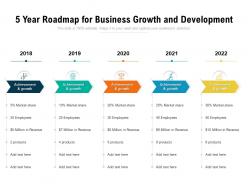
5 year roadmap for business growth and development
Try Before you Buy Download Free Sample Product
Audience
Editable
of Time
A well thought out action plan makes execution easier and increases the possibility of success significantly. Ensure hitting all the milestones within the deadlines by introducing our fully customizable 5 Year Roadmap For Business Growth And Development. Streamline the work related information, budget, timeframe, key deliverable, landmarks, and major steps involved, all in one place to give an organized overview of the project by utilizing our PowerPoint theme. Minimize time lag and increase work efficiency by providing insight into the process with our comprehensively researched roadmap PowerPoint layout. Color coding helps in highlighting the process and grabs the attention of the audience. Download our handy 5 Year Roadmap For Business Growth And Development to identify the possible problem areas in a much shorter time and propose solutions. Have a productive brainstorming session with your workforce by utilizing our action plan visualization tool.
People who downloaded this PowerPoint presentation also viewed the following :
5 year roadmap for business growth and development with all 2 slides:
Use our 5 Year Roadmap For Business Growth And Development to effectively help you save your valuable time. They are readymade to fit into any presentation structure.
FAQs for 5 year roadmap for business
Honestly, most people completely skip market analysis and just wing it - huge mistake. You need that plus a clear target audience and solid financial planning. Competitive positioning matters too. Pick specific channels for getting customers, whether that's social media, partnerships, whatever works for your thing. Oh and set up measurable growth metrics so you're not just guessing if it's working. The tricky part is making sure everything actually connects to your main business goals instead of just doing random stuff. My advice? Don't try tackling everything at once. Focus on maybe 2-3 things first, then build from there.
Market research shows you where the money actually is and how to grab it. You can spot which customer segments are growing, what they'll pay for, and where competitors are screwing up. Think of it like GPS for your growth plan instead of wandering around hoping to stumble onto customers. The data helps you figure out which products to build first, what markets to tackle, and how much cash to throw at each thing. Otherwise you're just throwing darts with your eyes closed - which honestly never works out well. Start by surveying your current customers about what they still need.
Look, customer feedback is gold - it shows you what's actually working versus what's falling flat. Use it to spot new opportunities and figure out which features to build next. I swear, half the companies I know just wing it instead of asking customers what they want (drives me crazy). Feedback also reveals why people are leaving and where you might expand. Oh, and churning customers? They'll tell you exactly what went wrong if you ask. Set up surveys, do quick calls, whatever works. Just make sure you actually do something with what you hear - otherwise it's pointless.
So diversifying is basically about not putting all your eggs in one basket, you know? When one product tanks, others can pick up the slack. Opens doors to new customers too. But here's the thing - I've watched companies get way too excited and try launching like five different things at once. Total disaster. You end up sucking at everything instead of being great at something. Smart move is checking what your existing customers are already buying elsewhere that you could offer. Way easier than starting from scratch with random stuff. Done right though, it makes your business way more stable when markets go crazy.
Honestly, just pick 2-3 things max and go deep on those. Look at ROI first, then what your team can actually handle without burning out. Market timing matters too but don't overthink it. Most companies I've worked with try doing everything at once - total disaster every time. Better to nail a few priorities that match what you're already good at. Quick wins are great for momentum, but you need some longer plays too. Map it out, stick to the plan, and resist shiny object syndrome. Your customers will thank you for actually finishing stuff instead of half-assing ten different projects.
Honestly, I'd start by stalking your competitors a bit—see what they're missing. Check out customer reviews and complaints too. Social media is like a goldmine for this stuff; people constantly vent about what they wish existed. Survey your current customers about other problems they deal with (you'd be surprised what comes up). Look for bigger shifts happening—new tech, changing demographics, even new regulations that might create gaps. Oh, and here's the thing everyone skips: test your ideas small before going all in. Run a pilot or something basic first. You don't want to build something nobody actually wants to buy.
Dude, digital marketing is such a game-changer for growing your business. You can reach tons more people without spending crazy money on traditional ads. The targeting is insane - you'll hit exactly who you want, track what's actually working, and pivot fast. Can't do that with a billboard, right? Content and social media let you build real relationships at scale, which honestly beats cold outreach every time. Oh, and don't try to be everywhere at once - that's exhausting. Pick one or two platforms where your people actually spend time, then go all-in on whatever's crushing it.
Honestly, focus on the money stuff first - revenue growth is obvious, but CAC and LTV are where you'll actually see if you're making smart moves. The LTV to CAC ratio is everything. Customer retention and NPS scores matter too because who cares about growth if everyone bails after month one? Track some operational metrics like cash flow and maybe employee productivity (though that one's tricky to measure). My advice? Pick maybe 4 metrics max that actually relate to your goals. I used to try tracking like 10 different things and it was just noise.
Partnerships are honestly a game-changer for growth. You get instant access to their customer base, distribution channels, whatever - stuff that would take you forever to build yourself. The costs and risks get split too, which is huge when money's tight. I always tell people to look for companies that have what you need but aren't direct competitors. Like maybe they've got the tech expertise and you bring the marketing muscle. First step? Figure out your biggest gaps, then hunt for businesses that already crush those areas. They might need exactly what you're good at.
Cash flow will hit you first - always does. Then you'll scramble to find good people quickly enough, which is honestly harder than it sounds. Your systems that worked perfectly with 10 employees? They'll completely fall apart at 50. I've watched this kill otherwise solid companies. Culture gets weird when you're hiring fast, and quality control becomes this whole thing. Oh, and everything costs way more than you budget for. Start writing down your processes now and save some extra cash. Document the boring stuff while it's still manageable - you'll thank yourself later.
You need systems where quick wins actually build toward your bigger picture. Find fast revenue that doesn't mess with your main vision - like tweaking current products while putting those profits into new R&D. Honestly, I've watched way too many companies get obsessed with quarterly reports and completely lose direction. Set aside a fixed chunk of profits for long-term stuff, period. Don't touch it when things get tight. Track both your immediate numbers and future-focused work. Map out which short-term moves actually connect to where you want to be in 3-5 years.
Honestly, training is like your secret weapon for growth. Your team needs the right skills when you're scaling up or launching new stuff - otherwise they're just winging it. I've watched companies skip this step and it's brutal. Confused employees, everything falls apart, missed chances left and right. Plus people actually stick around longer when you invest in them (which saves you money on hiring, btw). Figure out what skills gaps you'll have based on your growth plans, then build training around those specific needs. Short bursts work better than marathon sessions too.
Honestly, most companies just hoard data without doing anything useful with it. Pick 3-4 metrics that actually move the needle - customer acquisition cost, lifetime value, conversion rates. Then dig into where people are dropping off in your funnel. I can't tell you how many dashboards I've seen that nobody looks at after the first week! Segment your customers based on how they behave, then personalize their experience. Predictive stuff is great too - you can catch people before they churn. Track your key numbers religiously and let them tell you what to do next.
Start with your numbers - revenue, growth rate, projections with real math backing them up. Market size matters, but focus on what slice you can actually grab. Your competitive edge and how you'll spend their cash are huge too. Honestly? Most pitches are total fantasy, so being realistic makes you memorable. Team credentials, industry-specific metrics, exit plan - cover all that. Oh and practice like crazy because they will grill you. I've seen good ideas tank just because someone couldn't handle the follow-up questions.
Honestly, good branding is like a cheat code for business growth. People spot you instantly and trust you way faster than competitors. Even lets you charge more sometimes - wild but true. Your marketing hits harder because you're not explaining who you are from scratch every single time. Word-of-mouth works better too since customers can actually describe what makes you special. Better talent wants to work with you, partnerships come easier. I'd focus on getting your core message and visuals locked down first - that's where the magic starts.
No Reviews