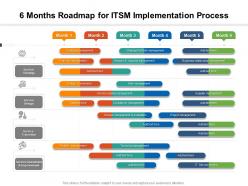
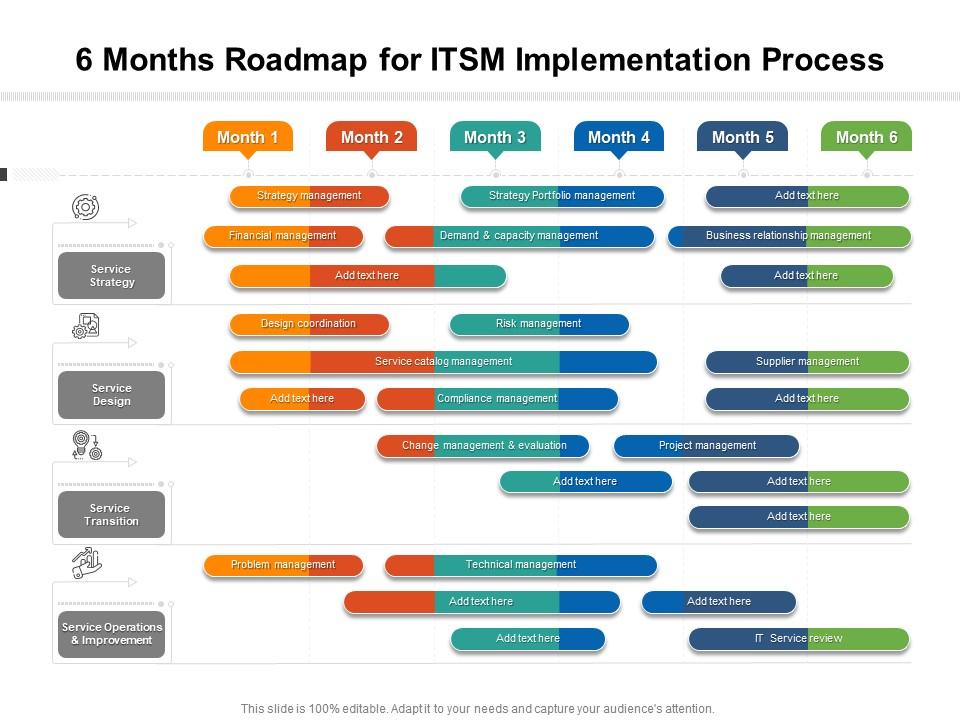
6 months roadmap for itsm implementation process
Try Before you Buy Download Free Sample Product
Audience
Editable
of Time
A cohesive work plan is essential for achieving the desired target. Communicate your vision and lay a firm ground in front of your audience with our PowerPoint layout. Align your project milestones, budgets, deliverables, deadlines, and all the requisite information for a dynamic presentation by employing this amazingly designed 6 Months Roadmap For ITSM Implementation Process. Maximize team efficiency and streamline a work plan efficiently by introducing our ready made roadmap PowerPoint theme. You can quickly establish coordination between different activities across the organization and present an insight to your colleagues by utilizing this useful business tool. Color code specific tasks, prioritize, and keep a close eye on the deadlines with the help of our eye catchy PowerPoint template. Download our 6 Months Roadmap For ITSM Implementation Process for excelling at productive management.
People who downloaded this PowerPoint presentation also viewed the following :
6 months roadmap for itsm implementation process with all 2 slides:
Use our 6 Months Roadmap For ITSM Implementation Process to effectively help you save your valuable time. They are readymade to fit into any presentation structure.
FAQs for 6 months roadmap for
So there are five main phases: Assessment, Planning, Design, Implementation, and Optimization. First you evaluate where you're at and spot the gaps. Then plan your approach and design new processes. Implementation is honestly the messiest part - that's when you're actually rolling out tools and training people. Always takes way longer than you think it will, just saying. After that you optimize based on what's really working (not what you hoped would work). Breaking everything into smaller milestones helps a ton. You can actually see progress instead of feeling stuck forever.
Start with an ITSM maturity assessment - basically rate your incident, change, and problem management processes on a 1-5 scale from "total chaos" to "well-oiled machine." Check if your processes are actually documented and if people follow them consistently. Here's the thing though - every organization I've seen thinks they're way more mature than reality shows! Get brutally honest feedback from your IT team AND end users about what's broken. Where do things fall apart? What makes people want to scream? This reality check will show you exactly which areas are dumpster fires that need fixing first. Way better than guessing what needs work.
Honestly, stakeholders can make or break your whole ITSM project. I've watched too many implementations fail because someone skipped this part. You'll need them for gathering requirements and getting people on board with changes. They're the ones who actually know what the business needs (versus what IT thinks it needs, you know?). Map out your key players right at the start. Keep them in the loop with regular demos and check-ins. Trust me - their feedback throughout the process is worth its weight in gold. Without them backing you up, good luck getting anyone to adopt your new system.
Honestly, mixing frameworks is the way to go for ITSM. Start with ITIL for your service management basics - it's solid. COBIT's great for governance stuff but yeah, it's dense as hell at first. Don't try cramming everything in at once though. Pick maybe 2-3 that actually solve your current headaches. Lean/Six Sigma cuts out the BS processes, Agile keeps things flexible. DevOps is clutch for getting dev and ops teams talking to each other instead of throwing things over the fence. Once you've got those down, then add more. Way less painful that route.
Definitely split up your training by role - admins and regular users need totally different stuff. Skip the boring PowerPoint marathons and do hands-on workshops instead. People learn way better when they're actually clicking around in the system. Build a practice environment where everyone can mess around without worrying about breaking anything important. Find your super users early too - they'll become lifesavers once you go live. Oh, and schedule follow-up sessions like a month later. That's when people have real questions from actually using it daily, not just hypothetical scenarios.
Oh man, biggest mistake? Trying to roll out everything at once - total nightmare. Pick one thing like incident management and nail that first. Also, and I can't stress this enough, actually talk to the people who'll be using it. I've watched so many projects die because IT just picked whatever looked shiny without asking anyone. Get some exec backing that's real, not just lip service. Change management isn't sexy but skip it and you're screwed. Quick wins build momentum way better than some massive rollout that takes forever.
Honestly, figure out your success metrics before you start anything - learned this the hard way on my last project. Measure where you're at now: ticket times, user satisfaction scores, system downtime. Then set realistic targets like cutting resolution time by 30% or bumping satisfaction from 6/10 to 8/10 in six months. Track operational stuff too - adoption rates, compliance, cost per ticket. Just make sure you can actually measure this with whatever tools you've got, otherwise you're flying blind. The baseline data is way more important than people think.
So first thing - get a solid ITSM platform sorted. ServiceNow, Remedy, Jira Service Management, whatever fits your budget. That's your backbone for tickets and workflows. You'll also need monitoring stuff like Nagios or SolarWinds, plus asset management and knowledge bases. Oh, and make sure everything actually talks to each other - APIs are your friend here. Honestly though? Size matters a ton when picking tools. Don't just grab what everyone else uses. Map out what you're actually doing first, then find tools that work with your processes instead of against them. Also reporting is boring but you'll need it to show you're not just burning money.
Don't treat change management like some side project you'll figure out later. Map out your stakeholders first and actually understand what they're worried about. Communication plans for each milestone are huge - I learned this the hard way watching projects crash and burn. People need to know "what's in it for me" right from the start, not weeks into rollout. Schedule feedback sessions and training alongside your technical work. Honestly, resistance is going to happen so plan checkpoints to catch it early. Run change activities parallel to everything else with clear owners tracking adoption metrics.
Start with regular check-ins with your team and users - that's where the real gold is. Monthly KPI reviews help, but honestly? Your agents know what's actually broken since they're in the trenches every day. Listen to them first. Set up feedback loops with stakeholders and do quarterly business reviews to catch bigger issues. Oh, and don't go crazy trying to fix everything at once - I've seen that backfire. Pick what's hurting users most or hitting the business hardest. Trends matter way more than one-off metrics anyway.
Look, if your ITSM processes aren't tied to what the business actually wants to accomplish, you're basically just running an expensive help desk that leadership ignores. I've seen this happen way too many times. You want stakeholders to care about what you're doing? Show them how your IT work connects to their goals. That's how you get buy-in and real budget allocation. Plus it makes prioritizing so much easier - you know which processes to tackle first. The metrics become meaningful too, not just "we closed 500 tickets this month" nonsense that executives tune out. Map your business goals to specific ITSM outcomes first.
So here's what worked for us - get cross-functional teams set up right away with people from IT, HR, facilities, whoever. Don't wait. Working sessions beat formal meetings every time (seriously, order pizza). Share your wins publicly and be honest about what's not working. People stop pointing fingers when they feel like they're actually part of the solution. Oh, and document everything in one spot - scattered info kills momentum. Set up shared channels so communication flows naturally. The whole thing falls apart if collaboration feels forced, so give teams real reasons to work together and make a big deal when they do.
Dude, automation is a game-changer for ITSM rollouts. It knocks out all the boring stuff - data migrations, user setups, configuration tasks that'd normally take your team weeks. Manual processes are such a pain because someone always fat-fingers something important. You can automate workflow builds and system integrations way faster than doing it by hand. Honestly, the automated testing alone is worth it since it catches problems before they blow up. Your people get to work on actual strategy instead of mindlessly clicking through setup screens all day. I'd start with whatever manual tasks are eating up the most time.
Get feedback channels going ASAP - surveys, focus groups, whatever works. Make it super simple for people to tell you what sucks. Weekly check-ins beat monthly ones because you can actually fix stuff before it's too late. Your most vocal users? Start there. They'll roast you honestly, which is gold. Here's the thing though - don't just collect feedback and ignore it. Show people what you changed based on their complaints. I swear this builds way more trust than you'd think. Creates this whole loop where they stay engaged instead of ghosting you.
Keep it simple with flowcharts and step-by-step stuff people can actually use. Put everything in one central spot - wiki or knowledge base works great. Seriously, I've watched teams spend weeks creating gorgeous docs that just die in some random SharePoint folder nobody visits. Include decision points and escalation paths, plus common fixes for when things go sideways. Oh, and treat it like it's alive - assign owners to different sections and review regularly. Otherwise it'll get stale fast and you're back to square one.
-
Attractive design and informative presentation.