Achieving economic sustainability for business environment

Achieving economic sustainability for business environment
Slide 1 of 2

or

Favourites Favourites

Try Before you Buy Download Free Sample Product

Audience Impress Your
Audience
Editable 100%
Editable
Time Save Hours
of Time
The Biggest Sale is ending soon in
0
0
:
0
0
:
0
0
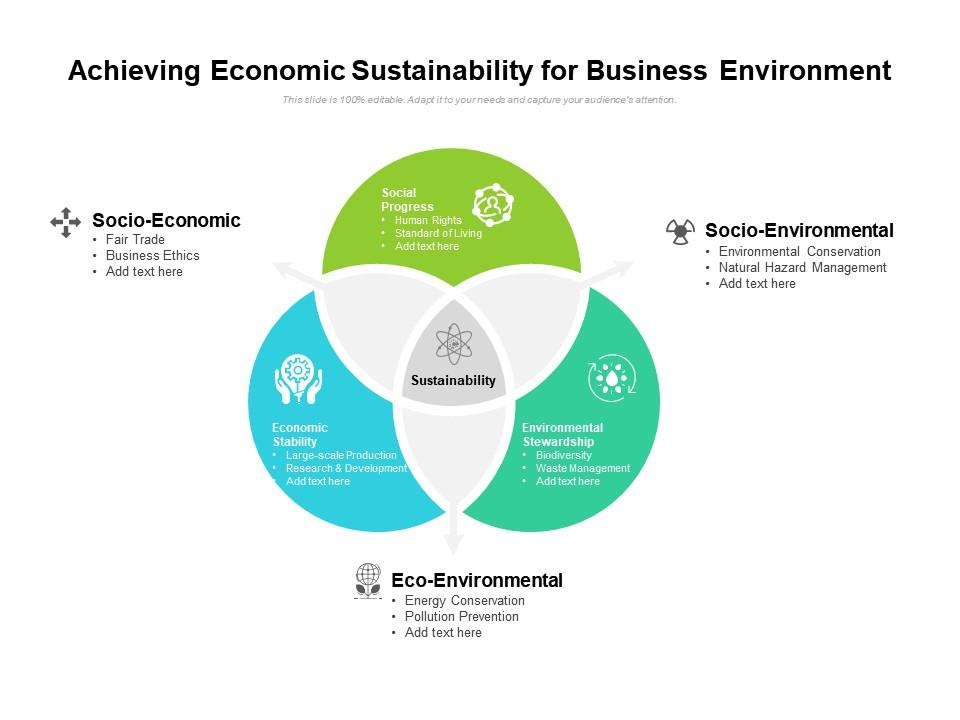
Presenting this set of slides with name Achieving Economic Sustainability For Business Environment. This is a three stage process. The stages in this process are Socio Economic, Socio Environmental, Sustainability, Social Progress, Business Ethics. This is a completely editable PowerPoint presentation and is available for immediate download. Download now and impress your audience.

FAQs for Achieving economic sustainability

Economic sustainability principles include resource efficiency, long-term value creation, circular economy practices, stakeholder capitalism, and responsible growth strategies. These approaches enable organizations to balance profitability with environmental stewardship and social responsibility, with many companies in manufacturing, retail, and financial services finding that sustainable practices ultimately reduce costs, enhance brand reputation, and deliver competitive advantage.

Businesses achieve this balance by integrating circular economy principles, investing in energy-efficient technologies, and adopting sustainable supply chain management practices. These approaches streamline operations while reducing environmental impact, with many organizations finding that renewable energy adoption, waste reduction programs, and green product development ultimately deliver cost savings, enhanced brand reputation, and competitive advantage in increasingly eco-conscious markets.

Policy-making drives economic sustainability through regulatory frameworks, incentive structures, tax policies, investment strategies, and resource allocation guidelines that balance growth with environmental stewardship. These governmental approaches enable nations to streamline sustainable practices across industries like manufacturing, energy, and agriculture, while ultimately delivering competitive advantages, reduced long-term costs, and enhanced economic resilience.

Renewable energy sources contribute to long-term economic sustainability by reducing operational costs, creating jobs, and minimizing dependence on volatile fossil fuel markets. Through solar, wind, and hydroelectric technologies, organizations streamline energy expenses, enhance energy security, and attract environmentally conscious consumers, with many manufacturing and retail companies finding that renewable investments deliver competitive advantage and improved profit margins.

Economic sustainability drives job creation by fostering stable industries, promoting green technologies, and encouraging long-term business investments that require skilled workforces. Through renewable energy projects, sustainable manufacturing, and circular economy initiatives, organizations create diverse employment opportunities while developing training programs, ultimately delivering enhanced worker skills and competitive advantage in an increasingly sustainability-focused market.

Companies can measure their economic sustainability performance through financial metrics like return on investment and cost savings, resource efficiency indicators, stakeholder value assessments, and long-term profitability analysis. These measurement frameworks enable organizations to track operational efficiency, identify improvement opportunities, and demonstrate value to investors, with many finding that comprehensive sustainability metrics ultimately deliver enhanced competitive advantage and stronger market positioning.

Small businesses face financial constraints, limited resources for sustainability initiatives, lack of expertise in green technologies, and difficulty accessing affordable sustainable suppliers when adopting economic sustainability practices. While these challenges present barriers, many small enterprises find that strategic partnerships, government incentives, and phased implementation approaches enable them to streamline operations, reduce long-term costs, and ultimately gain competitive advantage in increasingly environmentally-conscious markets.

International trade policies can significantly impact economic sustainability through tariff structures, environmental standards, labor protections, and resource management regulations that either incentivize or discourage sustainable practices. While restrictive policies may hinder short-term growth, strategic trade agreements increasingly incorporate sustainability clauses, with many countries finding that green trade initiatives ultimately deliver competitive advantages, enhanced supply chain resilience, and access to emerging sustainable markets.

Economic sustainability and social equity are interconnected, as sustainable economic practices require inclusive growth, fair resource distribution, and equal access to opportunities across all population segments. This relationship creates mutual reinforcement, where equitable policies enhance long-term economic stability, while sustainable economic frameworks enable broader social mobility, ultimately delivering resilient communities and competitive advantages for organizations prioritizing inclusive business models.

Technology innovation drives economic sustainability by automating resource management, enabling circular economy models, and optimizing supply chains through AI, IoT sensors, and blockchain systems. These technologies streamline operations while reducing waste, with manufacturing companies and retail organizations finding that predictive analytics and smart systems deliver significant cost reductions, enhanced efficiency, and competitive advantage in increasingly resource-conscious markets.

Strategies include circular business models, green financing initiatives, impact measurement frameworks, stakeholder collaboration networks, and resource-efficient operations. These approaches enable entrepreneurs to generate profits while addressing environmental challenges, with many startups in renewable energy, sustainable agriculture, and waste management finding that combining purpose with performance ultimately delivers competitive advantage and long-term viability.

Consumer demand significantly influences corporate economic sustainability commitments by driving purchasing decisions, brand loyalty, and market positioning requirements that directly impact revenue streams. Companies increasingly recognize that sustainable practices attract environmentally conscious consumers, reduce operational costs through efficiency improvements, and create competitive advantages, with many retailers, manufacturers, and service providers finding that sustainability initiatives enhance customer retention while delivering long-term profitability.

Climate change presents both significant risks and transformative opportunities for global economic sustainability, including increased infrastructure costs, supply chain disruptions, resource scarcity, shifting labor markets, and demand for green technologies. These challenges ultimately drive innovation in renewable energy, sustainable agriculture, and climate-resilient infrastructure, with many financial institutions finding that early adaptation delivers competitive advantage and long-term operational efficiency.

Financial institutions incorporate sustainability through ESG screening, impact investing, sustainable lending practices, climate risk assessments, and green bond financing. These approaches enable banks and investment firms to evaluate environmental impacts, social responsibility, and governance standards alongside traditional financial metrics, ultimately delivering competitive returns while supporting responsible growth and meeting increasing regulatory requirements.

Leading countries demonstrate that economic sustainability requires diversified renewable energy investments, circular economy policies, green technology innovation, and strategic public-private partnerships. Nations like Denmark, Singapore, and Germany show that early adoption of sustainable practices, combined with robust regulatory frameworks and stakeholder engagement, ultimately delivers competitive advantages, job creation, and resilient economic growth while attracting international investment.

Ratings and Reviews

0% of 100
Review Form
Write a review
Most Relevant Reviews

No Reviews