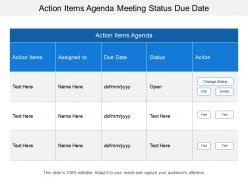
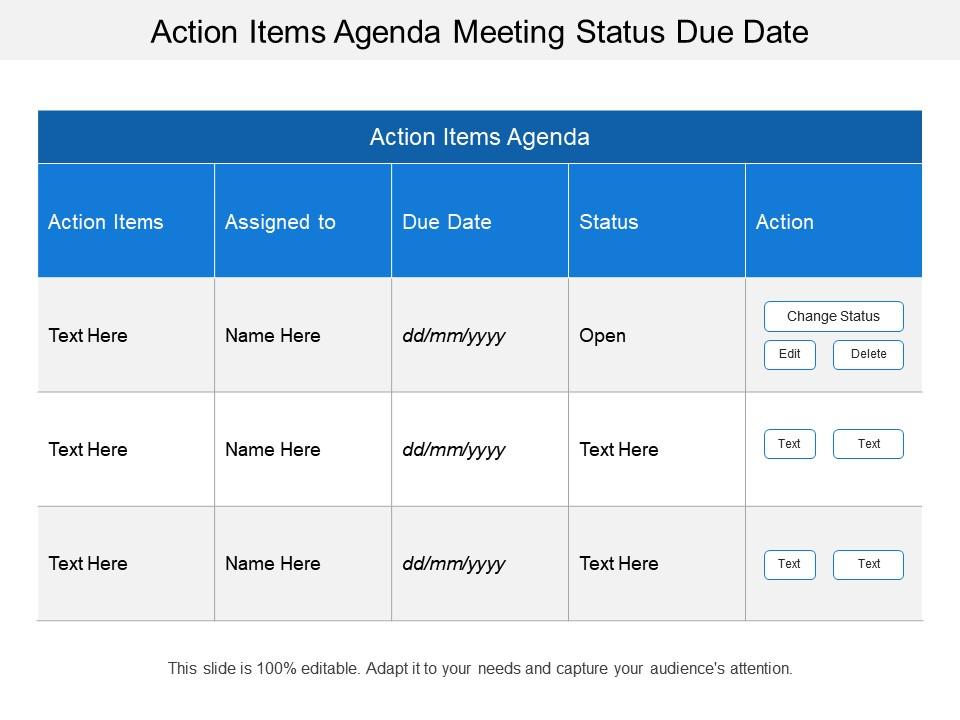
Action items agenda meeting status due date
Try Before you Buy Download Free Sample Product
Audience
Editable
of Time
Punch above your weight with our Action Items Agenda Meeting Status Due Date. Let fly with your thoughts.
People who downloaded this PowerPoint presentation also viewed the following :
Action items agenda meeting status due date with all 5 slides:
Freedom gets a boost with our Action Items Agenda Meeting Status Due Date. Folks find their fears disappearing.
FAQs for Action items agenda meeting
Effective action items include clear ownership assignments, specific measurable outcomes, realistic deadlines, required resources, and defined success metrics. These components streamline project execution by eliminating ambiguity, accelerating decision-making, and enhancing accountability across teams, with many organizations finding that well-structured action items ultimately deliver faster implementation and improved meeting productivity.
Action items enhance audience engagement by creating interactive participation, encouraging real-time feedback, and establishing clear next steps that involve attendees directly in the presentation outcomes. Through strategic implementation, presenters transform passive listeners into active participants, with many organizations finding that incorporating specific tasks, follow-up commitments, and collaborative decision-making ultimately delivers higher retention rates and stronger post-presentation momentum.
Best practices for prioritizing action items include categorizing by urgency and impact, assigning clear ownership with deadlines, distinguishing between immediate tasks and long-term projects, and aligning priorities with strategic business objectives. These approaches streamline post-meeting workflow by ensuring critical deliverables receive immediate attention, resource allocation matches organizational priorities, and team accountability remains clear, ultimately delivering faster project completion and enhanced operational efficiency.
Visual aids in presentation templates clarify action items by organizing tasks with clear hierarchies, timelines, and responsibility assignments, making complex project plans instantly understandable. Through strategic use of charts, icons, and color coding, teams can quickly identify priorities, track progress, and maintain accountability, with many organizations finding that visual clarity reduces confusion and accelerates project execution significantly.
Accountability drives successful action item implementation by establishing clear ownership, creating progress transparency, and ensuring consistent follow-through across team members. Through regular check-ins and status updates, organizations streamline project execution, minimize delays, and enhance team performance, with many companies finding that structured accountability systems ultimately deliver faster completion rates and stronger collaborative outcomes.
Effective delegation involves clearly defining the task scope, expected outcomes, and deadlines while matching assignments to team members' strengths and expertise. Through strategic delegation, managers streamline workflows, enhance team development, and optimize resource allocation, with many organizations finding that well-structured delegation ultimately delivers improved project efficiency and employee engagement.
**INPUT**: What tools or software can streamline the tracking of action items? **OUTPUT**: Action item tracking tools include project management platforms like Asana and Trello, collaborative software such as Monday.com, integrated suites like Microsoft Teams, and specialized task managers including Todoist and ClickUp. These technologies streamline workflows by centralizing assignments, automating deadline reminders, and providing real-time progress visibility, with many organizations finding that integrated tracking ultimately enhances accountability and accelerates project completion across teams.
Presenters can ensure realistic action items by setting specific timelines, assigning clear ownership, considering available resources, and breaking complex tasks into smaller steps. Through strategic planning and stakeholder input, organizations streamline project execution while maintaining accountability, with many teams finding that well-defined action items enhance productivity and deliver measurable outcomes.
**INPUT**: What strategies can be employed to follow up on action items effectively? **OUTPUT**: Effective action item follow-up strategies include regular check-in meetings, automated tracking systems, clear deadline reminders, progress milestone reviews, and accountability partnerships. These approaches streamline project management by enhancing transparency, minimizing delays, and ensuring consistent communication, with many organizations finding that systematic follow-up processes ultimately deliver improved completion rates and stronger team accountability.
Action items integrate into presentations through strategic placement, clear ownership assignment, and audience-specific framing that connects directly to presentation objectives. In sales presentations, action items focus on next steps and decision points, while project updates emphasize deliverables, timelines, and accountability measures, ultimately ensuring every presentation drives concrete outcomes and maintains momentum toward business goals.
Presenters should avoid vague language, unrealistic timelines, assigning tasks without clear ownership, and overwhelming audiences with too many simultaneous action items. These pitfalls undermine accountability and execution, with many organizations finding that specific, measurable actions with designated owners and realistic deadlines drive significantly better follow-through and business outcomes.
Cultural differences significantly impact action items through varying communication styles, hierarchy expectations, time perceptions, and accountability approaches across different organizational contexts. While direct cultures favor explicit task assignments and firm deadlines, relationship-oriented cultures often require consensus-building and flexible timelines, with many international organizations finding that culturally-adapted action item frameworks enhance team collaboration and ultimately deliver better project outcomes.
Effectiveness metrics for action items include completion rates, timeline adherence, quality assessments, resource utilization, and outcome impact measurements. These tracking mechanisms enable organizations to streamline project management, enhance accountability, and optimize resource allocation, with many teams finding that systematic measurement ultimately delivers improved productivity and strategic goal achievement.
Storytelling techniques enhance action item presentation by creating narrative context, establishing clear protagonists and outcomes, and framing tasks as plot progression toward strategic goals. Through compelling scenarios and case studies, teams can visualize implementation journeys, understand stakeholder impacts, and connect individual responsibilities to broader organizational success, ultimately transforming routine task lists into engaging roadmaps for achievement.
Feedback loops around action items can be established through regular progress reviews, completion rate tracking, stakeholder surveys, and post-implementation assessments. These mechanisms enable organizations to identify bottlenecks, measure effectiveness, and refine processes continuously, with many teams finding that systematic feedback collection ultimately delivers improved accountability, faster execution, and enhanced strategic outcomes.
-
Great experience, I would definitely use your services further.
-
Easily Understandable slides.