Agile Devops Process Devops Application Life Cycle Management

Rating:
100%
Agile Devops Process Devops Application Life Cycle Management
Slide 1 of 6

or

Favourites Favourites

Try Before you Buy Download Free Sample Product

Audience Impress Your
Audience
Editable 100%
Editable
Time Save Hours
of Time
The Biggest Sale is ending soon in
0
0
:
0
0
:
0
0
Rating:
100%
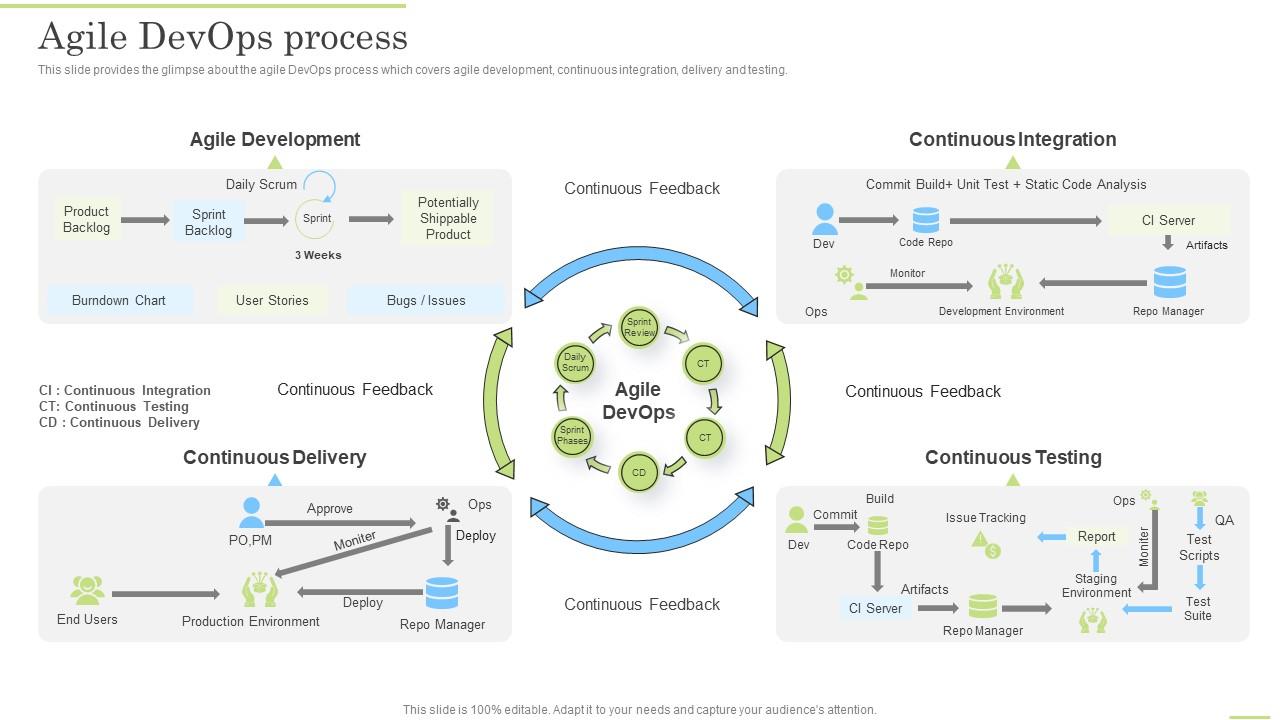
This slide provides the glimpse about the agile DevOps process which covers agile development, continuous integration, delivery and testing. Present the topic in a bit more detail with this Agile Devops Process Devops Application Life Cycle Management. Use it as a tool for discussion and navigation on Agile Development, Continuous Integration, Continuous Delivery. This template is free to edit as deemed fit for your organization. Therefore download it now.

FAQs for Agile Devops Process Devops Application

Agile DevOps core principles include continuous integration and deployment, cross-functional collaboration, automated testing, rapid feedback loops, and iterative development cycles. These methodologies streamline software delivery by eliminating silos between development and operations teams, accelerating release frequencies, and enhancing product quality, with many organizations finding that this strategic combination ultimately delivers faster time-to-market and improved customer experiences.

Agile DevOps improves collaboration by breaking down traditional silos through shared responsibilities, continuous communication, and unified goals focused on rapid delivery. This approach enables development and operations teams to work together throughout the entire software lifecycle, streamlining processes, reducing deployment errors, and ultimately delivering faster, more reliable releases that enhance customer satisfaction.

Effective Agile DevOps tools include Jenkins for continuous integration, Docker for containerization, Kubernetes for orchestration, Git for version control, and Jira for project management. These technologies streamline development cycles by automating deployments, enhancing collaboration, and improving code quality, with many software teams finding that strategic tool integration ultimately delivers faster release cycles and reduced operational overhead.

Agile DevOps enhances software delivery by integrating continuous integration, automated testing, collaborative workflows, and rapid feedback loops throughout development cycles. Through streamlined communication between development and operations teams, organizations accelerate deployment frequency, reduce defect rates, and minimize time-to-market, with many tech companies finding significantly improved customer satisfaction and competitive advantage.

CI/CD serves as the automation backbone of Agile DevOps, enabling frequent code integration, automated testing, and seamless deployment pipelines that accelerate release cycles. These practices streamline development workflows by reducing manual errors, minimizing deployment risks, and facilitating rapid feedback loops, with many organizations finding that CI/CD ultimately delivers faster time-to-market and enhanced operational efficiency.

Organizations measure Agile DevOps success through deployment frequency, lead times, mean time to recovery, change failure rates, and customer satisfaction metrics. These measurements enable teams to track delivery speed, system reliability, and business outcomes across development cycles, with many enterprises finding that combining technical metrics with user feedback delivers comprehensive insights into operational efficiency and competitive advantage.

Common challenges include cultural resistance to change, siloed team structures, inadequate toolchain integration, skills gaps in automation, and misaligned processes between development and operations. These obstacles often slow initial implementation, but organizations addressing them through comprehensive training, cross-functional collaboration, and strategic tool selection ultimately deliver faster deployment cycles and enhanced operational efficiency.

The Agile mindset fundamentally transforms DevOps culture by emphasizing collaboration, iterative improvement, and customer-centric delivery through cross-functional teams and continuous feedback loops. This integration enables organizations to streamline development cycles, enhance deployment frequency, and minimize time-to-market, with many tech companies and financial institutions finding that combining Agile principles with DevOps practices ultimately delivers faster innovation and superior competitive advantage.

Effective communication techniques in Agile DevOps teams include daily stand-ups, cross-functional collaboration tools, shared dashboards, continuous feedback loops, and integrated communication platforms. These approaches streamline information flow by eliminating silos, enhancing transparency, and enabling real-time problem-solving, with many organizations finding that consistent communication rituals ultimately deliver faster deployment cycles and improved team alignment.

Testing integrates into the Agile DevOps lifecycle through continuous integration, automated testing pipelines, test-driven development, shift-left testing practices, and collaborative quality assurance processes. These approaches streamline development cycles by enabling faster feedback loops, reducing manual testing overhead, and maintaining code quality throughout deployment phases, with many organizations finding that automated testing delivers significantly improved release velocity and enhanced product reliability.

Key metrics for Agile DevOps performance evaluation include deployment frequency, lead time for changes, mean time to recovery, change failure rate, and code coverage percentages. These metrics enable organizations to streamline development cycles, enhance system reliability, and accelerate delivery timelines, with many technology companies finding that tracking these indicators ultimately delivers competitive advantage and improved customer experiences.

Agile DevOps accelerates customer feedback loops by enabling faster deployment cycles, continuous integration, and real-time monitoring, allowing teams to gather user insights immediately after feature releases. Through automated testing and streamlined delivery pipelines, organizations can rapidly iterate based on customer input, ultimately delivering more responsive products and enhanced user experiences while maintaining competitive advantage.

Essential skills for Agile DevOps adoption include automation proficiency, continuous integration expertise, cloud technologies understanding, collaborative communication abilities, and cross-functional technical knowledge. These competencies enable teams to streamline deployment cycles, enhance code quality, and accelerate delivery timelines, with many organizations finding that investing in comprehensive training programs ultimately delivers improved operational efficiency and competitive advantage in increasingly dynamic markets.

Agile DevOps principles can be effectively applied across manufacturing, healthcare, finance, and retail industries by streamlining processes, enhancing collaboration, and accelerating delivery cycles. These methodologies enable banks to automate compliance workflows, help hospitals improve patient care coordination, and allow manufacturers to optimize production schedules, ultimately delivering faster services and competitive advantage.

Automation serves as the backbone of Agile DevOps by enabling continuous integration, automated testing, infrastructure provisioning, deployment pipelines, and monitoring systems. These automated processes significantly reduce manual errors, accelerate release cycles, and enhance collaboration between development and operations teams, with many organizations finding faster time-to-market and improved software quality.

Ratings and Reviews

100% of 100
Review Form
Write a review
Most Relevant Reviews
  1. 100%

    by Williams Nelson

    They saved me a lot of time because they had exactly what I was looking for. Couldn’t be happier!
  2. 100%

    by Cornell Hamilton

    Professionally designed slides with color coordinated themes and icons. Perfect for enhancing the style of the presentations. 

2 Item(s)

per page: