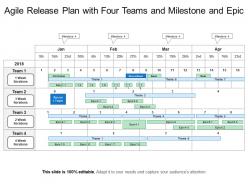
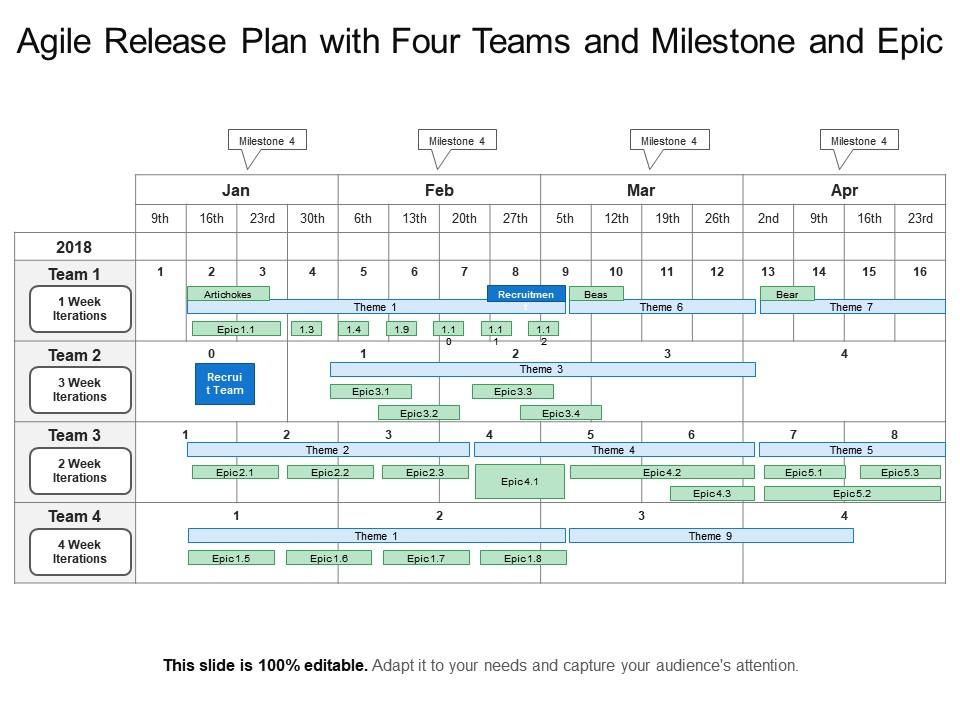
Agile release plan with four teams and milestone and epic
Try Before you Buy Download Free Sample Product
Audience
Editable
of Time
Are you looking for a professional PowerPoint template on agile management plan? Download this predesigned agile release plan with four teams and milestone and epic PowerPoint template slide. This agile release strategy PPT template slide consists of a table representing different months’ progress column, and four rows representing week wise iteration process growth. The tabular format of this timeline agile development presentation template will let you explain the plan in a descriptive way to the entire team which in return will help to achieve the project development. You can utilize this impressive agile release template slide to outline a professional presentation on related topics such as agile development, testing plan, agile scrum development, sprint release plan, agile methodology, scrum software development, project management, project development, sprint planning, software development framework, and project improvement planning. Download this agile release plan with four teams and a milestone presentation template slide. Assist folks in finding common ground with our Agile Release Plan With Four Teams And Milestone And Epic. It helps identify the cause of divergence.
People who downloaded this PowerPoint presentation also viewed the following :
Agile release plan with four teams and milestone and epic with all 5 slides:
Add extra flesh to your image with our Agile Release Plan With Four Teams And Milestone And Epic. It will beef up your impression.
FAQs for Agile release plan with four teams and
Honestly, start with your product backlog and make sure it's actually prioritized - not just thrown together. Get realistic velocity estimates from your team (they know better than anyone how fast they work). Map your highest-value features against what your team can actually handle, then work backwards from when you need to ship. Dependencies will absolutely wreck you if you don't think them through early. Set clear acceptance criteria for each feature and build in buffer time because something always goes sideways. Oh, and don't skip those stakeholder check-ins - keeps everyone sane and aligned on what you're actually building.
So basically, Agile lets you change course way more than traditional planning. Old school method? You map everything out months ahead and pray nothing changes (spoiler: it always does). Agile works in short bursts - you plan a few weeks out, ship features that actually matter first, then adjust based on what you learn. Your releases happen constantly instead of those massive yearly drops that stress everyone out. Traditional planning pretends you'll know every requirement upfront, but that's honestly pretty unrealistic. Start with your must-haves for the next release and build from there. Way less rigid overall.
Think of stakeholders as your sanity check - they tell you what "done" actually means and help rank what matters most. When deadlines get tight, they're the ones making those brutal cut-this-keep-that calls. Plus they'll call you out if you're building features nobody wants (trust me, better to hear it early). Don't just loop them in at the start though. Get their take on user stories as you go and show progress regularly. Otherwise you might end up with one of those awkward "this isn't what we wanted" conversations at the end. Keep them in the loop and they'll actually make your life easier.
Break your release down into user stories first, then estimate each one with story points or hours - whatever feels right for your team. Planning poker works great since everyone gets involved and you'll catch stuff you'd otherwise miss. Honestly, don't stress too much about being super precise though. After you get story point totals, use your team's past velocity to figure out timeline and resources. Oh, and definitely build in buffer time for testing, bug fixes, and when stakeholders inevitably change their minds halfway through. Just keep updating estimates as you go - you'll learn tons during development.
Ok so backlog prioritization - start with business value obviously. What's gonna make money or bring in customers? MoSCoW method works great (Must have, Should have, etc) or just do a simple impact vs effort grid. Don't forget dependencies though - some stuff has to happen first. Customer feedback beats your gut instincts every time, trust me on that one. Sometimes you'll need boring technical work before the cool features can happen. Oh and honestly? Mix a few approaches together rather than sticking to just one framework. Way more reliable that way.
Honestly, I'd look at your release plans every sprint - maybe during planning or retros. But don't get too rigid about it, you know? Like, if something major shifts or you hit a big blocker, just call a quick meeting and adjust things. The whole agile thing falls apart if you're being super strict about timelines anyway. Maybe set up a recurring meeting every 2-3 sprints so it doesn't get forgotten. We used to skip those and then wonder why we were always behind lol. Just treat the plans like they're meant to change - that's literally the point.
Honestly, Jira's your best bet - handles epics, story points, roadmaps, the whole thing. Azure DevOps works great if you're at a bigger company. Rally too. Sometimes I just grab Miro for visual stuff or literally use sticky notes (I know, I know, but it works). VersionOne's decent for estimation sessions, and PlanITpoker makes those meetings less painful. Here's the thing though - whatever you pick, your entire team has to actually use it. I've seen so many fancy setups fail because half the developers just... didn't bother. Pick something simple that everyone will stick with.
Honestly, agile planning just gets everyone talking to each other instead of working in their own little bubbles. You know how traditional planning meetings are a total drag? These are actually way better. Short sessions every few sprints where your developers, testers, and product people hash out priorities together. Everyone can see what's in the backlog and what's coming up next. No more guessing games or surprise blockers that derail everything. The whole team gets to discuss trade-offs and realistic timelines, which builds way better collaboration than I expected. Just keep the sessions focused and don't let them drag on forever.
Track your velocity first - how many story points you're knocking out each sprint. Burn-down charts show if you're on track for your release date. Cycle time tells you how fast stuff moves through your pipeline. Don't forget customer satisfaction and defect rates though - shipping fast but broken features is pretty much the worst case scenario. I'd also watch for scope creep since requirements always seem to multiply. Honestly, pick maybe 3-4 metrics max that your stakeholders actually care about. You'll go crazy trying to measure everything. Start simple with velocity and burn-downs.
Make a visual timeline showing your big releases and key features - something people can actually wrap their heads around. Present it in a meeting so they can ask questions, then send written follow-ups they can reference later. Honestly, stakeholders eat up the big picture view but they also need those details in writing. Keep updating the plan and communicate changes fast when they happen. Oh, and stick to the same format each time - people get confused when you keep switching things up. They need to know exactly where to find info.
Ugh, scope creep is the worst - stakeholders will literally ask for "one tiny change" that breaks everything. Unrealistic deadlines are brutal too, plus those surprise dependencies between teams that come out of nowhere. Keep your backlog super tight and don't let people change stuff mid-sprint. I learned this the hard way lol. Regular check-ins help manage expectations before things get crazy. Map out dependencies early or you'll hate yourself later. Always pad your timelines because everything takes 2x longer than expected. Oh, and start each planning meeting by comparing what you actually shipped versus what you promised - it's humbling but helpful.
Okay so time-boxing basically flips everything around - you pick your release date first, then figure out what features can actually fit. It's wild how different this feels from normal planning. Instead of letting scope creep destroy your timeline (we've all been there), you're forced to make real decisions about what matters most. The suitcase analogy is pretty spot-on - you can't make it bigger, so you get ruthless about what goes in. Honestly, it creates way more predictable delivery cycles and those tough priority conversations actually happen. Lock your date first, then fight over features.
Honestly, start with user interviews and surveys to check if your roadmap actually makes sense. Before planning sessions, dig through support tickets and usage data - that stuff's gold. Sprint reviews work great if you invite real customers instead of just internal people who *think* they know what users want (spoiler: they usually don't). Beta programs and feature flags let you test ideas without committing fully. Don't make feedback collection random though. Pick one approach first and bake it into your next cycle. You'll be surprised how much it changes your priorities.
Dude, you absolutely need everyone involved from the start. Get your devs, testers, designers, and product people together early - like, seriously early. Each person sees different roadblocks you'll miss otherwise. Your developers know what's actually possible tech-wise, QA spots where testing might get messy, and designers catch those annoying UI dependencies. Skip this step and your plan becomes total fiction. Trust me on this one - I've seen too many "perfect" plans completely fall apart during execution. Way better to hear the bad news upfront than get blindsided later when you're already committed.
Figure out the one main problem you're solving first. Don't build anything else - seriously, I've watched so many teams go down rabbit holes adding random features that seemed cool. Pick maybe 2-3 user stories that actually matter. Your MVP should take like 2-4 sprints max, depending how complex it gets. The whole point is learning fast, not shipping something polished. You need to be able to get feedback and pivot quickly. I know it's tempting to perfect everything, but honestly? That's missing the point entirely. Test your assumptions before you waste months building the wrong thing.
-
Unique and attractive product design.
-
Awesomely designed templates, Easy to understand.