Analysing inventory flow of warehouse

Analysing inventory flow of warehouse
Slide 1 of 2
Favourites Favourites

Try Before you Buy Download Free Sample Product

Audience Impress Your
Audience
Editable 100%
Editable
Time Save Hours
of Time
The Biggest Sale is ending soon in
0
0
:
0
0
:
0
0
Presenting Analysing Inventory Flow Of Warehouse slideshow. Our slideshow is easy to download and can be presented in standard screen(14:6) and widescreen (16:9) ratios. It is compatible with Google Slides. You can easily edit the font style, font color, and other components. This PPT can be transformed into numerous documents or image formats like PDF or JPEG. High-quality graphics ensure that the picture quality is maintained.

Content of this Powerpoint Presentation

Description:

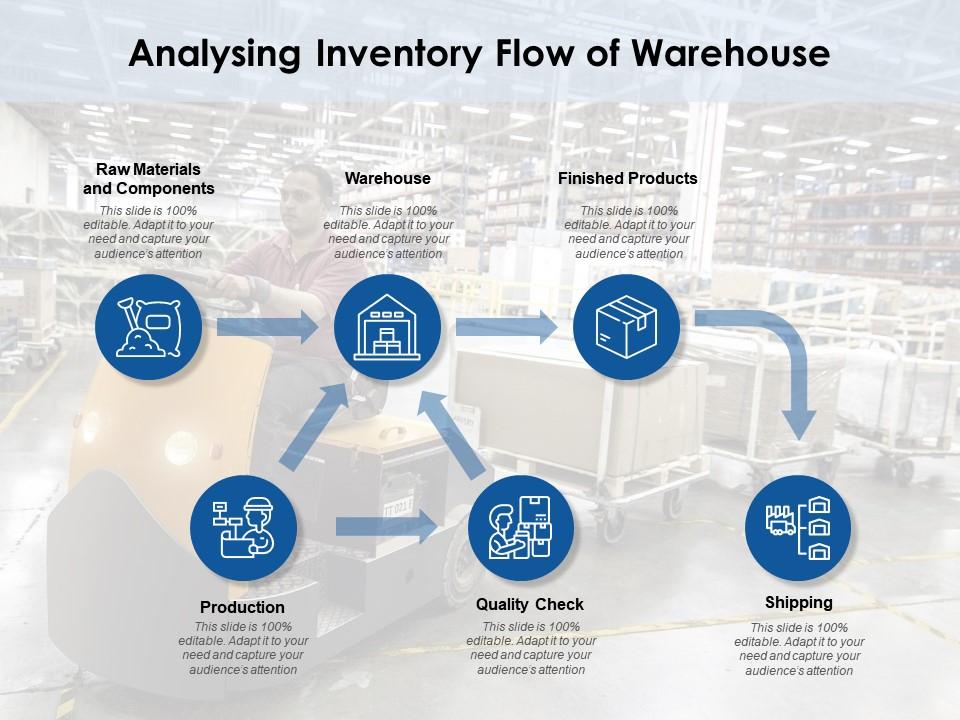
The image depicts a PowerPoint slide titled "Analysing Inventory Flow of Warehouse". It illustrates the sequence of inventory management within a warehouse setting, presented in a circular flow diagram with four key stages:

1. Raw Materials and Components: 

This stage focuses on the intake of raw materials required for production.

2. Production: 

This represents the process of transforming raw materials into finished goods.

3. Quality Check: 

This stage is for inspecting the finished products to ensure they meet quality standards.

4. Shipping: 

The final stage is where goods are dispatched and distributed.

Each stage is represented by an icon: a set of gears for Raw Materials and Components, a factory for Production, a checkmark for Quality Check, and a truck for Shipping. The slide is designed to be fully editable, allowing for customization according to specific operational details.

Use Cases:

This slide can be utilized across various industries that manage inventory and require efficient warehouse operations.

1. Manufacturing:

Use: Describing production and quality control processes.

Presenter: Operations Manager

Audience: Staff, Management

2. E-Commerce:

Use: Explaining order fulfillment and delivery.

Presenter: Logistics Coordinator

Audience: Warehouse Team, Customer Service

3. Pharmaceutical:

Use: Outlining drug manufacturing and distribution.

Presenter: Supply Chain Manager

Audience: Quality Assurance, Regulatory Affairs

4. Retail:

Use: Managing stock for retail outlets.

Presenter: Inventory Analyst

Audience: Store Managers, Distribution Partners

5. Automotive:

Use: Tracking parts and assembly line production.

Presenter: Plant Supervisor

Audience: Production Workers, Supply Chain Analysts

6. Food and Beverage:

Use: Monitoring food production, safety, and distribution.

Presenter: Quality Control Specialist

Audience: Food Safety Inspectors, Distributors

7. Consumer Electronics:

Use: Managing components to final product assembly and distribution.

Presenter: Warehouse Operations Lead

Audience: Technical Staff, Retail Distributors


FAQs for Analysing inventory

Key metrics for inventory flow analysis include inventory turnover ratio, days sales outstanding, stock-out frequency, carrying costs, and lead time variability. These metrics enhance operational efficiency by identifying bottlenecks, optimizing reorder points, and minimizing excess inventory, with many retailers and manufacturers finding that strategic tracking ultimately delivers reduced costs and improved customer satisfaction.

Inventory flow analysis helps optimize supply chain efficiency by identifying bottlenecks, reducing carrying costs, and improving demand forecasting accuracy through real-time tracking and data analytics. Through strategic analysis, organizations streamline warehouse operations, minimize stockouts, and enhance customer satisfaction, with many manufacturing and retail companies finding that optimized inventory flow ultimately delivers faster order fulfillment and significant cost reductions.

Inventory turnover measures how quickly inventory converts to sales, serving as a critical indicator of inventory flow efficiency, demand forecasting accuracy, and operational performance. Higher turnover rates typically signal effective inventory management and strong demand, while lower rates may indicate overstocking or weak sales, with many retailers finding that optimizing turnover ratios ultimately enhances cash flow and reduces carrying costs.

Businesses utilize inventory flow analysis to reduce holding costs by optimizing stock levels, identifying slow-moving items, and improving demand forecasting accuracy through data-driven insights. This strategic approach enables companies to minimize excess inventory, streamline warehouse operations, and enhance cash flow management, with many retail and manufacturing organizations finding that systematic analysis delivers significant cost reductions and operational efficiency.

**INPUT**: What software tools are most effective for conducting inventory flow analysis? **OUTPUT**: Effective inventory flow analysis software includes SAP SCM, Oracle WMS, Manhattan Associates, Fishbowl Inventory, and NetSuite ERP systems. These platforms streamline operations by automating tracking, optimizing stock levels, and providing real-time visibility, with many retailers and manufacturers finding that integrated analytics deliver faster replenishment cycles and significantly reduced carrying costs. [Word count: 54 words]

Seasonality significantly impacts inventory flow by creating predictable demand fluctuations, requiring businesses to adjust procurement cycles, storage capacity, and distribution timing accordingly. Retailers stock winter apparel months ahead while restaurants increase holiday ingredients, with many organizations finding that advanced seasonal forecasting streamlines operations, minimizes stockouts, and ultimately delivers improved cash flow and customer satisfaction during peak periods.

Common challenges in inventory flow analysis include data accuracy issues, demand forecasting errors, supplier reliability problems, seasonal fluctuations, and inadequate tracking systems. These obstacles can lead to stockouts, excess inventory, and increased carrying costs, with many organizations finding that implementing integrated analytics and real-time monitoring ultimately streamlines operations and enhances supply chain efficiency.

Yes, inventory flow analysis significantly assists demand forecasting by tracking historical consumption patterns, seasonal trends, lead times, and replenishment cycles to predict future requirements. Through analyzing movement velocities and stock turnover rates, retailers, manufacturers, and distributors enhance forecast accuracy, minimize stockouts, and optimize purchasing decisions, ultimately delivering improved customer satisfaction and reduced carrying costs.

**INPUT**: How do you differentiate between slow-moving and fast-moving inventory in your analysis? **OUTPUT**: Differentiating between slow-moving and fast-moving inventory involves analyzing turnover ratios, sales velocity metrics, demand patterns, seasonal fluctuations, and days-on-hand calculations. These analytical methods enable retailers, manufacturers, and distributors to optimize stock levels, reduce carrying costs, and improve cash flow, with many organizations finding that strategic inventory segmentation ultimately delivers enhanced operational efficiency and competitive advantage. [Word count: 58 words]

Lead time significantly impacts inventory flow management by affecting reorder timing, safety stock requirements, and cash flow optimization throughout the supply chain. Longer lead times force organizations to maintain higher inventory buffers and invest more working capital upfront, while shorter lead times enable leaner operations, faster responsiveness to demand changes, and improved inventory turnover rates across manufacturing and retail sectors.

Inventory flow analysis improves customer satisfaction by ensuring product availability, reducing stockouts, and enabling faster order fulfillment through optimized supply chain visibility. By analyzing demand patterns and inventory movement, retailers and manufacturers can maintain optimal stock levels, minimize delivery delays, and provide consistent product access, ultimately delivering enhanced shopping experiences and building stronger customer loyalty in competitive markets.

A comprehensive inventory flow assessment should include demand forecasting accuracy, supplier lead times, seasonal variations, storage capacity constraints, and inventory turnover rates. These factors work together to optimize stock levels, minimize carrying costs, and prevent stockouts, with many retail and manufacturing organizations finding that systematic assessment delivers improved cash flow and enhanced customer satisfaction.

Historical sales data enhances inventory flow analysis by revealing seasonal patterns, demand trends, and customer purchasing behaviors that inform more precise forecasting models. Through predictive analytics, retailers and manufacturers can optimize stock levels, reduce carrying costs, and minimize stockouts, with many organizations finding that data-driven inventory strategies improve turnover rates by 15-25%.

Businesses can implement demand forecasting optimization, automated reorder systems, strategic supplier diversification, warehouse layout improvements, and seasonal stock adjustments based on inventory flow insights. These strategies streamline operations by reducing carrying costs, minimizing stockouts, and enhancing supply chain responsiveness, with many retail and manufacturing organizations finding significantly improved operational efficiency and customer satisfaction.

Companies should conduct inventory flow analysis monthly for routine monitoring, quarterly for comprehensive reviews, and annually for strategic planning, with high-velocity businesses requiring weekly assessments. The frequency depends on inventory turnover rates, seasonal fluctuations, and business complexity, with many retail and manufacturing organizations finding that consistent monthly analysis enables proactive decision-making and optimal stock levels.

Ratings and Reviews

0% of 100
Review Form
Write a review
Most Relevant Reviews

No Reviews