Analyzing The Total Market Size Of The Product Annual Product Performance Report Ppt Slides

Rating:
90%
Analyzing The Total Market Size Of The Product Annual Product Performance Report Ppt Slides
Slide 1 of 6
Favourites Favourites

Try Before you Buy Download Free Sample Product

Audience Impress Your
Audience
Editable 100%
Editable
Time Save Hours
of Time
The Biggest Sale is ending soon in
0
0
:
0
0
:
0
0
Rating:
90%
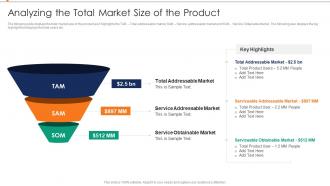
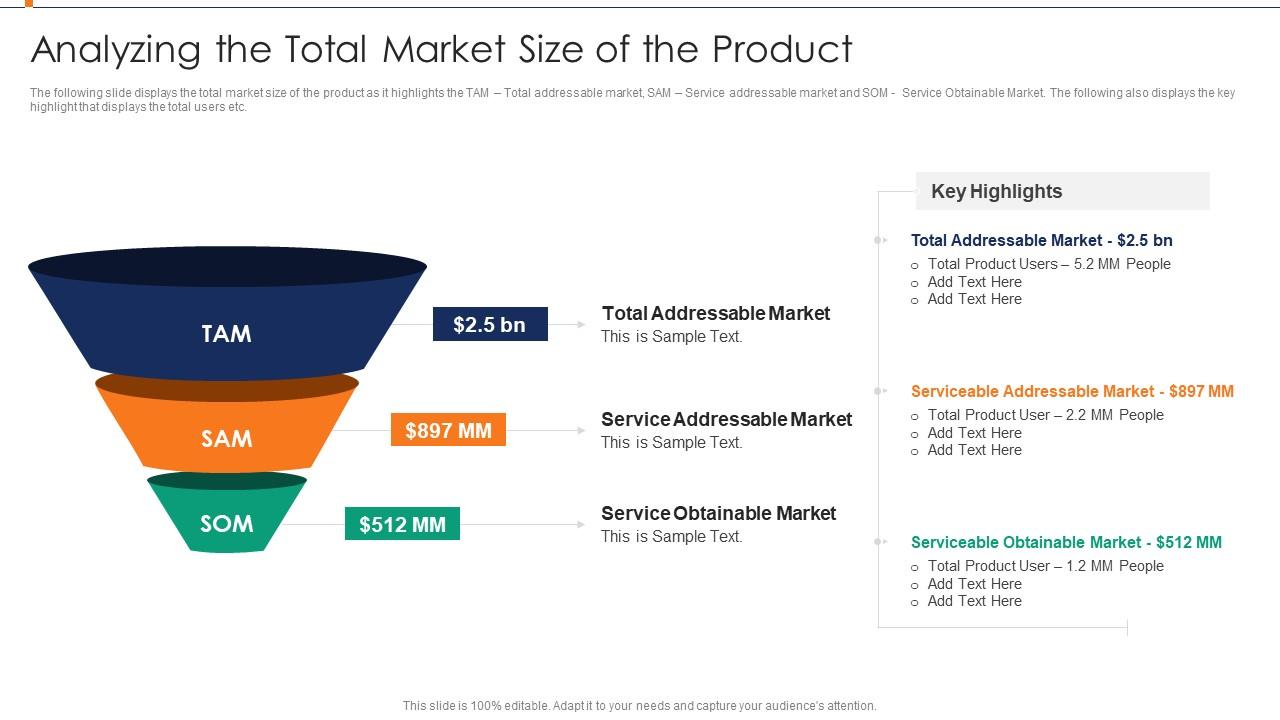
The following slide displays the total market size of the product as it highlights the TAM Total addressable market, SAM Service addressable market and SOM Service Obtainable Market. The following also displays the key highlight that displays the total users etc. Introducing Analyzing The Total Market Size Of The Product Annual Product Performance Report Ppt Slides to increase your presentation threshold. Encompassed with three stages, this template is a great option to educate and entice your audience. Dispence information on Analyzing The Total Market Size Of The Product, using this template. Grab it now to reap its full benefits.
FAQs for Analyzing The Total Market Size Of The Product Annual Product Performance

Key components contributing to total market size include consumer demand volume, average pricing levels, market penetration rates, geographic coverage, and competitive landscape dynamics. These elements work together by determining revenue potential, identifying growth opportunities, and revealing market saturation levels, with many organizations finding that comprehensive analysis of these factors enables strategic positioning, resource allocation optimization, and ultimately delivers sustainable competitive advantage in increasingly complex markets.

Businesses can effectively estimate total market size through demographic analysis, competitor research, industry reports, customer surveys, and government data sources. These methodologies work together by identifying target populations, analyzing spending patterns, and evaluating market penetration rates, with many organizations finding that combining multiple approaches delivers more accurate projections and strategic insights for product launches.

Market size calculation methodologies include top-down analysis, bottom-up analysis, value theory approach, demographic segmentation, and competitive benchmarking. These approaches enable organizations by combining industry reports with primary research, customer surveys, and sales data analysis, with many consulting firms finding that strategic combinations deliver more accurate forecasts and competitive advantage in increasingly data-driven markets.

Macroeconomic factors significantly influence total market size assessments by affecting consumer purchasing power, business investment capacity, and overall demand patterns across industries. Economic indicators like GDP growth, inflation rates, and employment levels directly impact market valuations, with analysts in sectors like automotive, real estate, and consumer goods finding that economic cycles can alter market size projections by 15-30% annually.

Demographic trends impact total market size through population growth, age distribution shifts, income level changes, geographic migration patterns, and lifestyle preference evolution. These demographic factors enable organizations to identify emerging market opportunities, anticipate demand fluctuations, and strategically reallocate resources, with many businesses finding that demographic analysis ultimately delivers more accurate forecasting and competitive positioning advantages.

Competitive analysis reveals market share distribution, identifies key players' revenue streams, and uncovers underserved segments within the total market landscape. Through competitor mapping and performance benchmarking, businesses can validate market size estimates, discover growth opportunities in overlooked niches, and strategically position themselves, with many organizations finding that comprehensive competitor insights ultimately enhance their market entry strategies and revenue projections.

Market segmentation enhances total market size estimates by breaking broader markets into distinct customer groups based on demographics, behavior, geography, and needs, allowing for more precise demand calculations. This targeted approach enables businesses to identify high-value segments, allocate resources strategically, and develop focused marketing strategies, ultimately delivering more accurate forecasts and competitive advantage in specific niches.

Total addressable market (TAM) represents the maximum revenue opportunity if a company captured 100% market share, while total market size reflects the actual current market value and existing transaction volumes. TAM helps businesses assess growth potential and attract investors by demonstrating scalability, whereas total market size provides realistic benchmarks for market penetration strategies, with companies like fintech startups using TAM projections alongside current market analysis to secure funding and guide expansion decisions.

Emerging technologies significantly expand total market size in established industries by creating new revenue streams, enabling innovative service models, and attracting previously underserved customer segments. Through AI, IoT, and automation, traditional sectors like banking, healthcare, and manufacturing unlock additional value propositions, reduce operational costs, and deliver enhanced customer experiences, ultimately driving market growth beyond conventional boundaries.

Seasonal trends significantly impact total market size calculations by creating fluctuations that can skew annual projections, requiring businesses to analyze quarterly patterns, adjust for cyclical variations, and apply smoothing techniques for accurate forecasting. Industries like retail, hospitality, and consumer goods find that incorporating seasonal adjustments delivers more reliable market assessments, ultimately enabling better resource allocation and strategic planning throughout varying demand cycles.

Businesses leverage total market size analysis for strategic planning by identifying growth opportunities, allocating resources effectively, setting realistic revenue targets, and assessing competitive positioning within their industry. Through comprehensive market sizing, organizations can prioritize market segments, guide product development decisions, and optimize investment strategies, ultimately enabling data-driven strategic choices that enhance competitive advantage.

Current methods for calculating total market size face limitations including outdated data sources, sampling biases, inconsistent methodologies across regions, difficulty capturing emerging market segments, and reliance on historical trends that may not reflect rapid market changes. These constraints can lead to significant miscalculations, with many organizations finding that traditional approaches underestimate niche opportunities or overestimate saturated markets, ultimately impacting strategic investment decisions and competitive positioning.

Companies use total market size data to identify growth opportunities by analyzing market segments, geographic regions, customer demographics, and competitive gaps within the overall addressable market. This strategic analysis enables businesses to prioritize resource allocation, target underserved segments, and develop expansion strategies, with many organizations finding that data-driven market insights deliver faster growth and competitive positioning advantages.

Geographic variations in total market size assessments reveal critical regional differences in purchasing power, consumer behavior, regulatory environments, and competitive landscapes that directly impact market entry strategies. These variations enable businesses to prioritize high-potential markets, tailor product offerings to local preferences, and allocate resources strategically, with many multinational companies finding that geographic segmentation ultimately delivers more accurate forecasting and competitive advantage.

Startups can utilize total market size analysis to demonstrate scalable revenue potential, validate market opportunity, and justify investment returns through TAM, SAM, and SOM projections. This strategic approach enables entrepreneurs to present compelling growth narratives, benchmark against competitors, and showcase addressable market segments, ultimately delivering investor confidence and positioning startups competitively within their industries.

Ratings and Reviews

90% of 100
Review Form
Write a review
Most Relevant Reviews
  1. 80%

    by Earnest Carpenter

    Colors used are bright and distinctive.
  2. 100%

    by Dario Freeman

    Great product with highly impressive and engaging designs.

2 Item(s)

per page: