Assess risk criticality relationship strength automated email response

Rating:
80%
Assess risk criticality relationship strength automated email response
Slide 1 of 5
Favourites Favourites

Try Before you Buy Download Free Sample Product

Audience Impress Your
Audience
Editable 100%
Editable
Time Save Hours
of Time
The Biggest Sale is ending soon in
0
0
:
0
0
:
0
0
AI-Ready
Upload this template to AI and ask it to make any changes to content or color
100% editable Powerpoint Template for AI-assisted presentations. Finish your work in less time. ​
Works with
Microsoft PowerPoint
Microsoft 365
Claude for PowerPoint
ChatGPT
Google Slides
Microsoft Copilot
Rating:
80%
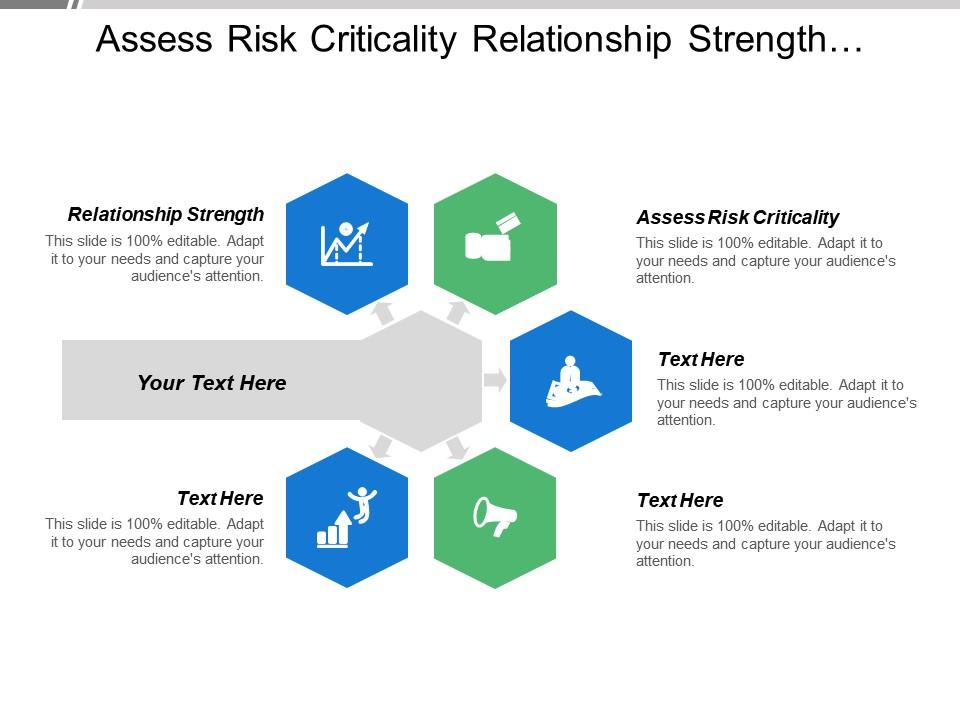
Presenting this set of slides with name - Assess Risk Criticality Relationship Strength Automated Email Response. This is an editable five stages graphic that deals with topics like Assess Risk Criticality, Relationship Strength, Automated Email Response to help convey your message better graphically. This product is a premium product available for immediate download, and is 100 percent editable in Powerpoint. Download this now and use it in your presentations to impress your audience.

FAQs for Assess risk criticality relationship strength

A comprehensive risk assessment process includes risk identification, probability analysis, impact evaluation, risk categorization, and mitigation strategy development. These components work together by systematically uncovering potential threats, quantifying their likelihood and consequences, and establishing prioritized response plans, with organizations across healthcare, finance, and manufacturing finding that structured assessments significantly enhance operational resilience and strategic decision-making.

Organizations effectively identify potential risks through comprehensive audits, stakeholder consultations, data analytics, scenario planning, and cross-departmental assessments that examine operational, financial, regulatory, and strategic vulnerabilities. These systematic approaches enable businesses to map risk interdependencies, prioritize threats by impact and likelihood, and develop proactive mitigation strategies, with many finding that regular risk identification processes ultimately deliver enhanced resilience and competitive advantage.

Stakeholder engagement ensures comprehensive risk identification by incorporating diverse perspectives, expertise, and concerns from employees, customers, suppliers, and regulatory bodies throughout the assessment process. This collaborative approach enhances risk accuracy, builds organizational buy-in, and improves mitigation strategies, with many organizations finding that engaged stakeholders deliver more effective risk management and faster implementation of protective measures.

Qualitative risk assessment uses descriptive categories and expert judgment to evaluate risks, while quantitative methods employ numerical data, statistical models, and probability calculations to measure potential impacts. Qualitative approaches work best for initial screenings and strategic planning, while quantitative methods suit complex projects requiring precise measurements, with many financial institutions and healthcare organizations combining both approaches for comprehensive risk management.

Common risk assessment tools in project management include risk registers, probability-impact matrices, SWOT analysis, Monte Carlo simulations, and decision trees. These techniques enhance project outcomes by identifying potential threats early, quantifying their impact on timelines and budgets, and enabling proactive mitigation strategies, with many organizations finding that systematic risk assessment reduces project failures and delivers more predictable results.

Technology enhances risk assessment through artificial intelligence, predictive analytics, automated data collection, real-time monitoring systems, and machine learning algorithms. These tools streamline processes by analyzing vast datasets instantly, identifying patterns humans might miss, and providing continuous risk updates, with financial institutions and healthcare organizations finding significantly improved accuracy and faster decision-making capabilities.

Organizations should prioritize risks by evaluating probability, potential impact, and time sensitivity, while considering regulatory requirements, strategic objectives, and available resources. Many financial institutions and healthcare organizations use risk matrices combining likelihood scores with business impact assessments, enabling them to address high-probability, high-impact risks first and allocate mitigation resources strategically.

Failing to conduct proper risk assessments can result in regulatory fines, legal liability, compliance violations, operational shutdowns, and reputational damage across industries. Organizations face increased scrutiny from regulatory bodies, potential lawsuits from stakeholders, and loss of business licenses, with many companies finding that inadequate risk management ultimately costs significantly more than proactive assessment investments.

Businesses maintain agile risk assessment processes through continuous monitoring systems, regular scenario planning updates, cross-functional collaboration, and flexible evaluation frameworks that incorporate real-time data. These adaptive approaches enable organizations to quickly identify emerging threats, adjust mitigation strategies, and respond to market volatility, ultimately delivering enhanced resilience and competitive advantage in increasingly dynamic business environments.

Risk mitigation strategies include risk avoidance, reduction, transfer, and acceptance, each tailored to specific threat levels and organizational capacity. Through insurance policies, diversification, contingency planning, and process improvements, organizations streamline operations while minimizing vulnerabilities, with many financial institutions and healthcare providers finding that strategic combinations of these approaches ultimately deliver enhanced resilience and competitive advantage.

Risk assessments should be reviewed quarterly at minimum, with updates triggered by significant organizational changes, new regulations, emerging threats, or major incidents. This frequency ensures organizations maintain current threat intelligence, adapt to evolving business landscapes, and preserve operational resilience, with many financial services and healthcare institutions finding that regular updates significantly reduce exposure while enhancing strategic decision-making capabilities.

Risk communication serves as the critical bridge between technical risk analysis and stakeholder understanding, involving the systematic exchange of information about potential hazards, their likelihood, and mitigation strategies among all parties. Through transparent dialogue, organizations enable informed decision-making, build stakeholder trust, and ensure regulatory compliance, with many finding that effective communication ultimately transforms complex risk data into actionable business strategies and enhanced organizational resilience.

Organizations measure risk management effectiveness through key risk indicators (KRIs), risk-adjusted performance metrics, incident frequency analysis, compliance audit results, and cost-benefit assessments of mitigation strategies. These measurement frameworks enable companies to track threat reduction, monitor control performance, and demonstrate ROI, with many financial institutions and healthcare organizations finding that regular effectiveness reviews ultimately enhance operational resilience and regulatory compliance.

Common pitfalls include insufficient stakeholder involvement, relying on outdated data, focusing only on obvious risks, inadequate documentation, and failing to regularly update assessments. Organizations often overlook interconnected risks or underestimate low-probability high-impact events, with many financial services and healthcare institutions finding that comprehensive, regularly refreshed assessments deliver better regulatory compliance and strategic decision-making.

Organizations can integrate risk assessment findings into strategic planning by incorporating identified risks into decision-making frameworks, aligning mitigation strategies with business objectives, and embedding risk considerations into resource allocation processes. This integration enables companies across sectors like banking, healthcare, and manufacturing to make informed strategic choices, optimize operational resilience, and ultimately deliver sustainable competitive advantage while minimizing potential disruptions.

Ratings and Reviews

80% of 100
Review Form
Write a review
Most Relevant Reviews
  1. 80%

    by Darin Chen

    Best way of representation of the topic.
  2. 80%

    by Dee Hicks

    Design layout is very impressive.

2 Item(s)

per page: