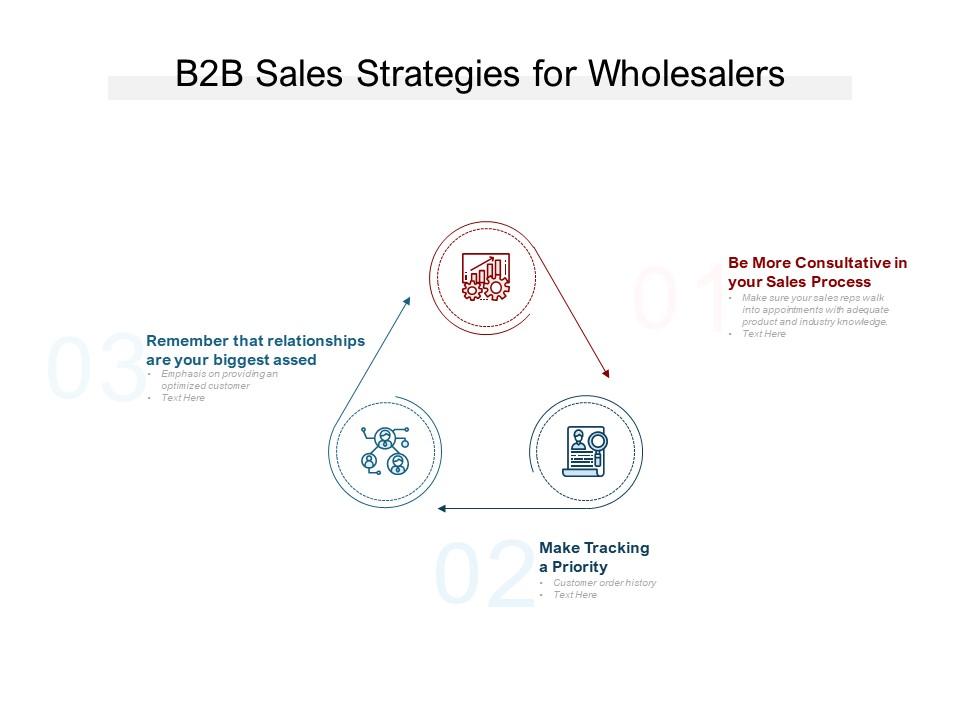
B2b sales strategies for wholesalers
Try Before you Buy Download Free Sample Product
Audience
Editable
of Time
Achieve a fine focus with our B2B Sales Strategies For Wholesalers. You will acquire extraordinary clarity.
People who downloaded this PowerPoint presentation also viewed the following :
B2b sales strategies for wholesalers with all 5 slides:
Achieve absolute and complete clarity with our B2B Sales Strategies For Wholesalers. They contain excellent graphics.
FAQs for B2b sales
B2B sales strategies focus on relationship building, longer sales cycles, bulk pricing negotiations, and technical product knowledge, while B2C emphasizes emotional appeals, quick transactions, and individual consumer needs. In wholesale operations, B2B requires account management, supply chain integration, and customized solutions for retailers or manufacturers, ultimately delivering sustained partnerships and predictable revenue streams compared to B2C's volume-based approach.
Wholesalers can effectively identify ideal B2B customers through market segmentation analysis, customer profiling based on purchase volume and frequency, competitor research, industry trend monitoring, and leveraging existing customer data patterns. Strategic approaches include attending trade shows, utilizing CRM analytics, partnering with complementary businesses, and conducting direct outreach to high-potential sectors, ultimately enabling targeted marketing campaigns and stronger customer relationships.
Relationship building serves as the foundation of B2B wholesale success, enabling trust development, long-term partnerships, repeat orders, and preferential treatment during market fluctuations. These connections streamline negotiations, enhance customer retention, and facilitate strategic collaborations, with many wholesalers finding that strong relationships ultimately deliver competitive advantages, reduced acquisition costs, and sustainable revenue growth in increasingly competitive markets.
Wholesalers can leverage data analytics to enhance sales strategies by analyzing customer purchasing patterns, identifying market trends, optimizing inventory management, and personalizing client communications. Through predictive analytics and customer segmentation, distributors streamline operations, reduce costs, and anticipate demand more accurately, ultimately delivering improved customer experiences and competitive advantage in increasingly data-driven markets.
The most effective communication channels for wholesalers include personalized email campaigns, direct sales calls, trade shows, LinkedIn outreach, and dedicated customer portals. These channels enhance relationship building by providing targeted product information, real-time inventory updates, and streamlined ordering processes, with many wholesalers finding that combining digital and personal touchpoints ultimately delivers stronger client retention and increased order volumes.
Wholesalers can leverage content marketing through educational blog posts, industry whitepapers, product demonstration videos, case studies, and targeted email campaigns that address specific buyer pain points. These strategies enable B2B companies to establish thought leadership, build trust with procurement teams, and guide prospects through longer sales cycles, ultimately delivering higher-quality leads and stronger customer relationships.
Wholesalers should track key performance indicators including sales conversion rates, average order value, customer acquisition costs, sales cycle length, and customer lifetime value. These metrics enable businesses to optimize their sales processes, identify high-performing channels, and enhance resource allocation, with many wholesale organizations finding that comprehensive tracking ultimately delivers improved forecasting accuracy and sustained competitive advantage.
Product knowledge is crucial for wholesalers in B2B sales, enabling them to address specific client pain points, demonstrate value propositions, and build credibility with decision-makers. Deep expertise allows sales teams to customize solutions, anticipate objections, and articulate competitive advantages, with many distributors finding that technical proficiency significantly shortens sales cycles and enhances client relationships.
Wholesalers can shorten B2B sales cycles through automated lead scoring, pre-qualified prospect databases, streamlined proposal processes, digital catalogs with real-time pricing, and relationship-based account management. These strategies enable faster decision-making by providing immediate access to product information, pricing transparency, and personalized service experiences, with many distributors finding that digital integration reduces typical sales cycles by 30-40 percent.
Customer feedback enables wholesalers to refine sales strategies by identifying pain points, optimizing product offerings, personalizing service approaches, and streamlining ordering processes. Through systematic feedback analysis, wholesale operations can enhance relationship management, adjust pricing strategies, and improve delivery schedules, with many distributors finding that responsive strategy adjustments ultimately deliver stronger client retention and competitive advantage.
Technology and automation in B2B wholesale sales deliver enhanced efficiency, improved customer experiences, streamlined order processing, better inventory management, and data-driven decision making. These solutions enable wholesalers to automate repetitive tasks, personalize client interactions, and optimize supply chain operations, with many distributors finding that automated systems reduce processing costs while accelerating order fulfillment and strengthening customer relationships.
Wholesalers develop compelling value propositions by identifying specific customer pain points, leveraging their supply chain advantages, offering customized solutions, and demonstrating measurable cost savings or efficiency gains. Through strategic partnerships with manufacturers and data-driven insights, wholesalers can deliver faster fulfillment, bulk pricing advantages, and specialized industry expertise, ultimately enabling retailers and businesses to enhance their competitive positioning while reducing operational complexity.
Pricing strategy serves as a cornerstone of B2B wholesale success, influencing customer acquisition, retention, competitive positioning, and profit margins across diverse market segments. Strategic pricing approaches, including volume discounts, tiered structures, and dynamic adjustments, enable wholesalers to optimize revenue streams while delivering value propositions that strengthen long-term partnerships and market share growth.
Wholesalers can enhance sales team effectiveness through comprehensive training programs focusing on relationship building, value-based selling techniques, product expertise development, negotiation psychology, and strategic account management skills. These programs should emphasize consultative selling approaches, competitive analysis mastery, and objection handling strategies, with many organizations finding that role-playing complex scenarios and cross-functional collaboration training ultimately delivers stronger client relationships and improved deal closure rates.
Wholesalers face challenges including intense price competition, complex buyer decision-making processes, lengthy sales cycles, inventory management pressures, and evolving customer expectations for digital experiences. These obstacles can be overcome by implementing value-based selling approaches, leveraging data analytics for better customer insights, streamlining operations through automation, and developing omnichannel strategies that enhance customer relationships while ultimately delivering competitive advantages.
No Reviews