

Blockchain für Handelsfinanzierung in Echtzeit-Verfolgung und Betrugsverhinderung





Try Before you Buy Download Free Sample Product
 Impress Your
Audience
 100%
Editable
 Save Hours
of Time


Unsere Blockchain für Handelsfinanzierung in Echtzeit-Verfolgung und Betrugsverhinderung BCT CD V sind thematisch so gestaltet, dass sie einen attraktiven Hintergrund für jedes Thema bieten. Verwenden Sie sie, um wie ein Präsentationsprofi auszusehen.
People who downloaded this PowerPoint presentation also viewed the following :
Inhalt dieser Powerpoint-Präsentation
Folie 1: Diese Folie zeigt den Titel Blockchain für Handelsfinanzierung Echtzeit-Tracking und Betrugsverhinderung. Geben Sie Ihren Firmennamen an
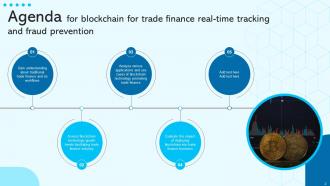
Folie 2: Diese Folie zeigt den Titel Agenda für Blockchain für Handelsfinanzierung Echtzeit-Tracking und Betrugsverhinderung
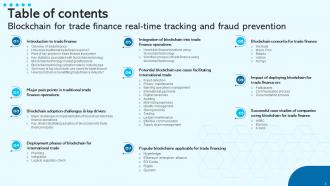
Folie 3: Diese Folie zeigt ein Inhaltsverzeichnis.
Folie 4: Diese Folie zeigt ebenfalls ein Inhaltsverzeichnis für die Präsentation.
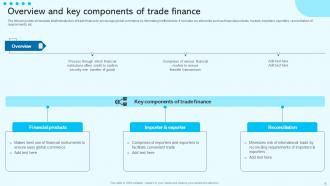
Folie 5: Diese Folie zeigt eine kurze Einführung in die Handelsfinanzierung zur Förderung des globalen Handels durch Minimierung von Ineffizienzen.
Folie 6: Diese Folie zeigt, wie die traditionelle Handelsfinanzierung funktioniert, um Kreditfazilitäten und globales Handelswachstum zu ermöglichen. .
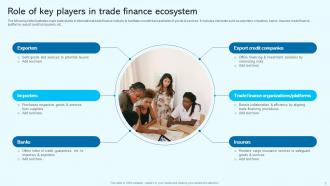
Folie 7: Diese Folie veranschaulicht die wichtigsten Akteure in der internationalen Handelsfinanzierungsbranche, um einen reibungslosen Transport von Waren und Dienstleistungen zu ermöglichen.
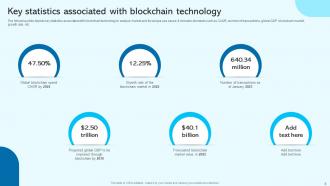
Folie 8: Diese Folie zeigt wichtige Statistiken zur Blockchain-Technologie, um den Markt und seine einzigartigen Anwendungsfälle zu analysieren.
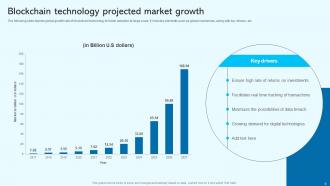
Folie 9: Diese Folie zeigt die globale Wachstumsrate der Blockchain-Technologie, um eine großflächige Einführung zu fördern.
Folie 10: Diese Folie zeigt den Prozentsatz der Branchen, die die Blockchain-Technologie einführen.
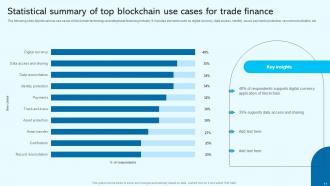
Folie 11: Diese Folie zeigt verschiedene Anwendungsfälle der Blockchain-Technologie, die die Handelsfinanzierungsbranche unterstützen.
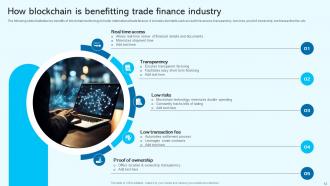
Folie 12: Diese Folie veranschaulicht die wichtigsten Vorteile der Blockchain-Technologie zur Förderung der internationalen Handelsfinanzierung.
Folie 13: Diese Folie zeigt ebenfalls ein Inhaltsverzeichnis für die Präsentation.
Folie 14: Diese Folie veranschaulicht verschiedene Probleme, mit denen Investoren im traditionellen Handelsfinanzierungsprozess konfrontiert sind, um grenzüberschreitende Transaktionen zu optimieren.
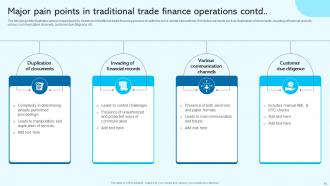
Folie 15: Die folgende Folie veranschaulicht verschiedene Probleme, mit denen Investoren im traditionellen Handelsfinanzierungsprozess konfrontiert sind, um grenzüberschreitende Transaktionen zu optimieren.
Folie 16: Diese Folie zeigt ebenfalls ein Inhaltsverzeichnis für die Präsentation.
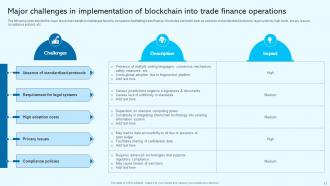
Folie 17: Diese Folie zeigt die größten Herausforderungen bei der Einführung von Blockchain für Unternehmen, die die Handelsfinanzierung erleichtern.
Folie 18: Diese Folie veranschaulicht einige Faktoren, die die hohe Einführung von Blockchain in die Handelsfinanzierungsbranche fördern.
Folie 19: Diese Folie zeigt ebenfalls ein Inhaltsverzeichnis für die Präsentation.
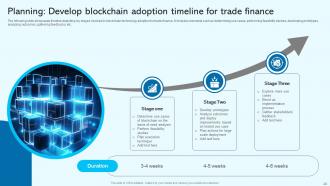
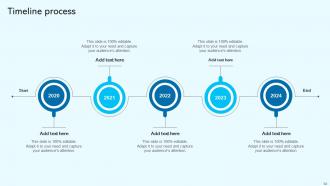
Folie 20: Diese Folie zeigt einen Zeitplan mit den wichtigsten Phasen bei der Einführung der Blockchain-Technologie für die Handelsfinanzierung.
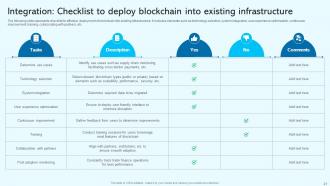
Folie 21: Diese Folie stellt eine Checkliste für die effektive Einführung von Blockchain in die bestehende Infrastruktur dar.
Folie 22: Diese Folie zeigt die Hauptkomponenten des rechtlichen und regulatorischen Rahmens für eine reibungslose Blockchain-Einführung.
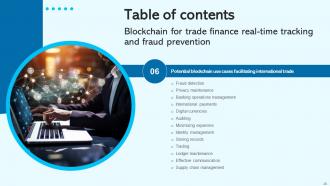
Folie 23: Diese Folie zeigt ebenfalls ein Inhaltsverzeichnis für die Präsentation.
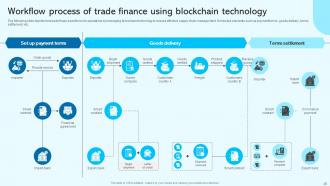
Folie 24: Diese Folie zeigt, wie die Blockchain-basierte Handelsfinanzierung funktioniert, um Kryptowährungen und intelligente Verträge zu nutzen.
Folie 25: Diese Folie zeigt, wie die Handelsfinanzierung ihre Aktivitäten unter Nutzung der Blockchain-Technologie zur Gewährleistung eines effektiven Supply Chain Managements durchführt.
Folie 26: Diese Folie zeigt ebenfalls ein Inhaltsverzeichnis für die Präsentation.
Folie 27: Die folgende Folie zeigt, wie die Blockchain-Technologie bei der Betrugsaufdeckung hilft.
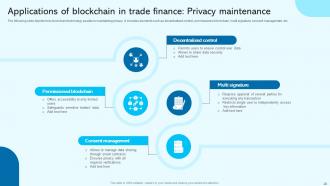
Folie 28: Diese Folie zeigt, wie die Blockchain-Technologie bei der Wahrung der Privatsphäre hilft.
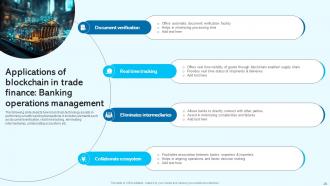
Folie 29: Diese Folie zeigt, wie die Blockchain-Technologie bei der Durchführung reibungsloser Bankgeschäfte hilft.
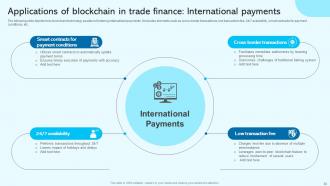
Folie 30: Diese Folie zeigt, wie die Blockchain-Technologie bei der Förderung internationaler Zahlungen hilft.
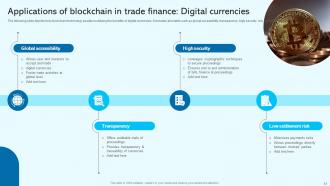
Folie 31: Diese Folie zeigt, wie die Blockchain-Technologie bei der Nutzung der Vorteile digitaler Währungen hilft.
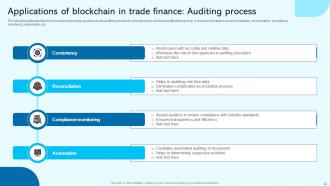
Folie 32: Diese Folie zeigt, wie die Blockchain-Technologie bei der Handelsprüfung hilft, um Fehler zu minimieren und eine effektive Nachverfolgung zu gewährleisten.
Folie 33: Diese Folie zeigt, wie die Blockchain-Technologie bei der Minimierung von Handelskosten hilft.
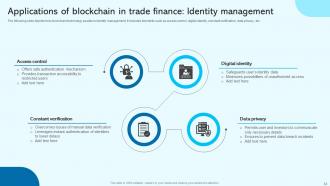
Folie 34: Diese Folie zeigt, wie die Blockchain-Technologie bei der Identitätsverwaltung hilft.
Folie 35: Diese Folie zeigt, wie die Blockchain-Technologie bei der Speicherung und Führung von Aufzeichnungen hilft.
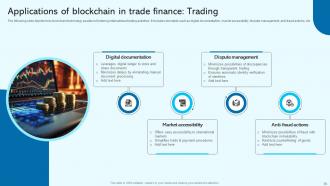
Folie 36: Diese Folie zeigt, wie die Blockchain-Technologie bei der Förderung internationaler Handelsaktivitäten hilft.
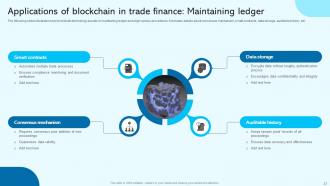
Folie 37: Diese Folie veranschaulicht, wie die Blockchain-Technologie bei der Führung von Hauptbüchern und der Abstimmung verschiedener Verfahren hilft.
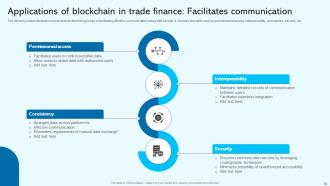
Folie 38: Diese Folie veranschaulicht, wie die Blockchain-Technologie bei der Ermöglichung einer effektiven Kommunikation zusammen mit Sicherheit hilft.
Folie 39: Diese Folie veranschaulicht, wie die Blockchain-Technologie bei einem reibungslosen Supply Chain Management hilft.
Folie 40: Diese Folie zeigt ebenfalls ein Inhaltsverzeichnis für die Präsentation.
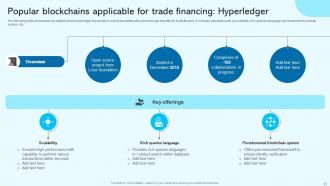
Folie 41: Diese Folie zeigt wichtige Details zur Hyperledger Blockchain, um die beste Alternative auszuwählen und die Vorteile für die Handelsfinanzierung zu nutzen.
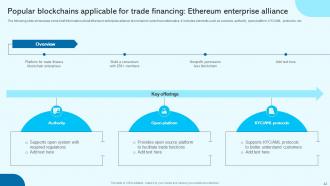
Folie 42: Diese Folie zeigt einige kurze Informationen zur Ethereum Enterprise Alliance Blockchain, um die beste Alternative auszuwählen.
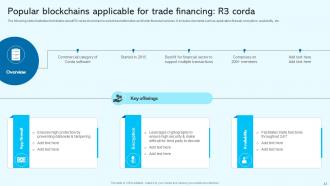
Folie 43: Diese Folie zeigt kurze Details zur R3 Corda Blockchain, um die beste Alternative auszuwählen und Finanzdienstleistungen zu fördern.
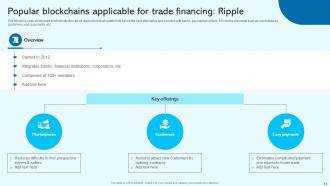
Folie 44: Diese Folie zeigt eine kurze Einführung in die Ripple Blockchain-Plattform, um die beste Alternative auszuwählen und sich mit Banken und Zahlungsanbietern zu verbinden.
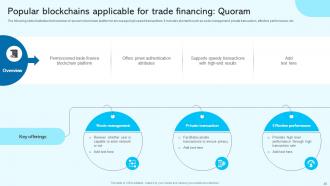
Folie 45: Diese Folie zeigt eine kurze Übersicht über die Quorum Blockchain-Plattform zur Förderung von Hochgeschwindigkeitstransaktionen.
Folie 46: Diese Folie zeigt ebenfalls ein Inhaltsverzeichnis für die Präsentation.
Folie 47: Diese Folie zeigt einige Details zum großen WE.trade Blockchain-Konsortium zur Regulierung der Abläufe.
Folie 48: Diese Folie zeigt einige Informationen zum Marco Polo Blockchain-Konsortium zum Aufbau einer kollaborativen Umgebung.
Folie 49: Diese Folie zeigt eine kurze Übersicht über das Batavia Blockchain-Konsortium zum Aufbau von Netzwerken und Organisationen.
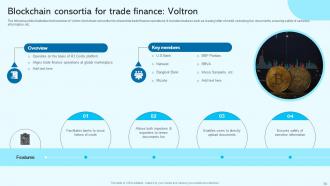
Folie 50: Diese Folie zeigt eine kurze Übersicht über das Voltron Blockchain-Konsortium zur Straffung der Handelsfinanzierungsaktivitäten.
Folie 51: Diese Folie zeigt eine kurze Übersicht über das Komgo Blockchain-Konsortium zur Schaffung einer großartigen Umgebung für die Handelsfinanzierung.
Folie 52: Diese Folie zeigt ebenfalls ein Inhaltsverzeichnis für die Präsentation.
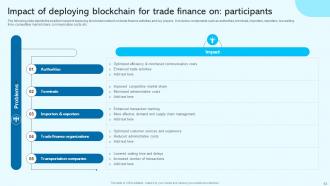
Folie 53: Diese Folie zeigt die positiven Auswirkungen der Einführung eines Blockchain-Netzwerks auf die Handelsfinanzierungsaktivitäten und die wichtigsten Akteure.
Folie 54: Diese Folie zeigt die positiven Auswirkungen der Einführung eines Blockchain-Netzwerks auf die Kommunikationsaktivitäten der Handelsfinanzierung.
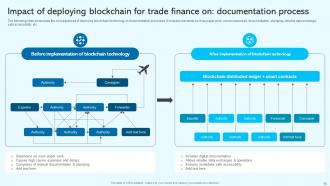
Folie 55: Diese Folie zeigt die Folgen der Einführung der Blockchain-Technologie für das Dokumentationsverfahren.
Folie 56: Diese Folie zeigt ebenfalls ein Inhaltsverzeichnis für die Präsentation.
Folie 57: Diese Folie zeigt, wie die HSBC Bank die Blockchain-Technologie zur Verbesserung der Handelsfinanzierungsfunktionen nutzte.
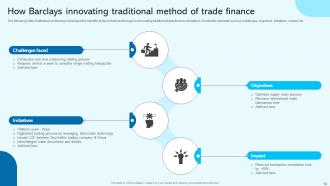
Folie 58: Diese Folie zeigt, wie die Barclays Bank die Vorteile der Blockchain-Technologie zur Innovation der traditionellen Handelsfinanzierungsaktivitäten nutzte.
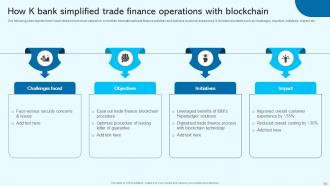
Folie 59: Diese Folie zeigt, wie die K Bank ein Blockchain-Netzwerk nutzte, um internationale Handelsfinanzierungsaktivitäten zu vereinfachen und die Kundenerfahrung zu optimieren.
Folie 60: Diese Folie zeigt den Titel Symbolfolien für Blockchain für Handelsfinanzierung Echtzeit-Tracking und Betrugsverhinderung
Folie 61: Diese Folie trägt den Titel Zusätzliche Folien für den Fortschritt.
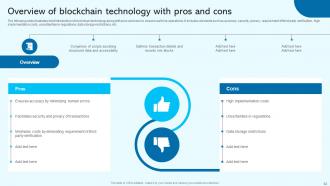
Folie 62: Diese Folie zeigt eine kurze Einführung in die Blockchain-Technologie sowie Vor- und Nachteile zur Gewährleistung von Echtzeit-Operationen.
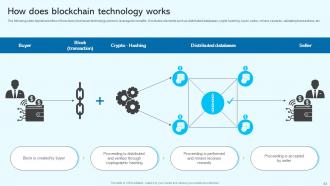
Folie 63: Diese Folie zeigt den Workflow, wie die Blockchain-Technologie funktioniert, um ihre Vorteile zu nutzen.
Folie 64: Dies ist unsere Zielfolie. Geben Sie hier Ihre Ziele an.
Folie 65: Diese Folie zeigt eine Roadmap mit zusätzlichen Textfeldern. Sie kann verwendet werden, um verschiedene Ereignisreihen darzustellen.
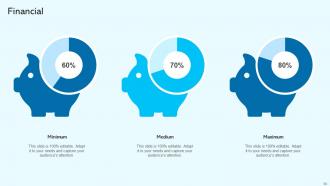
Folie 66: Dies ist eine Finanzfolie. Zeigen Sie hier Ihre finanzrelevanten Inhalte.
Folie 67: Diese Folie zeigt Post-It-Notizen für Erinnerungen und Fristen. Posten Sie hier Ihre wichtigen Notizen.
Folie 68: Dies ist eine Zeitachse. Zeigen Sie hier zeitintervallbezogene Daten.
Folie 69: Dies ist eine Dankesfolie mit Adresse, Telefonnummern und E-Mail-Adresse.
Blockchain für Handelsfinanzierung in Echtzeit-Verfolgung und Betrugsverhinderung
Nutzen Sie unsere Blockchain für Handelsfinanzierung in Echtzeit-Verfolgung und Betrugsverhinderung BCT CD V, um Ihre wertvolle Zeit effektiv zu sparen. Sie sind fertig, um in jede Präsentationsstruktur integriert zu werden.































FAQs for Blockchain For Trade Finance Real Time Tracking And Fraud Prevention
Public blockchains are decentralized, open networks like Bitcoin and Ethereum, while private blockchains are controlled, permissioned systems used by specific organizations. Private blockchains offer enhanced security, faster transaction speeds, and regulatory compliance for banks and financial institutions, while public blockchains deliver transparency and broader accessibility, ultimately enabling organizations to choose based on their strategic requirements.
Blockchain technology enhances supply chain transparency by creating immutable records of each transaction, enabling real-time tracking of products from origin to consumer, and providing decentralized verification systems. Through distributed ledgers, companies in manufacturing, pharmaceuticals, and food industries streamline compliance, reduce fraud, and deliver enhanced customer trust, ultimately enabling faster recalls and competitive advantage in increasingly regulated markets.
Consensus mechanisms serve as blockchain's security backbone by ensuring all network participants agree on transaction validity before recording, preventing double-spending, fraud, and unauthorized changes through cryptographic verification. These protocols, whether proof-of-work in Bitcoin or proof-of-stake in Ethereum, enable financial institutions and supply chain companies to maintain tamper-resistant records, ultimately delivering trust and transparency without central authority oversight.
Blockchain facilitates digital identity verification through decentralized credential storage, cryptographic authentication, immutable record keeping, smart contract automation, and cross-platform interoperability. These technologies streamline verification processes by eliminating intermediaries, reducing fraud risks, and enabling instant authentication, with banks, healthcare systems, and government agencies finding that blockchain-based identity solutions deliver faster services while enhancing security and user control.
Blockchain transforms financial services through smart contracts for automated loan processing, supply chain financing for trade verification, cross-border payments reducing settlement times, and identity management streamlining KYC processes. Banks and financial institutions leverage these applications to minimize operational costs, enhance transaction transparency, and deliver faster customer services, with many finding that blockchain integration provides significant competitive advantages in an increasingly digital banking landscape.
Organizations face implementation challenges including high development costs, scalability limitations, regulatory uncertainty, integration complexity with existing systems, and skills shortages in blockchain expertise. While these hurdles present initial obstacles, many financial services and supply chain companies find that strategic planning, phased rollouts, and partnering with experienced providers ultimately delivers enhanced security, transparency, and operational efficiency.
Blockchain technology addresses data privacy through decentralized storage, cryptographic encryption, user-controlled access permissions, and immutable audit trails that eliminate single points of failure. Through smart contracts and zero-knowledge proofs, organizations in healthcare, finance, and retail can enable selective data sharing while maintaining privacy compliance, ultimately delivering enhanced security and user control over personal information.
Blockchain is expected to significantly transform financial services, healthcare, supply chain management, real estate, and government sectors within five years. Financial institutions are leveraging blockchain for faster cross-border payments and fraud reduction, while healthcare organizations enhance patient data security, and manufacturing companies improve supply chain transparency, ultimately delivering operational efficiency and competitive advantage.
Smart contracts streamline business processes by automating agreement execution, eliminating intermediaries, and reducing manual oversight requirements through self-executing code. These blockchain-based contracts enable faster payment processing, automated supply chain verification, and seamless compliance reporting, with many financial institutions and logistics companies finding that operational costs decrease significantly while transaction speed increases.
Blockchain mining presents both environmental challenges and opportunities, with energy-intensive proof-of-work systems consuming significant electricity, while newer proof-of-stake mechanisms reduce consumption by up to 99%. Many organizations are increasingly adopting sustainable mining practices, renewable energy sources, and efficient consensus algorithms, ultimately delivering reduced carbon footprints and enhanced operational sustainability.
Legal and regulatory considerations for blockchain technology include data privacy compliance, anti-money laundering requirements, securities regulations, cross-border transaction laws, and smart contract enforceability. While regulatory frameworks continue evolving globally, organizations increasingly find that proactive compliance strategies enable sustainable blockchain adoption, with financial services and healthcare sectors successfully navigating these requirements through strategic legal partnerships.
Blockchain enables DeFi by eliminating traditional financial intermediaries through smart contracts, peer-to-peer transactions, and automated protocols that execute without banks or brokers. These decentralized systems streamline lending, trading, and yield farming across global markets, with platforms like Uniswap and Compound delivering lower costs, 24/7 accessibility, and enhanced financial inclusion for users worldwide.
Emerging blockchain voting innovations include zero-knowledge proofs for privacy, immutable audit trails, multi-signature verification protocols, decentralized identity management, and real-time result transparency systems. These technologies streamline electoral processes by eliminating intermediaries, reducing fraud risks, and enabling instant verification, with pilot programs in Estonia and Switzerland demonstrating enhanced voter confidence and operational efficiency.
Blockchain improves food traceability by creating immutable records of each product's journey from farm to consumer, enabling instant tracking of origin, processing, and distribution details. Through this transparent ledger system, retailers and restaurants can quickly identify contamination sources during recalls, reduce food waste, and verify authenticity claims, ultimately delivering enhanced consumer safety and brand trust.
Blockchain contributes to social impact through transparent donation tracking, secure identity verification for refugees, tamper-proof land registries, and decentralized microfinance systems. These applications enable nonprofits to demonstrate fund allocation transparency, help displaced populations access services more easily, and provide financial inclusion in underbanked communities, ultimately delivering greater accountability and trust in social programs.
-
“As you have innovative ideas and they are all customizable, this saves a huge chunk of your time to prepare well-read presentations.”
-
“You have the structure in place that are easy to explore new opportunities.I will be recommending your services to other people.”