





 0 Comment
 Customer Reviews

In every Bond movie, Mr. Bond's success isn't just about his physical skills. It’s also about his ability to gather and use intelligence effectively, much like competitive intelligence in business.
If you do not know what you are competing with, how will you complete any goals?
Running a business is not an easy task, and staying in the limelight of customers is even more of a task! New competition popping left and right, doesn't help either.
To give you and your business the breathing space, and help you make your way to the top, you need competitive intelligence.
Market analysis and marketing intelligence are the crux, as they give you an idea about the market environment. It helps to understand any opportunities or limitations you may face, and help you stay sharp!
What is Competitive Intelligence?
Competitive intelligence (CI) helps you stay updated on topics that affect your competitive edge in the market. It helps to gather information, analyze it, and develop personalized market strategies.
It works, that is why 90% of Fortune 500 companies invest in Competitive Intelligence (CI) and maintain their head start.
Market intelligence helps with both front and behind the scenes. It helps in understanding what is going on in the market and with your competitors. Moreover, it helps to work behind the scenes, by developing correct marketing strategies.
[product_image id=83181]
Check out our template and understand your landscape!
Benefits of Competitive Intelligence
Competitive Intelligence helps to steer your business in the right direction. It helps you get all the important info about your industry.
This is why, 73% of businesses allocate 20% of their IT budgets to CI initiatives, to make better decisions.
Here’s why it is beneficial, with examples:
- Better Outcomes: Competitive Intelligence helps you analyze feedback data and make better decisions. For instance, Apple likely uses competitive intelligence tools and tracks what their competitors are launching, so they can innovate and offer something unique in their own product lines.
- What’s New?: The trends in the market keep changing quickly. CI helps you stay on top. It analyses data and helps to make accurate decisions. Let’s understand by taking Netflix as an example. They use market intelligence tools to see what the audience is interested in. It can be a certain genre or a new celebrity, and quickly adjust their content strategy.
- Better Market Strategy: Professional competitive intelligence researchers help you make a blueprint for your business. It helps to work according to plan and increase profits. For instance, let's talk about Coca-Cola. They analyze their competitors and all the upcoming new products in the coda industry. Using this data they can make plans for new market strategies and hold their no. 1 position.
- Advantage in Market Pool: CI gives you a 360-degree snapshot of your competitors. To establish yourself as a unique business in the market, you need to be updated with your competition activities. Just look at Tesla. They closely monitored the market and saw a gap for electric vehicles. Moreover, this helps set a unique brand image in customers' eyes.
At the end of the day, competitive intelligence is all about using information to make smarter choices, to stay competitive!
- Protection from Mitigation: By using competitive intelligence software, you can spot potential threats before they become problems. Amazon might use competitive intelligence tools to monitor smaller e-commerce platforms, adjusting their pricing or delivery strategies to make sure they keep their lead.
- Better Product Development: CI is a goldmine for product development ideas. Take Nike, for example. They create professional competitor analysis reports. This helps them come up with better ideas. They have introduced sustainable materials and new designs which keep them as competitors in the shoe industry.
- Market Expansion Analysis: Competitive intelligence helps you find new opportunities in the sea of competition. Online taxis are all the range. Uber, an established player launched their app to fill in a market gap. They saw how there could be online booking services. Plus to stay on top, competitive research helps to spot gaps in the transportation market, allowing them to enter new cities and open up new services.
- Savings: CI helps to do things accurately which helps to save resources. Walmart uses market intelligence platforms to see how other retailers, are optimizing their supply chains or online platforms. Competitor analysis frameworks, being prepared with professional research services, help get better results at a lesser cost.
Understand more about competitive intelligence with our templates! Click here.
Methods of Competitive Landscaping or Competitive Intelligence
Understanding your competition is key to profits. Here's how this process takes place:
- Comprehensive Competitor Analysis
Competitive research helps you understand who your competitors are and what they’re up to. A competitor analysis framework highlights strengths and weaknesses, showing where you can improve.
- Social Media Analysis
Social media competitor analysis lets you see how competitors engage with their audience. Tracking posts, content strategies, and customer feedback helps shape your social media strategy. You know where you can get ahead in the market.
- Competitive Market Analysis
Looking at the competitive landscape means reviewing your competitors’ financial health, products, and marketing strategies. Competitor data helps shape your pricing, product, and marketing strategies.
- Promoting Innovation through Competitive Intelligence
Competitive research platforms reveal market gaps. Research services study competitors’ products and your customer feedback. This gives an additional boost to innovation. For example, the tech industry is super competitive and companies keep challenging each other.
- Competitive Intelligence for Market Expansion
Market intelligence for small businesses is essential. It helps get the first step in the market. Besides, it is also important for businesses to expand into different markets. Competitor analysis reveals underserved regions or niches, guiding your growth.
- Better Positioning with Competitive Intelligence Software
Research services use competitive intelligence software. They receive data and analyze it. This provides real-time feedback on which businesses can work on.
- Tracking Technological Advances
Staying updated on technology is crucial. Competitive intelligence helps to track and understand new tech trends and product releases. With this info, your business can adapt and innovate.
- Using Competitive Intelligence for Long-Term Strategy
Strategic competitive intelligence focuses on long-term growth. It helps to combine tactical and strategic intelligence. Moreover, it helps to avoid surprises from market shifts or competitors.
How To Collect Competitive Intelligence Data?
Gathering competitive intelligence is all about knowing where to look and using the right tools to find answers. Professional research services are pro at this, and will help you get the best out of your data:
- Public Sources
A lot of valuable information is out there in the open. Websites, press releases, and financial reports can give you a peek into what competitors are doing. But be cautious of which source to trust.
- Direct Observation
Sometimes researchers would put in the groundwork and check competitors' footprints. These involve trade shows, visiting stores, or checking out product launches. This gives your company the chance to observe competitors in action.
- Surveys and Interviews
Listening to customers is most important. After all, they are going to buy your products. Researchers use surveys and interviews to understand the customers. Marketing intelligence helps understand where competitors are excelling or falling short. This helps shape your strategy.
- Social Media Monitoring
Social media is a magic ball for competitive intelligence. Media platforms have helped bridge the gap, between customers and businesses. This provides quick feedback, be it for product needs or response to an existing product. It helps better market analysis strategies.
Difference Between Competitive Intelligence and Market Research
Competitive intelligence focuses specifically on competitors and the competitive environment, providing insights that can inform strategic decisions. Market research, on the other hand, is broader and typically focuses on understanding the market as a whole, including customer needs, preferences, and market trends.
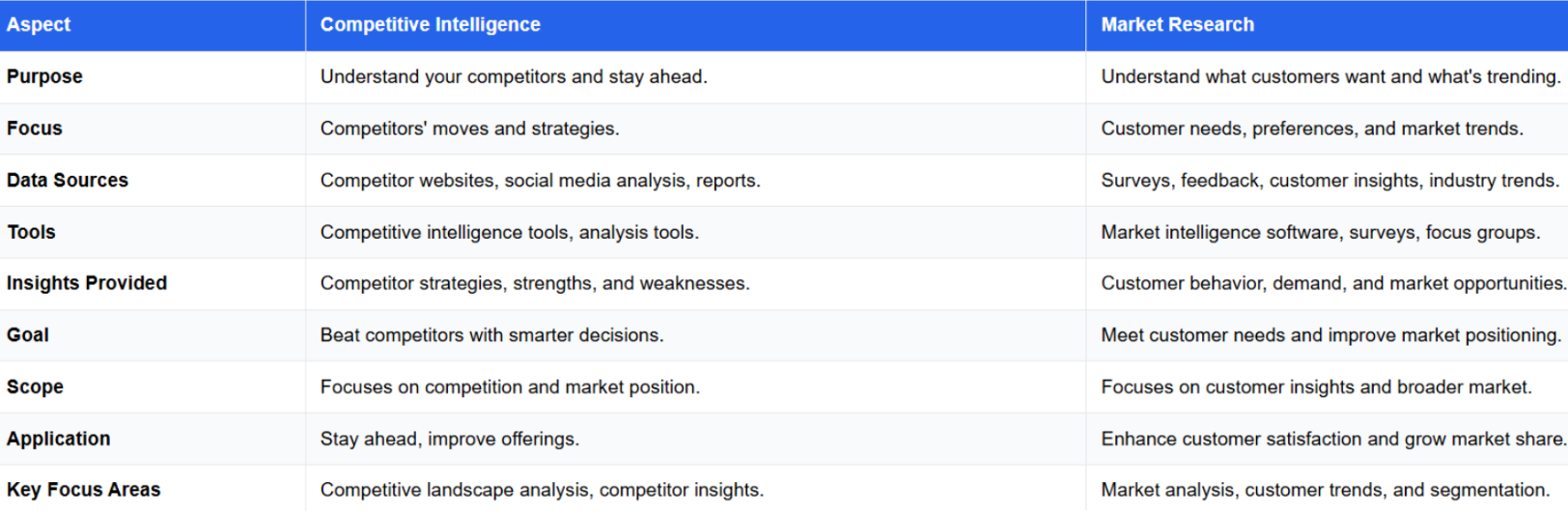
Source: AI PPT Generator
Conclusion
Competitive intelligence is your crystal ball in finding out where your business can grow the maximum. It helps you get a view of the market landscape.
Utilizing competitive intelligence research services will help you monitor your competitors. With data analyses, you can then adjust strategies, and discover new opportunities.
Don’t let your competitors outpace you. Start competitive intelligence for your business now.
We at SlideTeam, know how valuable competitive intelligence is, so let us do it right for you. Our research services will help you grow your business.
Moreover, we offer ready-to-use templates. These professional templates will help you with your presentations. Check them out!
FAQs
- What is CI?
CI is gathering and analyzing competitor information to make better business decisions. - How can CI help my business?
CI helps you understand competitors, spot trends, and find growth opportunities. - What tools can I use for CI?
Use market intelligence platforms, competitor analysis software, and social media analysis tools. - How often should I conduct CI?
Monitor competitors regularly, at least monthly or quarterly. - What’s the difference between CI and Market Research?
Market research focuses on customer trends; CI focuses on competitors to gain a market edge.


