


 0 Comment
 Customer Reviews

A three-year implementation plan is a strategic compass that helps firms navigate the intricacies of contemporary project and portfolio management. Such a plan provides a clear route to accomplishing goals through a methodical approach in a world where firms continuously adapt to change. It guarantees adherence to corporate objectives while offering the adaptability to deal with unforeseen difficulties. At this point, a carefully thought-out Application Roadmap Timeline becomes crucial. Each phase will go logically and effectively, reducing bottlenecks and optimizing results if the schedule smoothly incorporates the linear process of initiation, planning, and execution.
A three-year plan's significance goes beyond its implementation. By attending to the organization's long-term goals as well as its urgent requirements, it creates the foundation for long-term success. A three-year strategy guarantees that efforts are focused and results-driven, whether the goal is to introduce new apps, streamline current procedures, or propel digital transformation. Businesses can assess their success, modify their plans, and maintain agility in a constantly shifting environment by incorporating Portfolio Management principles into their plan.
With a well-defined Application Roadmap template and a resolute emphasis on the Application Linear Process, companies can confidently handle project management challenges, guaranteeing that every stage produces measurable, significant outcomes.
Template 1 - Application Roadmap Three-Yearly Plan Showing Initiation Planning Implementation Template
Organizations cannot afford to ignore an Application Roadmap Three-Yearly Plan as a strategic instrument. Establishing a straightforward, practical approach that incorporates Portfolio Management, standardizes procedures, and gauges progress is more important than merely establishing a course of action. When organizations function without a planned roadmap, it's like attempting to navigate a complicated journey without a map. An application roadmap's linear approach, in which the planning, implementation, and initiation phases flow naturally into one another, instills a sense of direction and confidence. This progression's clarity reduces misunderstandings and guarantees all parties involved are on the same page. While planning goes into defining milestones and allocating resources, implementation brings the vision to reality. Initiation concentrates on establishing objectives and essential stakeholders. The methodical approach creates a sense of direction and confidence, guaranteeing that no critical step is missed.
But why is a three-year perspective the best option? It strikes a perfect balance between actionable urgency and long-term vision. A three-year application roadmap timeline allows firms to make significant changes while allowing for iterative enhancements and modifications. An Application Roadmap Three-Yearly Plan is a framework for attaining excellence rather than only a paper. It revolutionizes how businesses function by combining rigorous measurement, process standardization, and portfolio management. It's essential to ensure the route is effective, well-planned, and has an impact rather than just getting there. This template is essential for businesses hoping to prosper in a technologically advanced, fast-paced environment.

Template 2 - PMO 3-Year Implementation Plan And Developing Charter Template
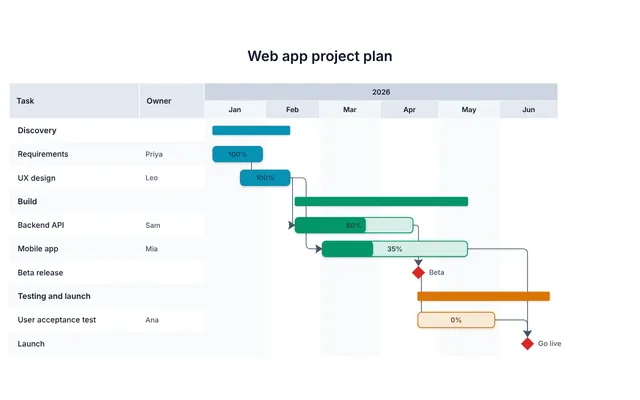
Any organization looking to optimize its project and portfolio management (PPM) procedures must have a three-year implementation plan and charter for the PMO (Project Management Office). Consider a situation where judgments are made based on intuition rather than facts, and projects are dispersed and lack coherence. In this situation, a well-written PMO plan is the main link between strategy and execution. The PMO plan structures this roadmap using a linear application process and application Gantt chart, a sequential technique that guarantees no critical phases are missed. Consider it like building a house, where every step is carefully planned and carried out, from laying the foundation to putting the roof on. This linear strategy maintains projects on schedule by avoiding duplication of labor, guaranteeing responsibility, and encouraging a disciplined approach.
Why is all of this significant? Organizations risk inefficiency, resource waste, and lost opportunities without a cohesive approach to PPM. By emphasizing portfolio management, the PMO ensures that each project is a strategic component of the overall organizational picture rather than merely a stand-alone endeavor. This alignment promotes growth and innovation by enabling executives to prioritize projects that yield the most significant value. This foundation is further strengthened by creating a PMO Charter, which outlines the PMO's goals, parameters, and governance. The charter acts as a compass, keeping the PMO's actions focused and aligned with the organization's strategic goals. It also serves as a roadmap that unites all involved parties, defines responsibilities, and creates accountability. In essence, the PMO Charter is a key component of the three-year implementation plan, ensuring that the PMO's activities align with the organization's long-term objectives.
The PMO 3-Year Implementation Plan and Charter is not just a document or a procedure but a transformation journey. It enables companies to move from disarray to order, from discrete projects to a unified portfolio, and from haphazard choices to strategic brilliance. As a result, the PMO becomes the beating heart of advancement, creativity, and long-term success, driving the organization forward and ensuring that every action is aligned with the strategic vision.

Conclusion
The foundation of any successful endeavor is a well-organized three-year implementation plan, which serves as a compass and a roadmap to lead an organization through a challenging process of change and expansion. Such a plan is necessary because of the ever-changing nature of contemporary business environments, where having a clear goal and direction is essential for overcoming obstacles and taking advantage of possibilities. A well-designed three-year application roadmap that covers planning, implementation, and commencement offers a step-by-step procedure that unifies disparate initiatives and synchronizes them with overall strategic objectives. By encouraging consistency and attention, this alignment ensures that every accomplishment advances the company toward its goal.
It is impossible to exaggerate the significance of such a scheme. Having a three-year blueprint guarantees that firms are not only reactive but actively building their futures in a time when agility and foresight are crucial. Teams can anticipate problems and react quickly thanks to their disciplined approach to innovation, operational excellence, and strategic alignment. In addition to its tactical advantages, this plan fosters a sense of unity and dedication among stakeholders by acting as a focal point. Any implementation plan's ability to balance operational practicality and strategic vision determines its effectiveness. Organizations can lay the groundwork for long-term success by adopting concepts like portfolio management, standardizing and evaluating PPM, and following an application roadmap schedule. The trip may take three years, but the effects of such a methodical approach are felt for years to come, influencing a future characterized by perseverance, creativity, and success. A well-run three-year implementation plan promises to deliver this: a legacy of advancement driven by accuracy and purpose.