





 0 Comment
 Customer Reviews

In the present times, buying anything from anywhere in the world has become easy with just a click on a screen. Behind such convenience lie the masterminds of the founders of e-commerce companies, and one such company is Alibaba. It started in an apartment as a small online marketplace to connect Chinese manufacturers to global buyers. Today, it has become one of the world's largest e-commerce companies. It reshaped the whole e-commerce ecosystem in China and also influenced how the sector should work globally.
Read our delivery highlights PPT templates here with samples and examples.
Alibaba e-commerce is not the only thing; the company has also branched out into sectors like cloud computing, digital media, logistics, fintech, and even smart technologies over the years. But this success was not achieved overnight. From convincing early investors to beating players like eBay with Taobao, the company has come a long way with bold ideas, calculated risks, and relentless execution.
How did the Alibaba global expansion begin? It was through the ecosystem it built that enabled businesses to sell, ship, get paid, and grow easily on one platform. Many companies and startups have so many lessons to learn from Alibaba's history. This blog takes you through Alibaba company profile templates, financial performance highlights, market share insights, competitor analysis, and more, giving you a roadmap to understand how Alibaba built one of the most influential business models of the digital era. In this blog, you will learn about Alibaba's services, Alibaba's market position, Alibaba's leadership team, Alibaba's logistics, Alibaba's supply chain, etc.
To get complete guidance on how to write retail company profile plans, check out our templates. Click here!
Let’s explore!
Template 1: Alibaba Company Profile
If you want to understand how Alibaba became successful, this presentation is for you. It includes everything from the company’s big milestones, its global footprint, to how the org chart is stacked, etc. The deck also includes a SWOT analysis to determine Alibaba's strengths and weaknesses, a business model to tell us how the company actually churns money, plus side-by-side competitor comparisons that put things in perspective. It also includes financial breakdowns that will help you to see what’s fueling the growth engine. If you are an investor, business strategist, student, or anyone who wants to learn how one of the world’s biggest tech giants operates, this deck is useful. Download now!
[product_image id=1119851]
Template 2: Alibaba Company Profile
This Alibaba profile deck is a clear reflection of how big giants run their show. It includes the story of how the company was founded, Alibaba's business models, its global expansion strategies, acquisitions, and financial highlights. For businesses that are just building, this slide deck is helpful as it gives some practical learning opportunities. You see how Alibaba built its marketplace ecosystem, scaled logistics and supply chains, and developed payment solutions like Alipay. You also get a close look at its cloud services, innovation roadmap, and sustainability efforts — all areas where companies can draw parallels for their own growth strategies. If you are an investor, strategist, entrepreneur, or student, this slide helps you benchmark against Alibaba competitors, study digital ecosystems, and explore new markets. Download now!
[product_image id=1469499]
Template 3: Alibaba Company Background
If you’ve ever been curious about how Alibaba went from a scrappy startup to one of the biggest tech companies in the world, this deck is for you. It includes everything from a backstory to the mission and vision that drove it, a breakdown of the business model, etc. It also includes revenue streams, profitability, global reach, and how they’ve handled regulations and compliance over the years. This deck helps you to see how Alibaba built logistics that actually scale, how they leaned into partnerships, how tech shaped their evolution, and where they are handling future growth. This deck gives you a strategy you can learn from on how the company overcame hurdles to reach the position it is now. It is useful for entrepreneurs, investors, students, or anyone who wants to peek inside a global giant and steal some playbook ideas.
[product_image id=1405317]
Template 4: Executive Summary
If you don’t have time to do research on websites and news articles and learn about what Alibaba actually looks like as a business, this executive summary slide does the job for you. It talks about who the company is, what it does, where it makes most of its money, what industries the company works in, and some figures on Alibaba's revenue growth, profit, and even global market share. You will also learn about their other services like core commerce, cloud, digital media, logistics, and some Alibaba innovations they’re always experimenting with. And the scale is wild, from billions in net income to millions of sellers and customers worldwide. For investors, strategists, or even students digging into case studies, this slide helps to understand how a giant like Alibaba positions itself and where the growth engines actually sit.

Template 5: Company Overview
Use this company overview profile to understand at a glance who Alibaba is and who founded it. It includes a timeline that indicates when the company was founded (back in April 1999), what industries it plays in (e-commerce, retail, internet, and tech), how many people it employs (a staggering 235,000+), and even the stock symbol and market cap. It also gives the names of the founders, including Jack Ma, Eddie Wu, Cathy Zhang, and Changwei Ma. Why does this matter? Because if you’re an investor, a strategist, or even just curious about how global giants are built, these are the anchor points. You can quickly see how big the company is, what space it dominates, and who’s been steering the ship.

Template 6: Mission & Vision
The mission and vision statements of Alibaba sound simple and non-corporate. You can understand how important it is to say what is meant to be said using simple words and messaging. Their mission is simple: “To make it easy to do business anywhere.” And then there’s the vision—to be around for 102 years. Oddly specific, right? But it’s clever. It means they’ll span three centuries. It’s less about numbers and more about legacy. The values they carry—customers before shareholders, trust, change, and even the reminder to work happily—are operating instructions and a culture code. And if you’re building a business, leading a team, or even just figuring out your own way of working, there’s something here to steal in the best way possible.

Template 7: Alibaba’s Market Position and Value
When you look at Alibaba’s market position, it tells a story about where the company is winning big and where it needs to improve. E-commerce is clearly the core of its business and revenue outcomes, pulling in the majority of revenue, but what really stands out is how much cloud has grown into the picture. Cloud occupies the next highest position on the pie chart after e-commerce. The revenue growth chart implies some ups and downs that make you realize growth isn’t always steady but comes with some shocks every now and then. And the key metrics hit you with both sides of the truth. Market share and user base are soaring, but profit margins and growth rates are feeling the pinch. Whether you’re an investor, a competitor, or just curious, this slide gives a quick pulse check of the company.

Template 8: Key Financial Highlights
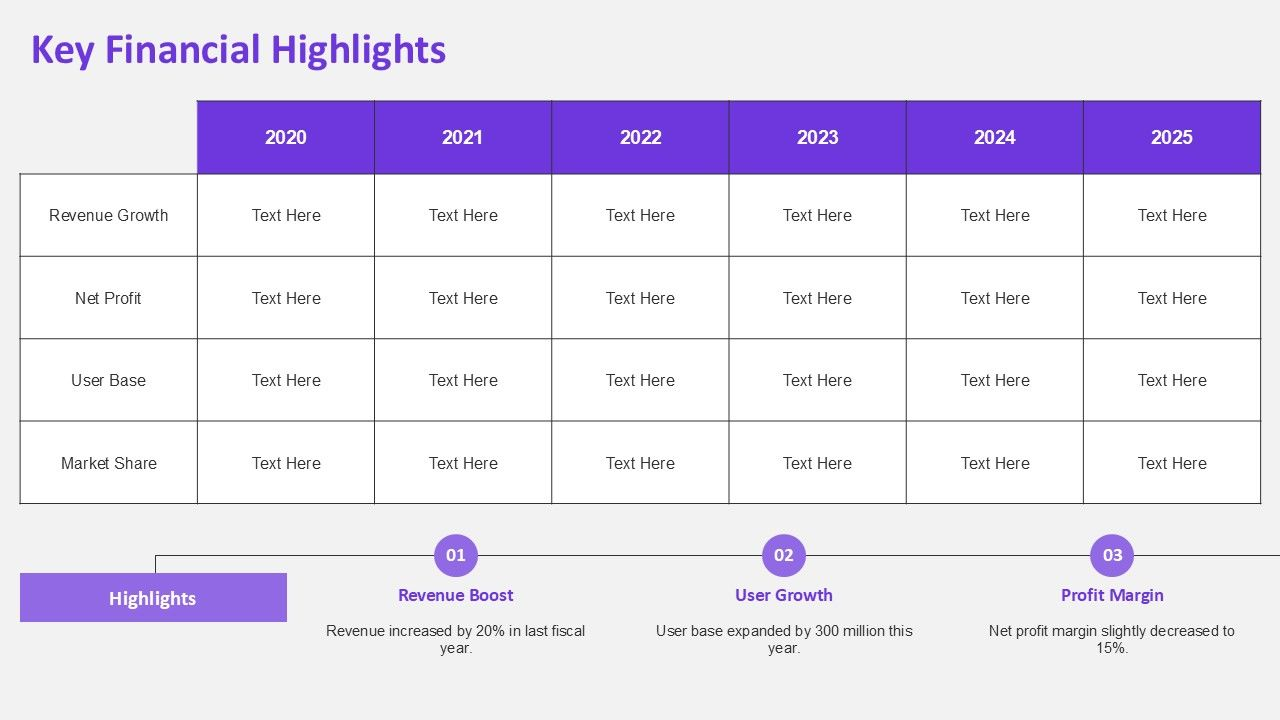
Alibaba’s financial story encompasses growth, dips, and adjustments that every business, big or small, can relate to. From 2020 through 2025, the company data in this slide implies that there was a steady climb in revenue and an increase in the user base by 300 million in just a year. There is also a slight decrease in profit margins. A 20% increase in revenue may look good, but when you look at the drop in profit margins, it raises questions like how Alibaba is reinvesting, what bets they are making, and what’s paying off? This slide acts as a reality check for investors, a playbook for strategists, and a guide for business people. And for anyone studying global giants, it’s a reminder that even the most powerful companies are constantly tweaking, testing, and learning. Numbers don’t just measure but tell the underlying story.
Template 9: Evolution of Alibaba Technology
Most companies evolve with technology, and so does the Alibaba company. This slide talks about the evolution of the company by offering a glance at the numbers, the milestones, and the moves in the past. This slide is a reminder that every slide, timeline, and metric is a moment where someone made a choice, took a risk, or solved a problem. When you look at their tech evolution, financial highlights, or market position, you start noticing patterns: bold ideas paired with calculated risks. They also signify that the growth was never persistent but constant, and wins did not happen overnight. The slide also signifies the values, the vision, and the culture behind it all. They show why the company moves the way it does. For entrepreneurs, investors, or anyone trying to figure out the game, seeing it this way is way more useful.

Template 10: Competitive Landscape Analysis
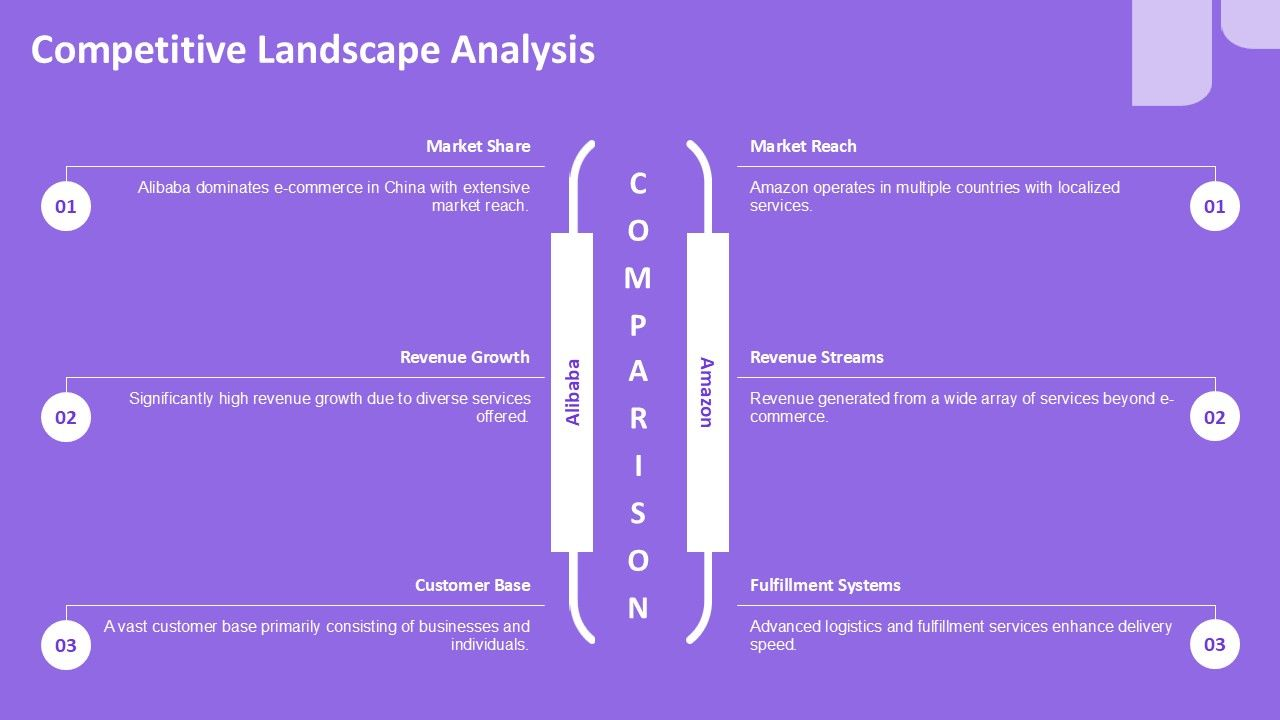
This slide shows a competitive analysis of Alibaba and its competitors, such as Amazon. Alibaba is perceived to be the biggest game player of China’s e-commerce scene with a good customer base, strong revenue growth, and a reach. Amazon, on the other hand, offers services worldwide, building localized services and coupling that with logistics and fulfillment systems. Alibaba thrives by deeply embedding itself in one huge market and diversifying services, while Amazon plays the global game, making sure deliveries are fast and seamless everywhere it operates. For business folks, entrepreneurs, or anyone just curious about e-commerce giants, this slide will help you see how scale, strategy, and operations all come together to create advantage.
Over to you!
Building a company from scratch may not be as easy as it is for every other founder. However, even if the inspiration doesn’t work, one can try to take the guidelines from the successful founders via decks like this. Our blog painted a complete picture of how Alibaba started, failed, thrived, and ultimately became successful. Although they had a tough journey somewhere in China, anyone around the world could easily understand how they built what they built with the help of our templates in this blog. Download our 100% editable and customizable templates for your best use.
Explore our top 10 company profile executive summary templates here
FAQs on Alibaba Company Profile:
When was Alibaba founded and who is the founder?
The Alibaba company was founded in 1999 by Jack Ma.
What is Alibaba’s mission and vision statement?
Its vision statement is: “To make it easy to do business anywhere.” And its mission statement is: “We aspire to be a good company that will last for 102 years. We envision that our customers will meet, work, and live at Alibaba.”
What are the core business segments of Alibaba Group?
Core Commerce, Cloud Computing, Digital Media & Entertainment, Local Consumer Services, Innovation Initiatives & Others