






 0 Comment
 Customer Reviews

The award-winning Hollywood film Erin Brockovich, starring Julia Roberts, shed light on water contamination. The film went on to win an Academy Award, but the questions it raised for biodiversity monitoring persist.
Biodiversity monitoring, the mammoth subject of study, requires careful study and application to be effective. SlideTeam knows the challenges of communicating the ins and outs of this topic. Hence, we provide businesses and consultancies with PPT templates that they can use to make an impact.
From definitions to technologies to metrics, we cover it all in our slides. Even better, here’s a table to illustrate how our templates have a clear edge and give you the boost you need to preserve and expand biodiversity monitoring.
How do SlideTeam’s PPTs help you achieve your goals?
Why SlideTeam Helps You Achieve Goals
How It Supports You
Ready-to-use professional designs
Delivers clarity and impact instantly.
Easy customization
Saves time and aligns perfectly with your needs.
Covers every business topic
Provides templates for any goal or scenario.
Structured, goal-focused layouts
Keeps presentations clear, logical, and actionable.
Boosts productivity
Lets you focus on strategy—not slide creation.
Let’s explore these 100% editable and customizable templates.
Template 1: Biodiversity Monitoring in Forests PowerPoint Template
Use this prebuilt SlideTeam PowerPoint Template to start with the state of forest biodiversity in terms of habitat loss, protected areas and so on. The complete deck also showcases biodiversity indications and metrics, with field surveys for monitoring getting a separate slide. Biodiversity monitoring challenges and solutions form an integral part of this PPT package. Educating stakeholders and public figures is next on the list of priorities, before we conclude with frameworks for effective biomonitoring strategies.
[product_image id=1512961]
Template 2: Biodiversity Monitoring and Conservation Using Remote Sensing
This is a ready-to-use PPT template for environmental managers and conversationalists to evaluate how remote sensing contributes to the goal of biodiversity monitoring. Use this predesigned SlideTeam PPT Template and give a brief overview of types of remote sensing data. Showcase the resolution, scale and application of each type and walk your audience through highlights of each. This PowerPoint template also comprises sections on satellite data, aerial imagery, ground surveys and lidar technology. Community involvement is also emphasized.
[product_image id=1582877]
Template 3: Mapping and Monitoring Biodiversity Hotspots
Use this SlideTeam PPT template to record a historical overview of biodiversity mapping and identify critical biodiversity areas. You can also take note of major and minor milestones. This professional and appealing PowerPoint template is perfect for drawing up a comprehensive analysis of how technology is useful in mapping biodiversity hotspots. Integrating traditional knowledge in monitoring helps as well. A geographical study is also included, as are future mapping techniques and innovations. Get this PPT template now!
[product_image id=1511988]
Template 4: Monitoring Frequency of Pollution and Biodiversity Loss Trends
Outline a comprehensive way to understand biodiversity loss trends and the impact of pollution on diversity. Regional variations and key pollutants and their effects flag the issue well. Challenges in pollution management also need documentation and this SlideTeam diagram does this well. How to ensure policy frameworks support the overall efforts and funding is adequate is also flagged before an alarm is raised. We end with a conclusion and key takeaways.
[product_image id=1617397]
Template 5: Key Components of Forest Ecosystems PPT Template
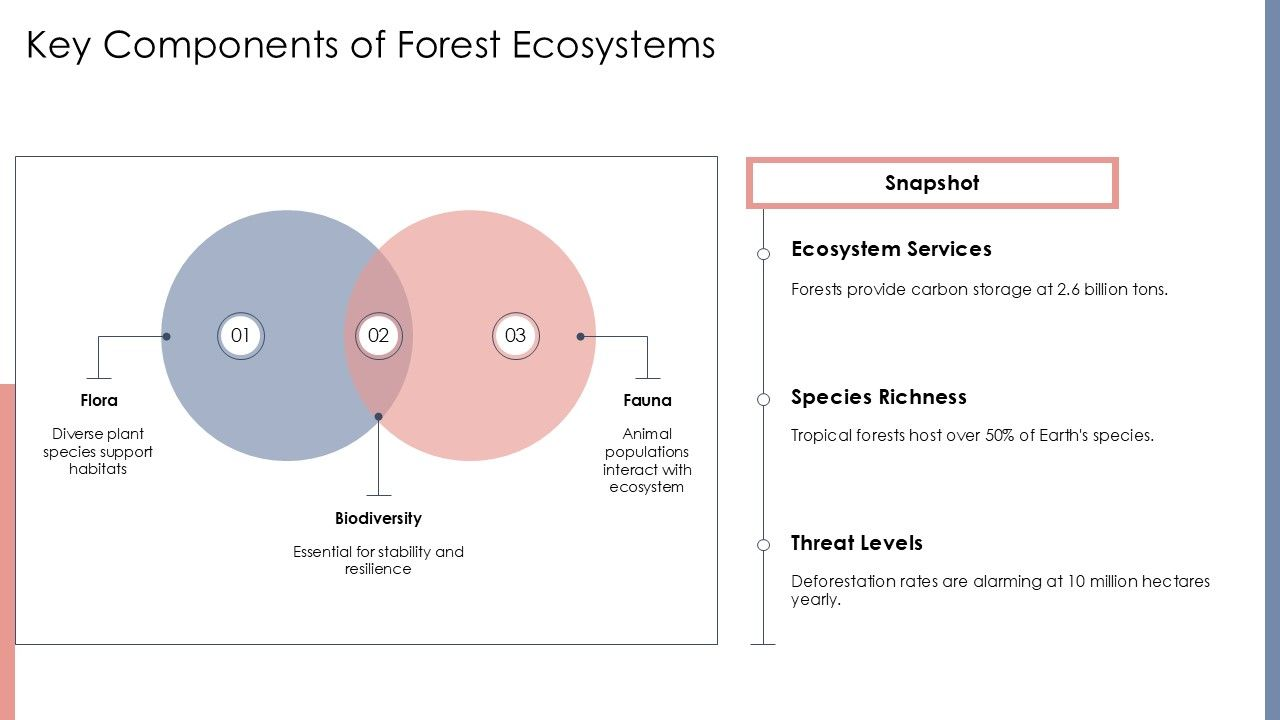
Use this predesigned PPT template to internalize a snapshot of what tasks you can plan around forest ecosystems, keeping their components in view. Create a professional and well-crafted diagram illustrating these as flora, biodiversity and fauna. This PPT template also comprises a section indicating how these components are linked to preserving the habitat we live in. Use this actionable PowerPoint template from SlideTeam to exhibit these as ecosystem services, species richness and threat levels.
Template 6: Biodiversity Monitoring Challenges PPT Framework
It is a ready-made PowerPoint template exhibiting your findings and conclusion on major challenges that biodiversity monitoring entails. This SlideTeam PPT consists of sections highlighting these as data limitations, funding shortfalls, policy gaps and technological barriers. You can also give a brief note on how each of these will be tackled so you understand how to holistically move toward better and more meaningful biodiversity monitoring.

Template 7: Policy Frameworks for Biodiversity Protection
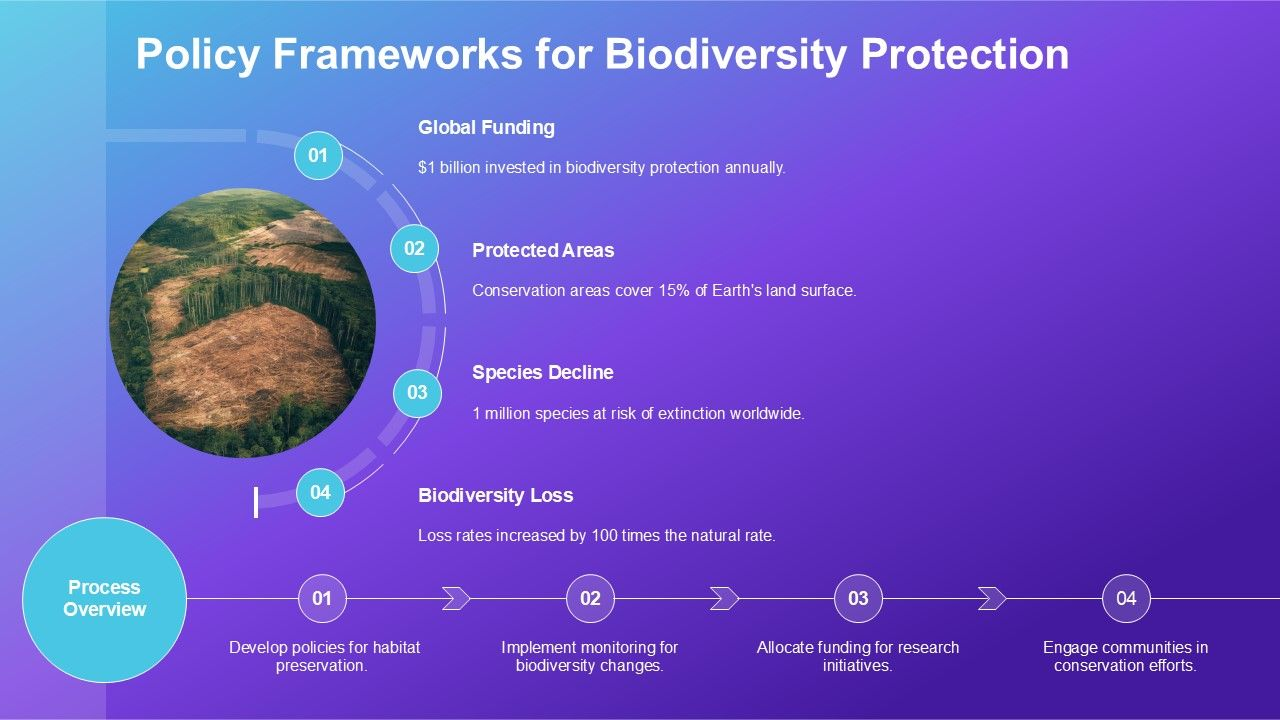
Incorporate this professional and appealing PPT slide to monitor activities involved in drawing up an implementable policy framework for biodiversity protection. This is a ready-made PowerPoint template to help you streamline a process that delivers on biodiversity monitoring and protection. This SlideTeam PPT Diagram showcases the key points to consider, such as global funding, protected areas, species decline and biodiversity loss. Grab this flexible PPT template to outline a process. It emphasizes developing policies for habitat preservation, allocating funding for research initiatives and engaging communities in conservation efforts.
Template 8: Role of Technology in Monitoring Biodiversity PPT Template
This pre-designed PowerPoint slide exhibits three technology domains that help preserve and conserve biodiversity. The purpose is to see biodiversity as something that deserves investment in technologies, such as remote sensing, data analytics and mobile applications. The USP is that the SlideTeam product facilitates citizen science. Our work is done through mobile apps that engage the public in reporting species sightings, which helps in the collection of valuable data for biodiversity monitoring.

Template 9: Data Sources for Pollution Monitoring PPT Template
This SlideTeam PowerPoint Template outlines how knowing accurate and usable data sources is critical to monitor pollution and hence biodiversity. It is a content-ready PowerPoint diagram showcasing satellite data, field sensors, community reporting and government reports that help in diagnosing the issue correctly. Deploy this pre-designed PowerPoint template to understand how insufficient data hampers effective monitoring efforts. Use this professional and attractive slide to ensure air quality, water quality, and biodiversity trends see a remarkable improvement once data-based reporting takes hold.

Template 10: Integrating Remote Sensing with Ground Data PowerPoint
This top-drawer PowerPoint template helps scientists and even the layman to systematically approach the issue of using technology wisely. It is a content-ready PowerPoint slide showcasing how identifying target areas for biodiversity is the first step. You can use this PowerPoint template to outline tasks involved, such as collecting, validating and analyzing data to ensure model biodiversity metrics can be arrived at using available data. Use this ready-made PowerPoint template to ensure that the reporting, implementing and monitoring systems are also perfected over time.

RESPECT BIODIVERSITY
The rich biodiversity of the world is a gift from the gods. We are under divine orders to preserve and monitor it to ensure our species can survive and businesses can function until eternity. With this aim in mind, SlideTeam has designed and curated these templates to ensure we all respect biodiversity. Understand, explore and ensure that biodiversity sustains and provides us with the invisible drive and power we need to function well as a united world.
FAQs on Biodiversity Monitoring
What are the most effective technological tools currently used in biodiversity monitoring?
Technology has indeed come to dominate the way biodiversity monitoring is conducted and implemented. The major techniques used are remote sensing, the use of sound (bio acoustics) and even the use of artificial intelligence to identify and decode patterns in biodiversity that might be in a negative direction. Geospatial analysis and satellite data also matter.
How can remote sensing and satellite imagery enhance biodiversity data collection?
Remote sensing is such an important part of biodiversity conservation, as it allows humans to identify and analyze without physical risk. It helps in habitat mapping, species distribution and forest health. It also allows comprehensive evaluation of assessment conditions. Satellite imagery uses global coverage to track ecosystem changes over time.
What role do citizen science initiatives play in large-scale biodiversity monitoring?
Biodiversity mining cannot be a top-down directive. It requires the application of techniques that involve active participation from citizens using science. The idea is that for biodiversity, it can be really impossible for an outsider to know the data except for people who have lived at a spot. A popular example that comes to mind is the Amazon rainforest biome, a biodiverse heaven. It can only be explored through citizens rather than any technology, though slowly we are also developing technologies that help us stay there.