





 0 Comment
 Customer Reviews

Do you think your hunt for better career prospects ends when you land ‘that’ dream job role? The simple answer is no. Once you get that position, there are a series of career steps that you want to climb to keep getting better. And that only makes sense, right?
These career progressions are important to keep momentum going, develop skills, and pivot into the right job role at the right time—simply summarizing, ‘not stopping’! Career steps tend to be crucial since they provide a clear job trajectory for growth by setting clear goals.
These steps are not restricted to a particular job role. These progressions come with every role, and every employee strives to get higher in the order; this helps them stay motivated and build exceptional skills.
This brings us to the question of seeing how such a career track progresses and if it's possible to track the trajectory. The answer is most definitely yes! These templates that you’ll check will do the same for you. Please keep reading to see how you’ll be able to use them!
Template 1: Human Resource Generalist Career Steps Flowchart
This template showcases the different career ladders for HR generalists, such as employee relationships, recruitment and talent acquisition, compensation and benefits, people and culture, and HR compliance. Every job role that the generalist might get into will have a series of steps in the future. For employee relationships, there is an employee relationship specialist, senior employee relationship specialist, employee relationship manager, employee relationship director, and then VP. A similar order of career steps is seen for HRG when it specifically gets into recruitment and talent acquisition, compensation and benefits, people and culture, or HR compliance.

Template 2: Product Marketing Manager Career steps with job responsibilities
This template illustrates the different levels of product marketing career pathways. It also includes the years of experience and job responsibilities to be fulfilled at each stage. The levels show the job titles - Associate PMM, PMM, Sr. PMM, Director of Product Marketing, VP, etc. All these levels will vary across the job role that is being talked about. Against each level is the years of experience mentioned along with job responsibilities. When it comes to the early stages of the job, managing different work streams or managing complete product launches can be the key role. However, as one keeps growing into the role, there are added job responsibilities, which could include representing the PMM team cross-functionally, key product marketing stakeholders to represent various functions, etc.

Template 3: Career Steps for Internet Marketing Professionals
This template helps illustrate the career path for digital marketing personnel with salary growth and years of experience. It includes different levels of career tracks, such as digital marketing assistant, manager, vice president, etc. In the early years, the role could be digital marketing assistant manager, which eventually grew into a manager role. This sees a jump to senior manager followed by general manager. After these, there is a track to get into the stakeholders' chair, with VP roles. The role could be VP of digital marketing and then Sr. VP of digital marketing. The growth potential is immense, and that can be highlighted using this slide.

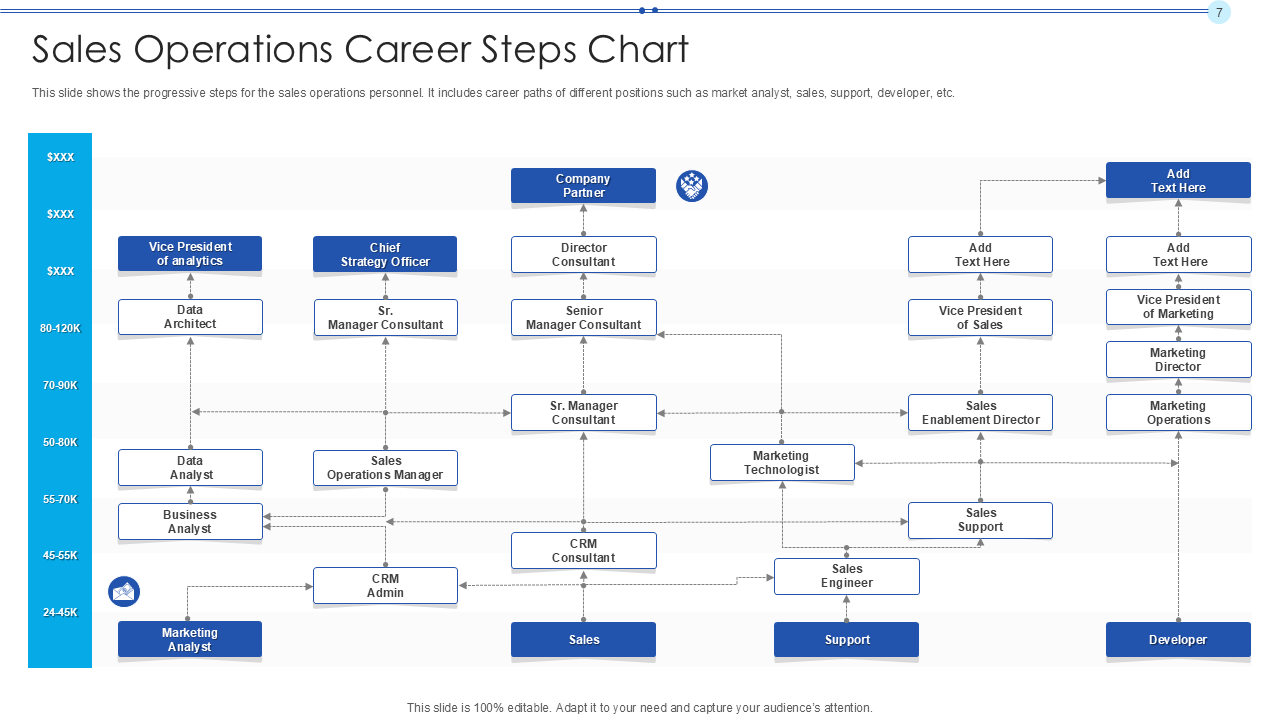
Template 4: Sales Operations Career Step Chart
This template helps show the progress made by the sales operations personnel. It includes career paths in different positions such as market analyst, sales, support, developer, etc. These different paths for marketing analysts could be CRM Admin, business analyst, data analyst, data architect, and then the VP of analytics. Similarly, sales could be following a similar trajectory. Support could be seeing the trajectory of a sales engineer, followed by a marketing technologist, who grows into a Sales enablement director or a Sr. Manager consultant. This template clearly shows that a single job position can have multiple trajectories, and people can grow into different job roles accordingly.
Template 5: HR Specialist Career Steps Flowchart
This template showcases the career track of a human resource specialist. It also includes necessary educational qualifications and work experience for different job grades, such as assistant, manager, specialist, director, etc. Education and experience in the field could be BA/BS in HR or related field - entry-level position or higher, which is 3+ years, or even higher, which is 5+ years, and that keeps increasing. The job role generalist track could be HRG - which grows into the Hr director role followed by Chief Human resource officer. When it comes to a specialist track - The HR specialist can grow into a Training and development specialist, payroll specialist, etc.

Template 6: Corporate Management Consultant Career Steps
This template showcases the corporate career ladder and the job responsibilities for consultants. It includes career positions such as business analyst, associate consultant, consultant, senior consultant, managing consultant, associate Partner, and Partner. A business analyst usually has a fresher level, followed by an associate consultant who has first-hand working experience in consulting. The consultant is a generalist with expert experience in consulting, followed by a project leader with deep consulting knowledge. The Managing Consultant has extensive consulting knowledge for client relationship building. The Associate partner has the responsibility for the company’s market share, followed by the Partner, who has the responsibility of associate partners and stakeholders.

Template 7: Corporate Marketing Career Steps Roadmap
This template shows the significant career levels for social media marketing employees. It includes job roles based on organizational priorities, such as intern/entry-level, junior content or marketing roles, mid-level roles, senior marketing roles, and C-suite marketing executive roles. The entry-level can be content creation with training and guidance, the junior content role could be independent content creation, the senior marketing role could be the implementation of marketing strategies and initiatives, and the mid-level could be social media account management and direct content creation. The C-suite role could be planning a budget for the company’s marketing strategy.

Template 8: Steps to Create Employee Career Development Plan
This template showcases steps to create employee career development paths that assist in skill enhancement and career advancement of the workforce in organizations. It contains points such as self-assessment activities, skill development steps, and plans, upgrade projects, etc. Engaging in self-assessment activities involves identifying employee skills, assessing career goals, etc. Setting clear objectives helps in defining short-term and long-term career objectives. Creating a skill development plan involves identifying skill gaps and areas for improvement. Seeking mentorship and guidance will help in connecting with mentors, seeking career advice, gaining insights, and learning from experienced professionals. Reviewing and upgrading progress will help assess career progress, adjust development plans based on changing career goals, etc.

Template 9: Steps for successful career pathing implementation
This template shows 4 four-phase career pathing execution processes to manage the career paths of employees in the organization. It includes identifying the career development stages that are needed, developing a talent framework, setting employees, and evaluating them. The identification of methods to motivate employees and align their career paths with the organization's objectives is important. Development of a talent management framework helps in building a portfolio for competency-based job roles, setting employees for career pathing helps in assessing job profiles to understand how ready the candidate is, and the final step is communication, development, and evaluation to assess program effectiveness and building strategies to make improvements to maximize results.

Template 10: Career Growth plan steps of marketing manager
This template shows the steps to pursue career growth in the designation of a marketing manager. The purpose of this slide is to highlight the major steps required to excel in the field of marketing as a manager. It includes steps such as building conceptual understanding and starting mini-projects. Building conceptual understanding can be done by learning the basics of marketing from online tutorial videos. Practising mini-projects is a good way to learn, and that can be done by joining internships or building LinkedIn profiles to join marketing communities. Designing portfolios can help build a portfolio of marketing, and implementing learnings via platforms like freelancer.com can help in getting remote projects.

Building a career with signs of professional growth is important to keeping employees going. These templates will come in handy when you are looking to see how role progression will happen across various job opportunities. We will be back with more such helpful templates; keep an eye on this space for more!