



 0 Comment
 Customer Reviews

Precision and efficiency are the cornerstones of a digitally controlled world. Information is stored, processed, and transacted using the binary number system, the language of ones and zeros that powers modern computing. Logic gates, the bread and butter of any digital circuit, manipulate binary signals to effectuate the simplest tasks. These circuits, or combinations thereof, are based upon Boolean algebra, which dictates the mechanics of aligning the logic gates and integrating them into managing rather complex duties in electronic devices.
This microprocessor, the computer brain, executes millions of instructions every second. A very complex system, this uses digital signal processing to perform anything from image rendering to audio enhancement, hence making it work appropriately through all its applications. But what is magic under that appearance is data encoding, which transforms raw information into some structured digital format that allows communication between systems. The efficiency of such processes relies on things such as flip-flops, which serve as tiny memory units that keep hold of and transfer information in sync with a system's clock synchronization mechanism.
The digital system is essentially a competition between its interrelated units to determine the efficient function of every instruction, signal, and data working under and toward the set goals. Operating in the silence of the night, the world of faster binary signals, from the time the finger presses a simple key to when breakthroughs are reached in computations inside an AI processor, will automatically build up a promising future for the technology.
Template 1 - Digital Payment System Market Entry Report Transformation Payment Solutions Template
The digital payment system market is shifting radically due to rapid technological advancements reenacting transaction processing. Digital circuits form the backbone of transactions in the modern world. These circuits work based on the binary system whereby every bit or piece of financial data, from a simple payment request to a complex encryption key, is represented by long strings of 1s and 0s. This primary trait of digital technology guarantees precision, security, and efficiency in electronic payments, thus becoming a far quicker and more dependable means of transactions than ever before. The future of digital payments is so much in the same coin as technological evolution. With the improvement of microprocessors and digital circuits, the industry is poised to see an unimaginable level of speed, security, and scalability. Payment systems will embrace innovations in digital signal processing and logic gate-driven automation that continue to change how consumers and businesses conduct their financial transactions, guided further down the line of seamless, intelligent, and secure digital commerce.

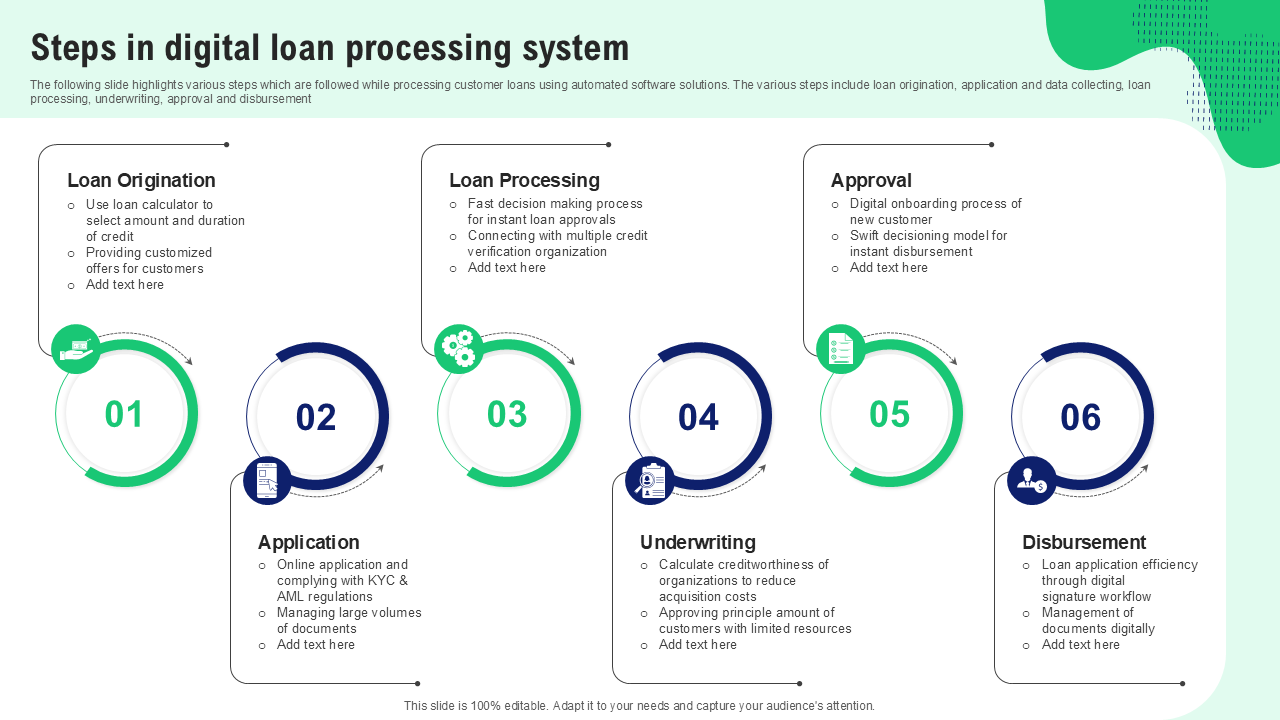
Template 2 - Steps In Digital Loan Processing System Template
Digital loan processing uses complex digital circuitry in which data are seamlessly transmitted through interconnected components in a system designed for efficiency and precision. The system is mainly guided by the principle of the binary system in which every operation is defined in 0s and 1s: the fundamental language of a digital system. This systematic numeric approach allows for smooth processing, archiving, and retrieval of financial data, especially for quicker and more reliable loan approvals. Since financial institutions deal with digitalized and traditional financial data, this conversion allows for a standard method for paper recordkeeping and converting handwritten signatures into machine-readable formats. This would also ensure that even conventional banking elements can fit within modern digital communication frameworks that allow instant loan approvals. In addition, embedded systems in banking infrastructure have automated critical functions, making loan disbursal, document verification, and fraud detection much more efficient than before. These dynamic digital processes have made modern loan processing faster, safer, and smarter than ever.
Template 3 - Essential Components Of Digital Twin System IoT Digital Twin Technology IOT SS Template
The Digital Twin system is further evidence proving the interesting phenomena that occur in the digital arena. These systems make virtual replicas of physical entities, enabling real-time tracking, forecasting, and more informed decision-making. At the core of each Digital Twin system is the foundation of digital tech- the binary system. By all accounts, the intricate interplay of ones and zeros of the binary code is the primary mode of how machines interpret and process information. These systems bear the complexity brought by processing vast amounts of data together. At the operational level, flip-flops are the earliest type of sequential circuits that flow information while ensuring stability in the transition from one state to another. Using memory storage as a secondary step, those components can store critical history remnants needed for a digital twin to learn from previous patterns while reiterating them for later improvements. Registers temporarily keep essential information concerning the current data processing to speed up the CPU and reduce latency. These operations are executed by the arithmetic logic unit, which is contained in the microprocessor and performs all the requisite mathematical and logical operations to drive intelligent decision-making with the digital twins. Digital twins will become more potent as industries adopt this paradigm, substantiating the intricate relationship between digital fundamentals and next-generation technological innovations

.
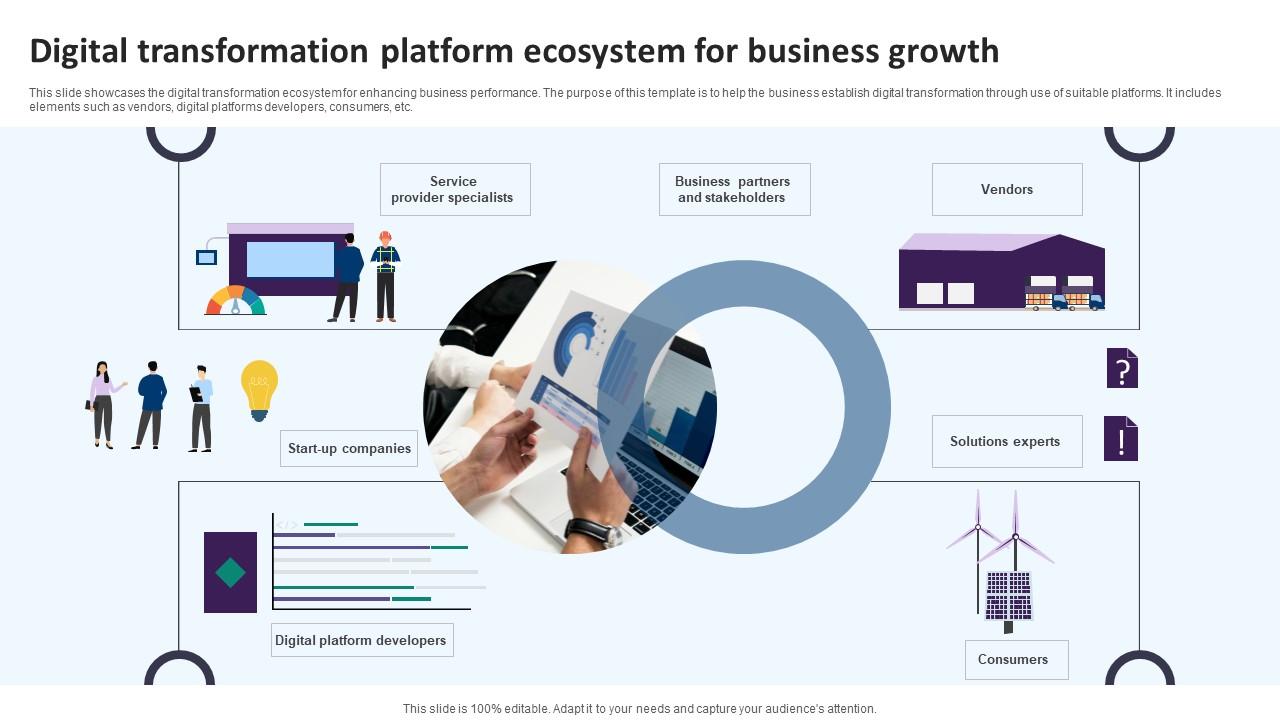
Template 4 - Digital Transformation Platform Ecosystem For Business Growth Template
Once upon a time, digital transformation was thought to be an idea of the future; now, it has become the blood that drives today's efficiency, scalability, and innovation machine. At the core of this transformation resides an intrinsic reliance upon the binary system, the primary language common to all digital systems. From a global company using cloud computing to a small business performing automation, all operations are built upon the binary engine of ones and zeros. In conjunction with digital circuits and logic gates, this binary model enables the smooth flow of information, allowing businesses to work with precision, speed, and intelligence. Digital transformation, in essence, is about using those intricate facets of technology to showcase innovative, fast, and adaptable business ecosystems. Convergence among digital circuits, microprocessors, and logic gates goes beyond computation- it's a channel for innovation, informed decisions, and opportunities unlocked. Businesses that make the most of these digital foundations will not only realize survival in this modern economy but also become increasingly scalable and intelligent, facilitating setting benchmarks toward efficiency in a world driven by automation.
Template 5 - Key Applications of Systems Engineering Models Template
Digital systems flourish owing to precision, efficiency, and seamless functioning underpinned by sound systems engineering models. These models are, in their very essence, deeply rooted within binary systems, the very basis of digital computation, wherein processes are reduced to a chain of ones and zeros. This simple framework enables a complex choreography of digital circuits such that information is processed, stored, and communicated efficiently. With the advances in digital technology, system engineering models and their digital advances continue to shape the modern world. Whether computing, communication, or automation, logic, memory, processing, and synchronization interact harmoniously, allowing digital systems to evolve efficiently, accurately, and adaptively while changing industries and lives.

Template 6 - Benefits of Model-Based Systems Engineering Template
Model-Based Systems Engineering (MBSE) transforms how digital systems are conceived, developed, and maintained. As in MBSE, everything ranging from microprocessors to embedded systems speaks to a controlled, efficient, and dependable methodology through system design. This approach enables engineers to conceptualize, simulate, and validate complex digital architectures before physical construction, thus reducing errors and optimizing performance. MBSE provides fast adaptability to make digital systems ever more complex, thus helping to refine unique functionalities and making them scalable over a certain period. It helps predict electronic circuit performance under different load conditions, locate bottlenecks, and take adequate actions in anticipation of improved efficiency. The predictive capability of MBSE minimizes costly mistakes, reduces cycle time, and inspires creativity in the fast-paced evolution of digital technology. Winning the long-sought goal of a comprehensive, simulation-driven system design, MBSE offers engineers a way to design more innovative, faster, and more efficient digital solutions that drive the future of technology.

Template 7 - Digital Transformation in Banking Service System Template
Digital transformation has brought radical changes into the banking world, incorporating innovative digital mechanisms to simplify and revolutionize core processes such as efficiency, safety, and customer experience. While doing this, at the center is a binary system- a module where the fundamentals of digital work operate. In the banking world, every transaction, whether as simple as a balance inquiry or as complex as risk assessment, is ingrained in bits, allowing seamless digital communication between banking infrastructures and the end-users thereof. As the world continues to go digital, so do the various processes of innovation taking place in the banking world as they enhance reliability, speed, and safety. Everything revolves around twos and zero, from binary, the core of digital banking, to the various intricate webs of digital circuits and processors. Inspired by advances in AI, blockchain, and quantum computing, the future of banking is promisingly more efficient, ensuring the world's financial market remains central in the vast scale of digital development.

Template 8 - Future Advancements in Model-Based Systems Engineering Template
MBSE applications are set to transform the world's present and initiate a future of perfect efficiency, precision, and innovation. In this metamorphosis, binary systems, representing the underlying language of all digital devices, stand right at the conflux. According to technology’s evolution, MBSE entails groundbreaking improvements in the design, simulation, and optimization of digital circuits. The most exciting OMG advancements are in digital signal processing, where model-based techniques are already enhancing real-time data encoding and transmission. MBSE helps engineers analyze the system in detail by predicting results for audio processing, video compression, and digital communication projects before deployment. By incorporating intelligent algorithms into their designs, engineers can optimize the speed and efficiency of data transfer and facilitate seamless communication in embedded systems. The speed of change in the evolution of the digital world leaves one breathless and tired already; model-based approaches suggest to lead it. As each innovation has opened a new limit and a new horizon, rather reassuringlyMBSE has been pushing the boundaries toward faster, smarter, and more efficient digital systems of the future. The future is not just digital—it is model-driven, with limitless possibilities.

Template 9 - Foundation of Model Based Systems Engineering Project Template
The fundaments of Model-Based Systems Engineering (MBSE), as they apply to digital engineering, are all based on a set of computational, logical, and processing principles: in a binary system, language of machines, everything existing involves the efficacy and efficiency of decision-making rather than mechanical functioning of integers. The assembly of these fundamentals results in a seamless operation of complex architecture where speed and precision in the digital world reign supreme. Within this arena, every mode of existing has come together to converge, from binary logic to signal conversion form intelligent, responsive, and efficient computing environments. The formalism of MBSE gives a vision of the process where designers and engineers can plan, adjust, and tune these complex systems with a digital intelligence approach

.
Template 10 - Challenges of Model-Based Systems Engineering and Solutions Template
Model-Based Systems Engineering (MBSE) has reinvented the process of designing digital systems, yet it comes with its challenges. At the heart of every digital system lies the binary system, the foundation on which all computations occur. The shift from abstract models to functional design requires detailed planning, especially in the case of logic gates and integrating them into complex digital circuits. These circuits must be designed for efficiency and reliability under the tutelage of Boolean algebra, particularly for systems that rely on microprocessors and digital signal processing to carry out high-speed operations. As butts are constantly being developed in embedded systems, this allows the prospect of more innovative, self-correcting architectures predicting dynamic changes within an environment. These new approaches are allowing engineers to steadily tackle complexities involved in MBSE while pushing beyond boundaries of digital technology as never seen before.

Conclusion
Digital systems have changed how we interface with technology, serving as the underlay for present-day computing and communications. The binary number system is what ranks in the engine beneath every electronic system. A language of zeros and ones, it allows machines to process and store information very easily. While this might be considered a simple yet all-encompassing system to wise use, it is the building base for logic gates, which are the essential components of digital circuits. These gates combine to perform operations in different circuits involving AND, OR, and NOT functions. Such gates, which are brought to life by the principals of Boolean algebra, decide on the workings of circuits that include simple computing to very complex processing. And whenever there is any progress in digital, other facets of modern life continue to open avenues for wider application. From precise, high-performance computation to communication networks in most industrial applications, the harmonious functioning of binary logic, memory, processors, and circuits provides technology in its steady progress. The unity of all that ensures the digital system works best is well and remains our prime exigence in the connected world.