





 0 Comment
 Customer Reviews

Think of the most successful products or marketing campaigns you know—each of them wasn’t just born out of sheer luck. Behind the scenes, rigorous experimentation and well-planned designs played a crucial role in their success. From A/B testing in digital marketing to clinical trials in healthcare, experimental design is the backbone of informed decision-making and innovation.
But here's the challenge—designing experiments that yield reliable, actionable insights isn’t a walk in the park. It requires a structured approach, careful planning, and the right tools to present your methodology effectively to stakeholders. That’s where the concept of experimental design steps in, helping businesses and researchers craft well-defined tests to validate ideas, optimize processes, and minimize risks.
To make this process easier, SlideTeam brings you a set of expertly designed Experimental Design PPT Templates—crafted to help you outline your research structure, hypothesis testing, variables, and result analysis with precision and clarity. Whether you're planning a business experiment or conducting scientific research, these templates serve as a valuable asset to communicate your strategy effectively.
Each template is 100% customizable, allowing you to tailor it to your specific experimental goals and audience needs. With intuitive layouts and visually appealing designs, you can present your experimental framework with confidence and clarity.
Ready to take your experimentation game to the next level? Let’s dive into these top-notch templates below!
Template 1: Research Design For Clinical Trials
This PowerPoint presentation provides a comprehensive overview of the clinical trial process, covering the multiple phases, key objectives, and milestones involved in bringing a new drug to market. It outlines the step-by-step progression from Preclinical studies to FDA approval, offering insights into the goals, timelines, and participant involvement at each stage.
The slides systematically break down the clinical trial journey, starting with Preclinical testing, where lab studies determine the drug’s feasibility, followed by Phase I, which focuses on human safety with a small group of participants. Phase II scales up testing to evaluate drug efficacy, while Phase III involves large-scale trials to assess effectiveness and potential side effects. The presentation also highlights the critical role of the FDA Review, ensuring regulatory compliance and confirming the drug’s safety before reaching Phase IV, where post-market monitoring evaluates long-term effects.
Key milestones such as drug approval for human testing, FDA submission, and final market approval are clearly mapped out, providing a structured timeline for stakeholders. Additionally, the presentation covers essential aspects such as the objectives, outcomes, and review process, offering a holistic understanding of the clinical research pipeline.
This presentation serves as a valuable resource for pharmaceutical companies, healthcare professionals, and regulatory teams seeking to navigate the complexities of clinical trials and ensure successful drug development and approval.
[product_image id=606726]
Template 2: Cyclic Voltammetry Experimental Procedure Overview
This PowerPoint presentation provides a comprehensive overview of cyclic voltammetry, a fundamental electrochemical technique widely used in energy storage, corrosion analysis, and material characterization. The slides guide the audience through essential concepts, principles, experimental design, and electrode materials required for conducting successful cyclic voltammetry experiments.
The presentation begins with an introduction to cyclic voltammetry, highlighting its applications in energy storage and corrosion analysis, where it aids in understanding electron transfer processes and electrochemical behavior. It further delves into the principles of cyclic voltammetry, covering critical factors such as electrode preparation, scan rate selection, data analysis, and ensuring reproducibility to achieve reliable results.
A step-by-step guide to electrochemical cell setup is provided, outlining the key stages from material preparation to setting parameters and monitoring the experiment. The presentation also offers insights into various working electrode types and materials, detailing their advantages and applications across different industries, such as energy research, catalysis, and biochemical sensors.
Additionally, the deck provides a detailed breakdown of reference and counter electrodes, emphasizing selection criteria, placement, voltage stability, and cleanliness for optimal performance. The final section presents a structured approach to the cyclic voltammetry experimental design, encompassing preparation, execution, and data analysis to derive meaningful conclusions.
This presentation serves as a valuable resource for researchers, engineers, and students looking to gain a deeper understanding of cyclic voltammetry and its practical applications in diverse fields.
[product_image id=1286052]
Template 3: Exploring Latin Hypercube Design of Experiments
This PowerPoint presentation delves into the comprehensive framework of Latin Hypercube Design (LHD) and its pivotal role in experimental design. It begins by introducing the core applications of LHD across various domains, including quality control, environmental modeling, pharmaceutical research, and agricultural experiments, highlighting its versatility in optimizing processes and resource allocation. The presentation further explores the importance of experimental design, emphasizing key benefits such as optimized sampling, reduced variability, and predictive modeling, which collectively contribute to more efficient and insightful research outcomes.
A deep dive into the historical background of LHD traces its evolution, from its initial introduction in 1979 to its modern-day applications in machine learning and artificial intelligence, showcasing its growing relevance in the era of data-driven decision-making. The presentation also sheds light on the principles underlying Latin Hypercube Sampling, such as sample efficiency, stratified sampling, and variance reduction, offering a robust foundation for leveraging this technique in complex studies.
Lastly, the presentation concludes with an overview of experimental applications, focusing on product optimization and environmental studies, providing actionable insights into how LHD aids in fine-tuning product configurations and enhancing ecological research. This slide deck serves as an essential guide for researchers and professionals aiming to harness the power of LHD to achieve precision, efficiency, and reliability in their experimental endeavors.
[product_image id=1280068]
Template 4: Experimental Error Analysis
This presentation offers a comprehensive overview of Experimental Error Analysis, focusing on its significance, types, and impact on scientific and industrial processes. It begins by introducing the importance of accurate laboratory measurements and quality control, highlighting how error analysis enhances reliability and consistency in experimental results. The slides delve into the various types of experimental errors, including systematic, random, and human errors, explaining their causes and potential impacts on data integrity. Additionally, the presentation outlines practical strategies to mitigate these errors, such as proper calibration, environmental controls, and procedural adherence. The content also emphasizes the role of error analysis in optimizing resource allocation, improving decision-making, and ensuring the validity of scientific findings. Whether for laboratory applications or industrial quality control, this presentation provides valuable insights into achieving accurate and reproducible results through effective error management.
[product_image id=1363104]
Template 5: Research Method PPT Set
This PowerPoint presentation provides an in-depth overview of various aspects of quantitative and qualitative research methods. It covers key components such as quantifying problems, sampling techniques, and data analysis methods to help businesses make informed decisions. The slides include a comprehensive flowchart for selecting primary market research methods based on factors like opinions and behaviors, ensuring that the appropriate research approach is chosen. Additionally, the presentation explores the suitability of different market research methods for data analysis, ranging from secondary research to quantitative surveys. By outlining multiple qualitative research methods such as one-on-one interviews, case studies, and observation techniques, it equips businesses with the tools to solve complex issues effectively. The flow of the research process, from problem identification to data collection and analysis, is also depicted through a detailed primary and secondary research method flow chart, ensuring a structured approach to data-driven decision-making. This presentation serves as a valuable guide for professionals looking to implement effective research strategies in their business operations.
[product_image id=263711]
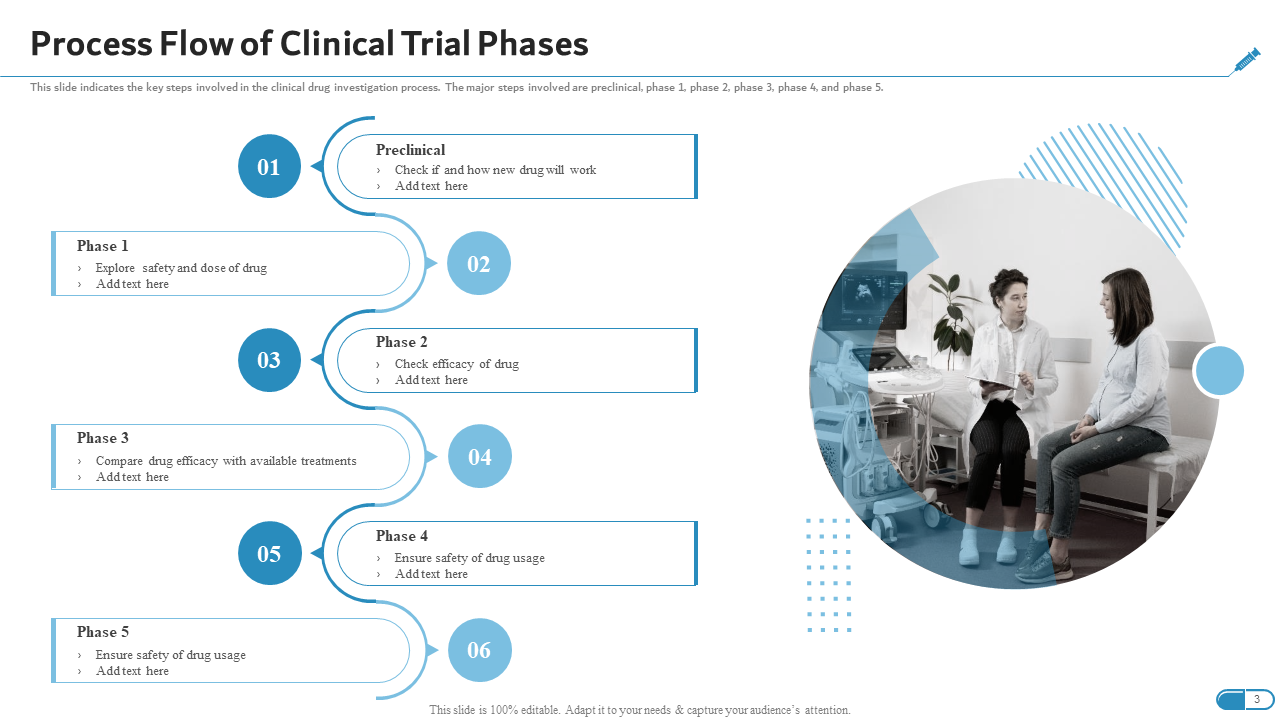
Template 6: Process Flow of Clinical Trial Phases
This slide outlines the step-by-step process flow of clinical trial phases, highlighting the critical stages involved in drug development. It covers the journey from the preclinical phase, which assesses the initial feasibility of a new drug, to Phase 5, ensuring long-term safety and efficacy of drug usage. Each phase is meticulously designed to explore key aspects such as safety, dosage, efficacy, and comparison with existing treatments. This structured approach helps researchers and healthcare professionals make informed decisions regarding drug approval and market readiness.
Template 7: Clinical Trial Phases with Objective and Timeline
This slide presents an overview of clinical trial phases by aligning their objectives, timelines, and participant numbers. The phases progress from preclinical lab studies, which span several years, to human safety trials in Phase I, involving a small number of participants over a short period. Phase II and Phase III focus on expanded and large-scale safety and efficacy evaluations, with increasing participant numbers and extended timelines. This visual representation helps to understand the structured approach of clinical trials, ensuring thorough evaluation before market approval.

Template 8: Multiple Phases of Clinical Trial with Outcomes
This slide presents an overview of the multiple phases of clinical trials along with their expected outcomes at each stage. The clinical research process is divided into four key phases:
- Phase I – Focuses on evaluating the safety of the drug, with approximately 70% of drugs progressing to the next stage.
- Phase II – Aims to test drug efficacy, with only about 33% of drugs advancing to the subsequent phase.
- Phase III – Concentrates on monitoring drug side effects, with 25-30% of drugs making it to the next level.
- Phase IV – Ensures the safety of drug usage in the public after market approval.
This structured approach allows researchers to systematically assess the drug’s effectiveness and safety, ensuring it meets regulatory standards before it becomes widely available.

Template 9: Clinical Trial Phases with Goals to Accomplish
This slide outlines the clinical trial phases along with their specific goals to achieve a successful drug investigation and launch. It covers the key deliverables at each stage of the process, ensuring the drug's safety, efficacy, and market readiness.
- Preclinical Phase:
- Goal: To determine if the drug has any effect and assess its initial potential.
- Activities include laboratory testing and preliminary assessments.
- Phase I:
- Goal: Identify a safe dosage and potential side effects of the drug.
- Conducted with a small group of participants to establish safety parameters.
- Phase II:
- Goal: Expand the drug's administration to more patients and monitor its results.
- Focuses on evaluating the drug's effectiveness and determining optimal dosage.
- Phase III:
- Goal: Perform comparative analysis of the drug against existing treatments.
- A larger population is involved to validate efficacy and gather comprehensive data.
- Launch Phase:
- Goal: Successfully introduce the drug into the market after regulatory approvals.
- Final stage ensuring the drug meets all safety and efficacy standards for public use.
Each phase plays a crucial role in ensuring the drug is both safe and effective before being made available for widespread consumption.

Template 10: Clinical Trial Phases with Review and Approval Process
This slide provides a comprehensive overview of the clinical trial phases, detailing the key steps involved from pre-clinical research to the final FDA approval and production process. The journey begins with the pre-clinical phase, where the drug undergoes toxicity testing on animals to evaluate potential risks. During this stage, a proposal for clinical trials is submitted as an Investigational New Drug (IND) application to the FDA. Upon approval, the manufacturer becomes the official sponsor, allowing the drug to proceed to the next phase.
The clinical trial phase is divided into three key stages. Phase I focuses on assessing drug safety and determining the optimal dosage, typically involving a small group of volunteers. In Phase II, the efficacy of the drug is tested on a limited number of participants to gather preliminary data on its effectiveness. Phase III further expands the number of participants to validate the drug’s efficacy and safety by comparing it with existing treatments. Data collected from this phase is critical for regulatory review and approval.
Following successful clinical trials, the review and approval process begins with the submission of a New Drug Application (NDA) to the FDA. This involves a thorough evaluation of the clinical trial data to determine the drug’s safety and effectiveness for widespread use. If approved, the drug advances to the production stage, allowing for large-scale manufacturing and market distribution.
Overall, the clinical trial process follows a structured and rigorous approach to ensure that new drugs meet the highest standards of safety and efficacy before they reach the public.

Final Word
In today’s data-driven world, the ability to design and execute experiments effectively is crucial for businesses and researchers alike. Whether you're testing new product features, optimizing marketing strategies, or conducting scientific research, having a well-structured experimental design ensures that your decisions are backed by solid evidence and meaningful insights.
With SlideTeam’s Experimental Design PPT Templates, you no longer have to struggle with presenting complex methodologies. These professionally designed slides provide a clear, structured framework to communicate your experimental objectives, variables, and findings with precision and ease.
From startups to established enterprises, these templates empower teams to present their experimental designs confidently—ensuring clarity, consistency, and collaboration across stakeholders.
So why wait? Download these templates today and turn your ideas into actionable insights with well-planned experimentation!


