





 0 Comment
 Customer Reviews

"Exploratory testing can be described as a creative, autonomous testing approach, carried out by skilled testers, where the tester employs their skills and knowledge to design and execute tests, and interpret and learn from the outcomes." - Cem Kaner
Exploratory testing is an important aspect of the quality assurance process. With the rise of Agile and DevOps methodologies, teams are under pressure to deliver software quickly, without compromising on quality. Exploratory testing allows testers to adapt and respond to the changing requirements along with uncovering the defects that scripted testing may miss.
It's an interactive approach that promotes learning and is well-suited to Agile environments.
Also explore our ten pre designed load testing templates with a click here!
However, exploratory testing has its own set of challenges. Businesses often struggle between balancing structure and flexibility and providing clear documentation. This is where SlideTeam's exploratory testing PPT templates come into picture. These templates present a clear framework for planning and executing exploratory testing sessions. These are completely customizable and cover a wide range of testing techniques including session-based testing, freestyle testing, unscripted testing etc. Moreover, they're designed to help you get the most out of your exploratory testing efforts.
Let’s explore the slides now!
Template 1: Exploratory Testing Upgradation Proposal
The below-mentioned Template is designed to help businesses in enhancing their functionality and software quality framework by upgrading to the latest mechanisms. It aims to identify problems with the traditional exploratory testing technique and develop a plan for migrating to the latest framework. The deck further presents details regarding the expert team, client testimonials, sponsorship agreement, etc. It incorporates the timeline and contact details of the organization. Grab now!
[product_image id=1327251]
Template 2: Introduction of Exploratory Testing for Quality Assurance
This PPT Template highlights exploratory testing methods with a neat chronological design and five important phases. The green navigation bar leads viewers through the following steps, freeform testing, unscripted testing, functionality checks, software enhancement goals, and configurable content. The professional layout blends useful text with key icons to make difficult testing concepts understandable. Investigative testing principles are presented in a logical flow that focuses on quality assurance foundations that are solid. QA teams, developers of software, and testing instructors can all benefit from this template. Grab it today!

Template 3: Why Replacing Traditional Exploratory Testing
This PowerPoint Template explains the benefits of modern exploratory testing using a visually appealing five-point approach. The modern layout includes color-coded numbered icons that points out speed through automation, scalability for expanding test suites, and increased coverage through session-based testing. It also promotes increased collaboration to speed up issue detection. The varying blue-green headers add visual interest while keeping professional clarity. The template clearly demonstrates how investigative testing alters standard approaches, making complicated concepts easier to understand. Download today!

Template 4: Project Context for Modern Exploratory Testing Proposal
Do you want to turn your testing proposals into attractive visual presentations? This PowerPoint Template displays an elaborate dual-column structure that balances the organizational requirements with company outputs. The eye-catching blue circular design contains important testing elements such as scalability, vulnerability scanning, efficiency, and flexibility, along with proper execution processes. The layout includes attractive icons and clear text boxes, which are ideal for presenting complex testing methods. The flexible testing approach presented here delivers a compelling story for updating quality assurance activities. Download now!

Template 5: Our Offerings for Modern Exploratory Testing Proposal
Are you looking for ways to show your innovative method for conducting investigative assessment? This PowerPoint Slide clearly illustrates six key services for modern exploratory testing proposals. It presents uncertainty to enable session-based testing, cloud integration, and continuous testing, making complex methods simple to communicate. The sleek, color-coded timeline design emphasizes the flexible and constantly changing nature of exploratory approaches. This template may assist testing consultants and service providers promote modern, unscripted testing solutions to customers or stakeholders. Grab today!

Template 6: Timeline for Exploratory Testing Upgradation Proposal
This PowerPoint Template features a professional timeline which serves as a visual roadmap for implementing new testing techniques. The four-week cycle clearly shows the journey from requirements research to testing and prototyping, which is ideal for presenting how session-based testing could substitute for outdated methods. Each milestone has clear indicators and detailed subtasks that show the systematic flow from planning to execution. Software engineering teams, IT consultants, and testing service providers can all profit from this template. Download now!

Template 7: Key Benefits of Exploratory Software Testing
The beautiful arrow-based PPT Template promotes exploratory testing benefits through visual impact and clarity of concept. The upward-flowing diagram highlights five main advantages, like faster bug detection, missed defect discovery, and higher software quality. These advantages are properly numbered and color-coded in green and red to highlight increased originality and impact. The balanced structure ensures great reading while presenting challenging testing principles in an understandable format. Grab it today!

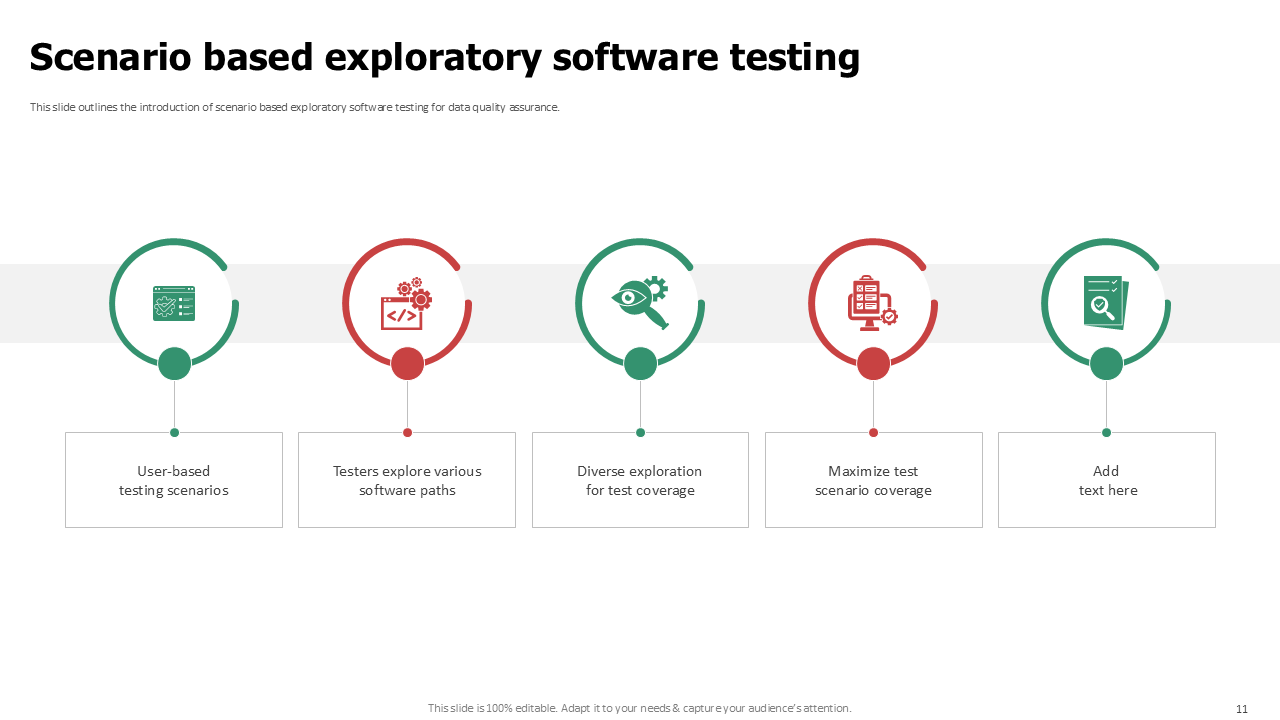
Template 8: Scenario Based Exploratory Software Testing
This PowerPoint Template describes an organized method for scenario-based exploratory software testing. It highlights five important components such as user-driven testing scenarios, multi-path exploration, diversity coverage, and maximum test reach. Its trendy icons and appealing color palette clearly convey the complex nature of testing using real-world circumstances. Use this template to provide impromptu testing techniques which will improve the design of tests and stakeholder confidence. Grab today!
Template 9: Process Phases for Conducting Exploratory Testing
This PPT Template depicts exploratory testing methods using a clear five-phase diagram with contrasting green and red patterns. Each phase categorizes flaws, creates a test charter, time box, evaluates findings, and debriefs. It has meaningful icons and clear explanatory language beneath each step. The session-based testing strategy is systematically presented with a professional visual hierarchy, which guides visitors through the process while being eye-catching. Download now!

Template 10: Difference Between Scripted and Exploratory Testing
Are you looking to clarify testing approaches with visual impact? Using a balanced split-circle shape, this PowerPoint Slide clearly compares typical scripted testing to exploratory options. The green-red color scheme visually separates important characteristics such as formal specification verification versus tester expectations; repeatability versus innovation, and more. The expertly created connecting lines and rounded capsule text boxes set up visual unity while also ensuring optimal readability. Grab it today!

Final Thoughts
Exploratory testing allows testers to adapt and respond to changing requirements and gain valuable insights into the product. SlideTeam’s PPT Templates provide a structured framework for planning and executing exploratory testing sessions. They are fully customizable to suit your team's needs. With our templates, you can ensure that your exploratory testing efforts are well-documented, and effective. Download now!
PS: You can communicate details regarding Scrum testing with ease by adopting our pre-designed templates.
FAQs
What do you mean by exploratory testing?
Exploratory testing is similar to exploring a new location without a map. You do not have a predetermined plan or directions. Instead, you learn about the software by testing it. You consider what the software is supposed to do, experiment with various methods, and observe the results. If you discover anything surprising, you examine more. It's a way to identify issues that you might have missed if you merely followed a set of pre-written instructions. The tester employs their knowledge and creativity to control the testing process, always learning and adjusting along the way.
What is the difference between exploratory testing and regression testing?
Exploratory testing and regression testing are two different methods to find out if the software works properly. Exploratory testing is similar to exploring a new location. You don't have a set plan; you just test whatever is important as you go. You are looking for unknown issues and learning about the software while testing it. Regression testing, on the other hand, is like ensuring that something you fixed previously is still fixed after making adjustments. It ensures that fresh upgrades don't break current features. Exploratory testing identifies new issues, whereas regression testing ensures that existing ones are corrected. The first is about discovery, while the second is about stability.
Is exploratory testing black box testing?
Exploratory testing and black box testing are similar, but not identical. Black box testing is the process of testing software without knowing how it works within. Exploratory testing is a kind of testing in which testers learn about the product while testing, building tests on the go. While black box approaches are frequently used in exploratory testing, system knowledge may also be required. Exploratory testing is not always black box, but it frequently employs black box methods to identify problems.