





 0 Comment
 Customer Reviews

‘We have updates for you’ - this is a common message you may have come across on your laptops or phones. These updates could be new features, security measurements or improvements based on feedback.
For example, the newest Microsoft updates include enhanced connectivity with Wi-Fi 7, quick settings, and AI-powered features for Copilot+ PCs.
The software updates you receive are an example of the incremental model. It is a model in which you deliver the product in stages, adding functionality with each increment.
If flexibility and adaptability are your prime concerns, opt for an agile methodology of development. Here are our top 10 agile delivery model PPT templates that will help you get started.
The incremental process model can be used in scenarios, where you need to get the product/system to the market quickly. It is also useful when the project’s core objectives are clear, but certain features are still evolving. It is also a required model for delivering a working product in stages. The incremental model is popularly used in software engineering, but its principles can be applied to other situations like policy making.
At SlideTeam, we offer pre-designed slides on the incremental model with topics like its purpose, phases, and differences with other development models covered. The design and content-rich templates, each 100% editable and customizable, showcase information in an easy-to-understand manner.
Let’s explore.
Template 1: Incremental Model of Policy Making PowerPoint
Logical incrementalism is a process of developing and implementing strategies in the form of small steps rather than implementing changes in the long term. The PPT below explains how the principle of the incremental model can be used to develop and implement policies. The 30+ slides bundle takes you through topics like the need for logical incrementalism, steps, and how it can benefit companies. Additional design-based slides like roadmap, 30-60-90 day plan, and stages are included for a well-rounded presentation.
[product_image id=282433]
Does the incremental approach not work for your project? Are you looking for a more adaptable development approach? Explore our top 10 agile sprint templates to know more.
Template 2: Incremental Model Learning Cloud Computing Standard Architecture Patterns PPT Template
Incremental model learning aims to make machine learning (ML) models adaptive and well-suited for dynamic environments, while optimally utilizing resources. For example, when new data is available, the ML models will process and learn about the new data without retraining from scratch. This mode allows the ML models to learn and evolve continuously in the presence of new data. The slide below explains this process in the form of a diagram for better understanding. At the bottom is a row with multiple text sections you can use to highlight relevant steps in the learning process.

Template 3: When to Use The Incremental Model PowerPoint Slide?
There are popular software development models, such as waterfall, RAD, iterative, and incremental. So, when should you use an incremental model? The slide below presents the answer. The first section showcases what the phases and the project timeline look like with an incremental model. The second section highlights scenarios where the developmental model is beneficial, such as when the requirements are stringent, the project has a long development time, the team is not well-trained, or the consumer expects the product to be delivered quickly.

Template 4: The Quinns Incremental Approach
James Brian Quinn developed ‘logical incrementalism,’ an approach that looks at strategy development as an iterative process rather than a long-term, one-time event. The incremental process helps companies be flexible and adaptive to changing market conditions, manage risk, learn from feedback, and improve over time. The slide below shows the incremental approach in action. At the top is the goal of strategic development, which could be increasing revenue. You can use a simple table template to define strategies and parameters like owner, timeline, resources, and challenges.

Template 5: Software Development Life Cycle IT and Disadvantages PPT Template
Is the incremental model the right approach for your software development project? The slide below, which presents the advantages and disadvantages of the incremental model, helps answer the question. We have used a table with icons to showcase the pros and cons of the development model. As you develop in stages, it will be easier for you to identify, test, and troubleshoot issues. You can manage risk better and also send a basic working model to the client. On the flip side, you must ensure the project planning is thorough, and the model interfaces are well-defined.

Template 6: SDLC Incremental Model
The SDLC incremental model breaks down project requirements into small, manageable parts. The aim is to deliver a core working product to the client, and subsequent increment deliverables will add functionality to the product. The slide below presents the build phases and stages involved in the SDLC incremental development process. You can explain the process in detail using the bullets section on the right-hand side of the slide. We have added relevant content that can help you get started.

Template 7: Difference Between RAD Model and Incremental Model PowerPoint Slide
Rapid Application Development (RAD) is an agile approach that focuses on creating prototypes and getting client feedback. Developers consider the feedback, make changes, add functionality, and release the product. On the other hand, the incremental model focuses on several small deliverables over time. The slide below explains the differences between RAD and the incremental model. We have used a simple table to present data. For example, RAD is suited for complex projects with changing requirements and where the developers are highly skilled. An incremental approach is more suited for projects with well-defined scope and can be managed by less experienced developers.

Template 8: Phases of Incremental Model PowerPoint Template
Every cycle of the incremental model in software engineering has four defined phases. These phases are requirement analysis, design, and development, testing, and implementation. The content-ready slide explains each phase in brief. For example, the product analysis team will understand the requirements. Next, the system functionality and design technique are completed. The focus is on testing existing and new functionality. Lastly, the working code will be implemented and integrated with the existing product. We have used a pastel color scheme and descriptive icons to maintain visual appeal.

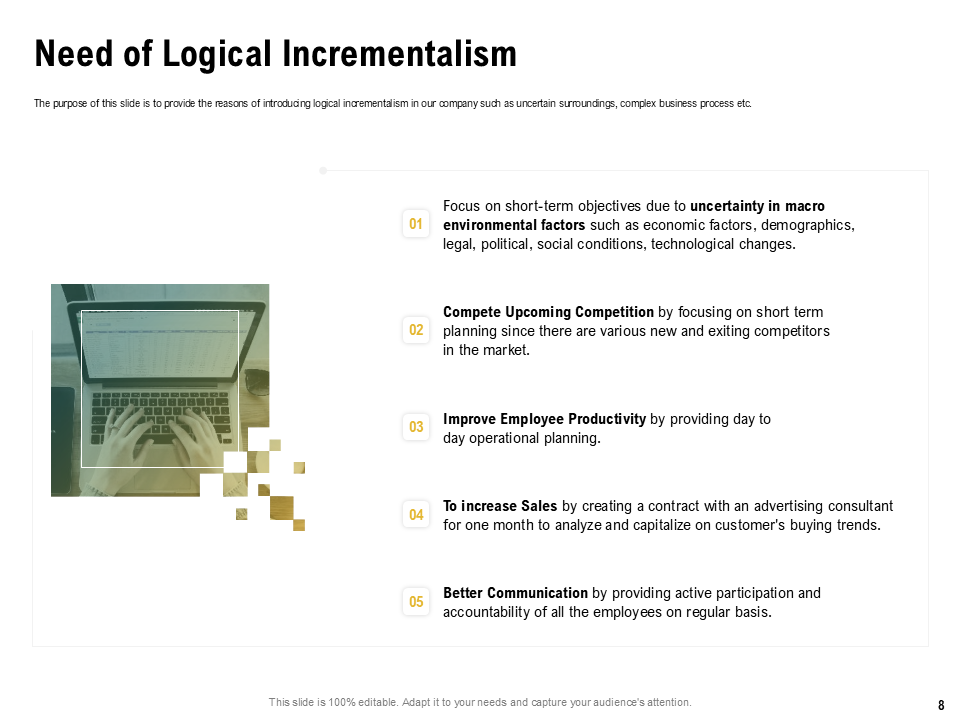
Template 9: Need for Logical Incrementalism
Why are implementing strategic decisions in phases? Why can’t we implement an organization-wide change? These are examples of some valid concerns your stakeholders or employees may have. You can explain to them the need for logical incrementalism using the slide below. It uses a numbered bulleted list to highlight relevant reasons. For example, it describes how the incremental approach can help the company deal with competitors and uncertain market factors or how employees can be more open to small changes, leading to increased productivity and revenue.
Template 10: Responsibility Allocation for Achieving Short-Term Strategies PPT Template
If you aim to implement the incremental approach successfully, you must invest time and resources in preparing a plan. Use the slide below to break the deliverable into small, manageable tasks and assign owners to each task. A well-laid-out responsibility table provides transparency and helps hold the owners accountable for their tasks. The template has the table index defined at the top, followed by the work area, task description, and owners.

Improve Time to Market with our Incremental Model Templates
An incremental approach of development offers benefits such as faster delivery, easier risk management and identification of errors. Our templates explain the concept and use case of the incremental model with infographics, diagrams and simple tabular formats. The slides are also content-ready, providing you with a starting point which you can build on adding project-specific data. The editing instructions will be included in your download, helping you customize the templates within minutes.
PS Do you want to know how the agile approach can help with your project development? Explore our top 10 agile release planning templates to learn more.