





 0 Comment
 Customer Reviews

Do your industrial working environments look out for the health of your employees? If so, it’s time to think about the potential of industrial ergonomics — the science of designing jobs, tools, and tasks to fit the capabilities and limitations of workers. Sound ergonomic habits are crucial in creating safe industrial workspaces where employees can work without physical stress.
Human factors engineering addresses manual handling, workstation design, and task repetition issues via ergonomics. Through ergonomic evaluation, problem areas like awkward postures or poorly designed workstations can be identified and changed appropriately to prevent and improve the occupational health risk of future injuries.
Not only maintaining employee safety, maximizing ROI in office design leads to increased productivity. A secure, pleasant place to rest reduces downtime and maintains morale. By focusing on ergonomics, companies are investing in employees well-being and long-term operational efficiency, safety, and performance combined.
Find our Top 10 Ergonomic PPT Examples and Templates to facilitate the exhibition of ergonomic tools and promote workplace efficiency.
Improving the safety of industry and the well-being of employees begins with improving the workplace design, and that is where industrial ergonomics fits in very well. A properly conducted ergonomic evaluation can point out these hazards and result in the ideal configuration of workstations that may prevent fatigue and injury. The result? Enhanced productivity increment and facilitation of operations.
SlideTeam offers ready-to-use PPT Templates on industrial ergonomics. Since these PPT layouts are completely editable, you would work out an explanation for goals and aims, benefits, and more of the implementation. Use these well to make your filing for ergonomic excellence in any industrial facility.
Explore the best and most beautiful Industrial PowerPoint templates with samples and examples to convey complex industrial concepts with clarity.
Template 1: Enhancing Workforce Well Being the Case for Industrial Ergonomics
This PPT Bundle informs about the necessity of improving the well-being of the workforce by using Industrial Ergonomics. It discusses the notion, identifies ergonomic risks, and evaluates office setups. The slide showcases the physical and psychological effects of ergonomics and goes through some case studies of good results. In addition, it also contains ergonomic determination methods, aids, and development exercises to accomplish successful ergonomic evaluation of workstations. HR professionals, safety officers, facility managers, and operations heads can use this to enhance the welfare of the employees and work efficiency.
[product_image id=1439234]
Template 2: Future Trends in Ergonomics Adapting to Industry Changes
This PPT Deck explores future trends in ergonomics. It outlines the ways in which contemporary workplaces transform with the influence of technology and user-centered design. The slide deals with the influence of industrial changes, human elements, and ergonomic solutions that embrace safety concerns. It is focused on ergonomic assessment, workstation setup, employee well-being, and productivity improvement.
[product_image id=1447455]
Template 3: Understanding Industrial Ergonomics
This PowerPoint Diagram offers the fundamentals of knowing about industrial ergonomics. It notes that places of work should be reviewed periodically in order to improve their ergonomics. Furthermore, the slide will promote the training of employees and safety training programs on how to lift and how to have an ideal workstation. It encourages taking breaks regularly and use of ergonomic solutions and tools to alleviate some of the strain, improve comfort, and even your productivity. This presentation design is suitable for safety officers, human resources, operations managers, and ergonomists.

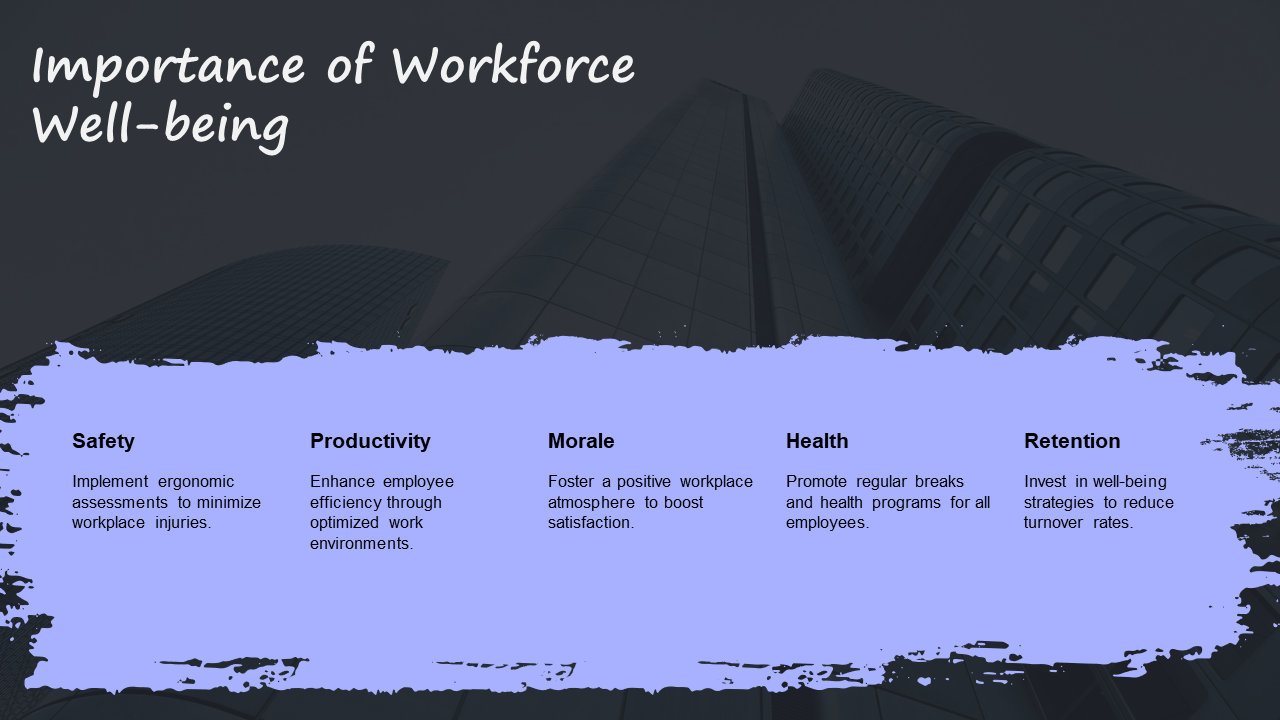
Template 4: Importance of Workforce Well-being
This PPT Template puts significance on the well-being of the workforce. It lays emphasis on the points about safety by ergonomic risk assessment. The design also focuses on the reduction of workplace injuries and adherence to health and safety regulations. It indicates how productivity can be enhanced with well-optimized working environments. This PPT diagram is helpful to HR managers, safety managers, compliance teams, and workplace wellness consultants to establish healthier, more engaged employees.
Template 5: Identifying Ergonomics Risks in the Workplace
This presentation layout identifies key ergonomic risks in the workplace. It includes posture evaluation, poorly designed equipment, inefficient environment layout, and repetitive movements. The layout talks about factors that are crucial for minimizing strain, discomfort, and injury. It is apt for safety officers, facility managers, HR professionals, and occupational health specialists.

Template 6: Understanding Ergonomics in Modern Workplaces
This PowerPoint Slide explains the importance of knowing about ergonomics in contemporary workplaces. It explains the significance of workstation design, adjustable layouts, and employee education in increasing comfort, minimizing strain, and increasing long-term well-being. This design is beneficial for HR, management of facilities, health and safety officers, and team leaders.

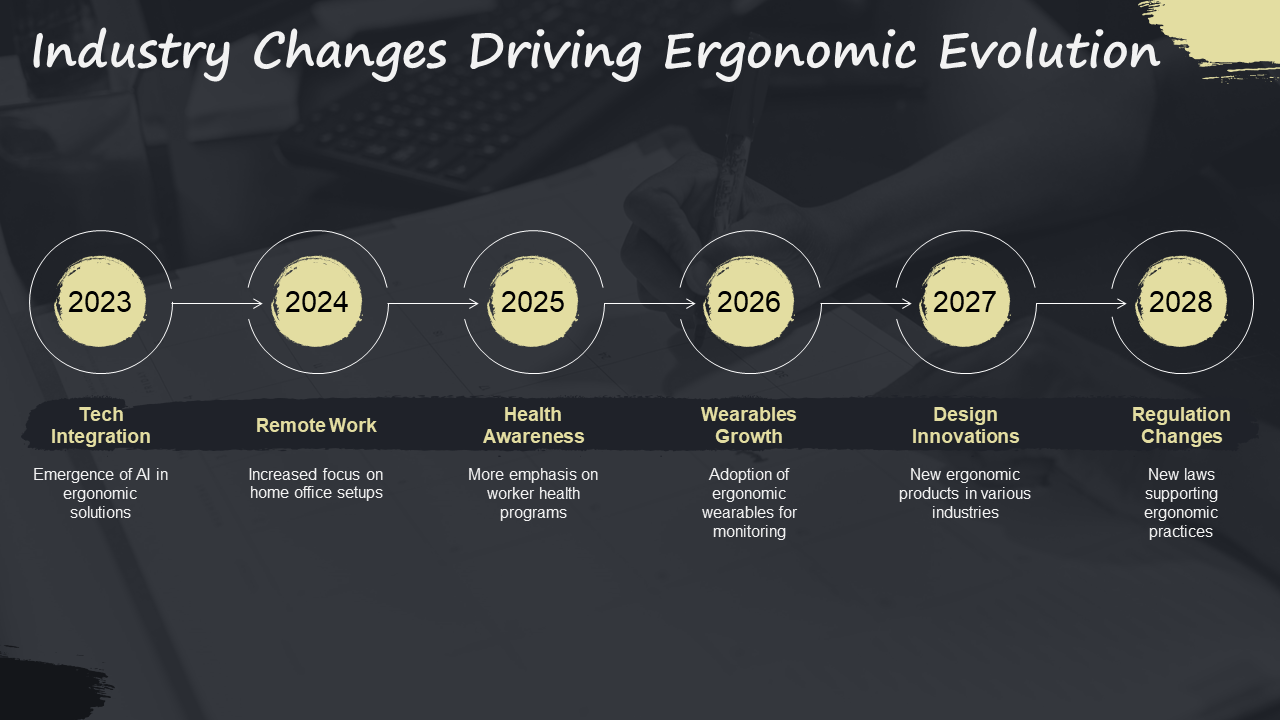
Template 7: Industry Changes Driving Ergonomic Evolution
This PowerPoint Slide illustrates the industry changes driving evolution of ergonomics from 2023 to 2028. It is useful for HR managers, occupational health professionals, and industrial designers. It depicts the adoption of AI, remote working arrangements, innovative design, and legal changes throughout the years. Get it now.
Template 8: Use-Centered Design Principles
This PowerPoint Slide aims at developing simple and convenient solutions. It emphasizes the value of empathy to learn about the needs of users, feedback loops to act in terms of constant improvement, and the availability to a variety of users. Furthermore, interdepartmental and continuous user involvement make it compatible with real-world requirements. This PPT diagram is appropriate for UX/UI designers, production managers, human factors experts, and industrial designers. Download now.

Download This Presentation Now
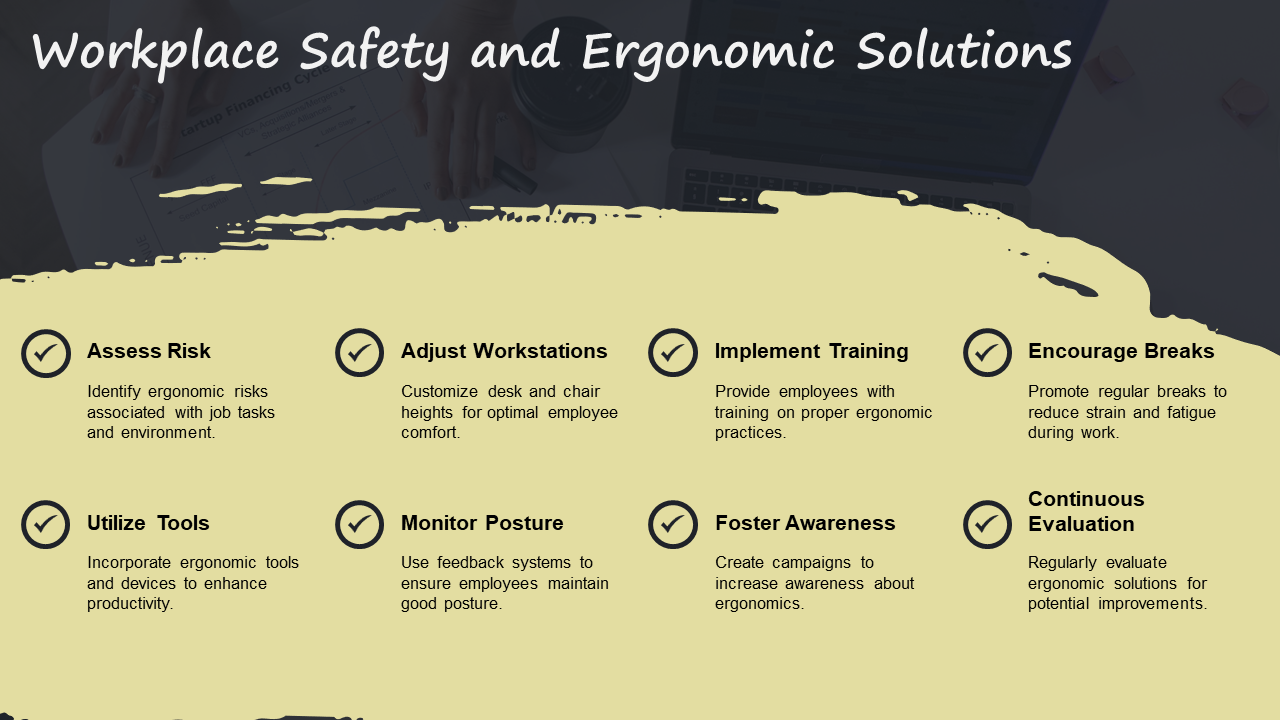
Template 9: Workplace Safety and Ergonomic Solutions
In this PPT demonstration, the solutions addressing safety at the workplace and ergonomics are evident. It lays stress on risk analysis, changes in workstations, and employee education that can help develop a healthy working atmosphere. Besides, it stimulates taking periodic breaks, the use of ergonomic devices, tracking the position, and promoting awareness. The presentation framework adds value to HR professionals, safety officers, and operations managers.
Template 10: Remote Work: Ergonomic Challenges and Solutions
This presentation framework outlines the remote work ergonomic issues and recommendations. It explains the issues experienced, like the uncomfortable and strained powered workstations. Some of the solutions provided are ergonomic analyses of home office settings. Various benefits, such as comfort, posture, and increased productivity of remote employees, are also given attention.

Industrial Wellness Starts with Ergonomics
The significance of industrial ergonomics to industrial safety and well-being of workers cannot be over-emphasized. Whether it’s highly accurate ergonomic evaluations or improved workstation applications, these operations result in great productivity enhancement and help prevent injury. These industrial ergonomics presentation templates will enable you to communicate effectively the benefits of ergonomics. Download and take your ergonomics journey with you!
Bring to life the future of manufacturing with our Top 10 Industrial Technology PPT Templates with Samples and Examples.
FAQs on Industrial Ergonomics
1. What are industrial ergonomics?
Industrial ergonomics is a field of study that involves adding more human factors and data to the task of human engineering and industrial design. It is intended to help prevent injuries, increase productivity, and reduce strain or fatigue. It helps to set up workstations and arrange tools and work to prevent the development of musculoskeletal disorders (MSDs). In other words, industrial ergonomics works to produce healthier, safer work environments for workers.
2. What are the 3 types of ergonomics?
The three primary dimensions of ergonomics include:
Physical Ergonomics – It relates to physical activity and encompasses posture, repetitive motions, how a workplace is organized, and the design of tools.
Cognitive Ergonomics – It relates to concerns of the mind like perception, memory, decision-making, and reaction time. It works to improve system use, minimize errors, and improve human-computer interaction.
Organizational Ergonomics: Focuses on optimizing the structures, policies, and processes of an organization, including such aspects as teamwork, communication, work orders, policies, shift design, and work scheduling in order to achieve productivity.
3. What are the 5 points of ergonomics?
The five basic dimensions of ergonomics are safety, comfort, operability, productivity, and aesthetics. These elements address redesigning the fit between a person and their task in the workplace, enhancing efficiency and well-being while minimizing injury risk.


