


 0 Comment
 Customer Reviews

The impeccable client relationship management skills of Harvey Specter (Suits) have taken the modern world by storm! What is so unique about him? He never treated his biggest clients like just another case file. He anticipated their needs, placed himself as a reliable counselor, and never took short-term actions.
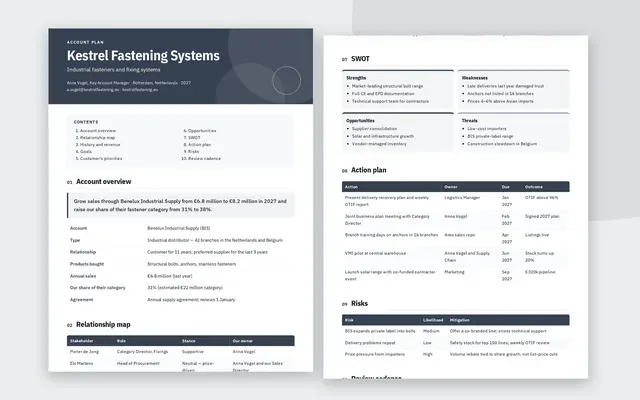
That is what Key Account Management (KAM) is all about; with high-value customers, it comes down to building a long-term partnership. KAM charts the objectives of the client, identifies growth opportunities, plans strategies, and makes sure that both parties receive value on a regular basis. Done right, it transforms businesses from being “just another vendor” into indispensable partners.
However, it is not always easy to provide a detailed plan. It is a job that needs balancing insights, predicting needs, and matching internal teams.
SlideTeam's Key Account Management Plan PPT Templates become useful here. They offer pre-made models to map out client strategies, monitor goals, and convey value with accuracy.
We will discuss 10 professionally created templates to help you manage your accounts more easily, effectively and faster in this blog, because in business, as in Suits, retaining your key accounts is not a choice, it is survival!
SlideTeam has curated a list of the best-in-class Account Management Plan Templates for you. Click here to explore.
Template 1: Key Strategic Account Management Plan for Improved Customer Retention
This PPT Set constitutes a strategic plan for enhancing customer retention via account management. It focuses on the role of loyalty, referrals, and cost-efficiency in addition to the significance of feedback, brand advocacy, and predictable revenue. The content describes the procedures to establish key accounts, customer needs, and the review of current practices through data review, communication audits, and performance measurement. Also, it offers practical plans such as frequent check-ups and customized options to establish better relationships, which will guarantee client satisfaction in the long term.
[product_image id=1417476]
Template 2: Key Business Account Planning and Management Strategies
This PPT Deck is a comprehensive guide to meaningful business account planning and management. It underlines establishing effective relationships with clients based on understanding, engagement, support, and evaluation. This PPT focuses on strategies used to segment accounts, such as market analysis, customer profiling, and strategy alignment, in order to maximize the value delivery. It further describes the key account plan frameworks, which include objectives, stakeholders, value propositions, performance metrics, and review mechanisms. It also discusses goal setting in managing the account and presents CRM tools to get customer insight, automation, and teamwork to achieve better results.
[product_image id=1405521]
Template 3: Key Business Account Planning and Management Strategies
This PPT Bundle offers a systematic way of planning and management strategies in accounts and includes key areas of business expansion. It starts with an introduction to account management strategies and best practices, statistics, and possible disadvantages. It then proceeds to business analysis, customer insight, and competitive evaluation. Subsequent sections deal with software tools, team roles, tasks, and team culture. Measuring the changes caused by the account management strategies is the final part of the presentation that will make the changes to guarantee successful results in the long term.
[product_image id=864848]
Template 4: Key Account Management Plan PPT
This PPT Set focuses on actionable strategies of successful key account management. It describes best practices, including hiring qualified account managers, criteria to be used in the selection process, customer training, risk analysis, and articulate communication strategies. It also brings in the means of assessing accounts based on weighted criteria, comparative analysis, and management strategies. They are introduced as a seven-step process that includes analysis of the account, segmentation, identification of the decision-maker, SWOT diagnosis, and monitoring. It further identifies key elements such as building relationships, business analysis of customers, setting goals, and customized account strategies as a way of improving profitability and customer retention.
[product_image id=719595]
Template 5: Key Account Management Plan PPT Template
This PPT Set gives a practical approach to the management of clients and business development, owing to proper account planning. It focuses on analysis of stakeholders, articulation of objectives, and alignment of teams to realizable targets. The slides emphasise ways of creating individual account plans, creating good working relationships through trust, and continuous improvement through constant feedback and frequent communication. Through approaches such as personalized interactions, specialized contacts, and demonstrative utilities, it empowers professionals to enhance client satisfaction, improve cooperation, and attain sustainable long-term success in account management.
[product_image id=1474073]
Template 6: Best Practices to Formulate Key Account Management Plan
This PPT Slide profiles key point-to-be considerations in account management to promote profitability and long-term growth. It focuses on the hiring of competent account managers, setting up precise selection guidelines, and the production of comprehensive profiles of customers. Another aspect that is emphasized in the framework is the use of risk assessments by SWOT analysis and proactive retention and responsiveness by creating proactive communication plans.

Template 7: Key Account Assessment and Management Plan PPT
This PPT Preset shows a well-organized way of reviewing and updating key accounts. It emphasizes measures like bringing in revenue, reaching the market, matching the product, and the degree of innovation, giving weights and ratings to prioritize the accounts with high effectiveness. The framework is able to make data-based assessments and provide insights about the strengths and weaknesses of every customer. It has actionable plans such as regular assistance, collaborations, product improvements, and technology cooperation to ensure that businesses are in a position to fully leverage account potential by synchronizing management practices with customer needs and market opportunities.

Template 8: Seven-Step Process Key Account Management Plan PPT
This PPT Slide describes a seven-step process of managing key accounts to enhance retention and growth. It starts with the analysis and segmentation of accounts to find good customers. It is analyzed with the mapping of decision-makers and the diagnosis of needs using SWOT analysis. A clear set of objectives is then established, and this results in custom strategic plan formation. This is followed by constant monitoring of the process by giving feedback and making corrections. By doing this, businesses will be able to respond to customer needs, build relationships, and adopt data-driven strategies to improve performance and client satisfaction in the long term.

Template 9: Key Components of Account Management Plan
This PPT Preset points out the main elements needed to develop a solid account management structure, which will help to fuel business development. It focuses on creating and sustaining good customer relationships, as well as making a comprehensive financial evaluation to know the wellbeing and objectives of the clients. It would be necessary to set account goals that have attainable targets to have focused strategies and a customer-driven account strategy to enhance engagement by addressing the feedback to make appropriate improvements. Combined, these components form a systematic process of opportunity identification, performance improvement, and coordination of efforts towards long-term profitability and customer satisfaction.

Template 10: Guideline to Develop a Successful Key Account Management Plan PPT
This slide presents the recommendations towards designing an effective account management strategy that aims at enhancing client relationships. It insists on taking a proactive stance in the process of providing periodic feedback and updates, being responsible for promising what can and should be delivered, and establishing achievable goals. Teamwork is promoted to involve clients in the strategy development. Also, client business reviews will guarantee the alignment of objectives and assessment of the performance progress, which helps develop a framework that will lead to trust, responsibility, and future satisfaction.

Managing Key Accounts Expertly
Key account management is not about quick wins; it is about developing relationships that are so good that your clients would not know how to conduct their businesses without you. It is about projecting their needs, matching their goals, and demonstrating value at each stage. The companies that get this right, such as Microsoft or Salesforce, do not retain their clients; they expand with them.
The Key Account Management Plan PPT Templates provide you with the framework to do just that. They turn disjointed plans into a professional roadmap. With these by your side, you can enter any meeting with confidence.
FAQs on Key Account Management Plan
What is a Key Account Management (KAM) plan, and why is it important?
A Key Account Management (KAM) plan is a strategic map for developing relationships with the most valuable customers of the company, called key accounts, to build mutually beneficial, long-term relationships. Such plans are essential as they enhance customer loyalty and retention, revenue growth, and profitability, and offer a competitive advantage as the resources are being directed toward the elite customers who tend to be very significant to the success of a firm.
How do you create an effective Key Account Management strategy?
The first step to develop a successful Key Account Management (KAM) strategy is to identify and categorize your key accounts in relation to their strategic importance, and then build a complete profile of your clients with thorough research of their business goals and challenges. Second, develop tactical plans that have specific objectives and activities, have account managers assigned to them, and have a routine and communication rhythm. Lastly, you need to constantly check the performance, measure the results according to established metrics, and be adaptable to change and improve your strategy as it goes.
What are the essential components of a successful KAM plan?
The most effective Key Account Management (KAM) plan program envisages the identification of key accounts, analysis of the key account, elaboration of the collaboration strategy, creation of a detailed action plan, a special team, creation of the definite metrics, and a constant cycle of monitoring, reviewing, and revising the plan. They are developing strong internal and external relationships, selling solutions and not products, and mutual growth and profitability in the long run.