





 0 Comment
 Customer Reviews

Have you ever attempted to solve a problem only to find out you were viewing it from the wrong perspective?
Perhaps you tried to restart your Wi-Fi router because your video would not load, only to find that the problem lay with the streaming app. Or you might have spent hours debugging a small segment of code, only to learn that the actual bug was being caused by a whole other module.
That's precisely why perspective is important, and that's what multiscale modelling facilitates. It makes you not only think about a piece of the system but also how all pieces fit together, from the smallest detail to the overall picture. That way, you're solving the right problem, at the right scale, with the right answer.
Explore our blog on the Top 10 Ecosystem Modelling to understand how ecosystems respond to disruptions.
Let’s explore how it works. But don’t worry, no science degree required, just a curious mind!
So, what is Multiscale Modelling?
Imagine you’re building a house.
- At the largest scale, you need to know where to put walls, doors, and windows.
- At a middle scale, you're concerned with plumbing and wiring.
- At a microscopic scale, you're concerned with the materials, how concrete blends, or how steel performs.
Multiscale modelling brings all those scales together into one virtual model. It's like having a microscope, drone, and blueprint simultaneously to comprehend the whole system. Multiscale modelling is a way of studying complex things by looking at them on different levels or scales, like zooming in and out. It’s used in fields like science, engineering, and medicine to connect small details with big-picture behavior.
To know more about how structured frameworks can simplify complex systems, ensure consistency across scales, and accelerate your modelling process, Check out our blog on Data Models.
We have curated the top 10 excellent PowerPoint designs to ensure clear, impactful, and scalable presentations of multiscale modeling across dimensions. Let’s get started!
Template 1: Importance of Diffusion Modelling Techniques PPT Template
This PPT presents the importance of different diffusion modeling methods to analyze, forecast, and optimize the diffusion of things, energy, or data through different media and systems. The integrated modeling presentation involves methods like data insights, allocation of resources, optimization of speed, risk evaluation, etc. additionally, it also involves scenario planning, personalization, predictive analysis, and collaboration.
Using this PPT, you can learn about the major diffusion modeling methods and their applications in various fields. Download today!

Template 2: Understanding Diffusion Processes PPT Template
This template is useful for grasping the fundamental principles behind how particles, energy, or information spread within a system, enabling better analysis, simulation, and application in fields such as materials science, biology, environmental studies, and engineering. These processes include model calibration, scalability analysis, data integration, real-time monitoring, software tools, and case studies. Get the presentation today!

Template 3: Data Requirements for Effective Modelling PPT Template
This PowerPoint presentation identifies the key data requirements required for the construction of good and trustable models. It underlines the need for high-quality data, correct temporal resolution (registering data at the correct intervals), spatial resolution (precise location-based detail), variability in a range of variables, and adequate data quantity. All these together constitute the basis for good and sensible modelling, making simulations and predictions realistic as well as useful for a wide range of applications.

Template 4: Innovative Applications in Technology Sectors PPT Template
This PPT layout is a powerful aid for organizations to depict their technological capabilities. It communicates innovative applications in technology sectors and highlights solutions across various domains. These applications are social media, healthcare, marketing, and sustainable energy. The PPT layout also enables organizations to explore cross-industry opportunities for innovation and growth. Get it now!

Template 5: Risk Analysis in Multi-Scale Modelling PPT Template
This slide presents a clear risk matrix that categorizes risks based on their likelihood (Rare, Unlikely, Possible, Likely) and severity (Minor, Moderate, Major, Severe). By mapping out scenarios such as 'Slight Delay' or 'Project Complete Failure' across different probability-impact combinations, the slide helps users assess where their modeling efforts may face challenges, from manageable disruptions to critical overhauls, further helping them to improve. Download today!

Template 6: Interactive Modelling and Visualization Techniques PPT Template
This system-level modeling template functions as a key performance indicator dashboard, divided into two key sections. On the left-hand side, a section showcases a pie chart that indicates resource allocation. On the right side, a bar graph plays a pivotal role in representing performance metrics and the time period required. Furthermore, the slide provides details on growth rate, user engagement, data accuracy, and process speed. This multi-resolution modeling template is a powerful resource helpful in tracking progress and driving performance improvement.

Template 7: Global Perspectives on Diffusion Processes PPT Template
Get access to this template, as it provides us with global perspectives on diffusion processes. The slide highlights info such as innovative product adoption trends in markets, cultural influence on consumer behavior patterns, environmental factors affecting resource distribution, etc. The slide provides a deep understanding of how physical, economic, and political conditions shape diffusion processes globally. This slide is a significant tool for strategists, researchers, and decision-makers seeking a well-rounded view of diffusion dynamics in diverse contexts.

Template 8: Impacts of Scale on Diffusion Dynamics PPT Template
Curious about how different scales affect diffusion dynamics?
This pyramid diagram provides an easy-to-understand overview of three main types of scales, i.e., micro-scale, meso-scale, and macro-scale, and how each one plays a role. At the micro-scale, the focus is on individual behavior and interaction. The meso-scale exhibits community-level dynamics and examines the structure and behavior of networks. The macro-scale is concerned with the bigger picture, such as the focus on broad trends in society. Get this micro-to-macro modeling template to know more of the diffusion process! Get access now!

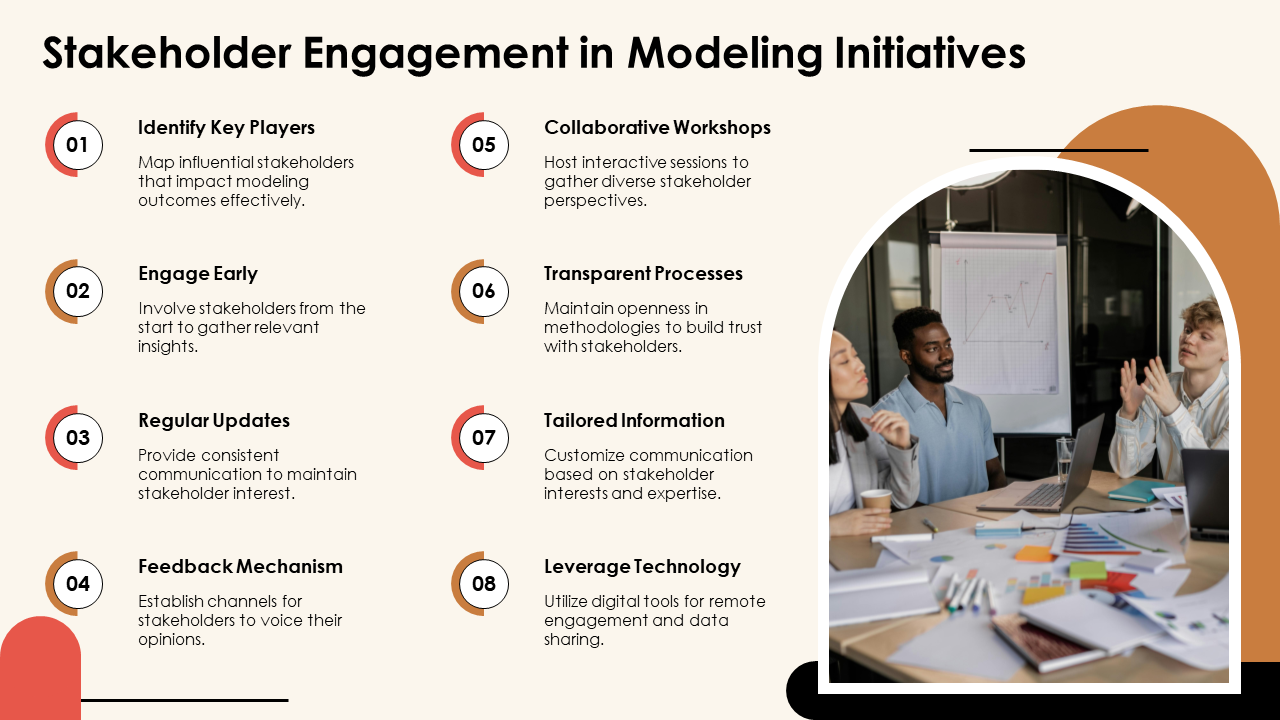
Template 9: Stakeholder Engagement in Modelling Initiatives PPT Template
What role does a stakeholder play in modelling initiatives?
Presenting a slide that underscores the collaborative nature of stakeholder engagement. The slide explores their roles, such as identifying key players, engaging early, providing regular updates, using feedback mechanisms, holding collaborative workshops, transparent processes, providing tailored information, and leveraging technology. Download the presentation to elevate your engagement strategy!
Template 10: Multiscale Modelling Approaches PPT Template
This pyramid chart illustrates coupled modelling approaches. These hybrid modeling approaches are presented through eight ways, such as finite element analysis, molecular dynamics, microstructural analysis, atomistic simulations, etc. They help in bridging gaps between scales and enhance model accuracy. Download now to explore these practical applications!

Final Thoughts
Multiscale modeling is a powerful method of dealing with complex systems that cannot be solved via one scale alone. It allows scientists, researchers, and engineers to provide better predictions, designs, and decisions by combining different levels of a system and connecting the big picture to the small details.
SlideTeam provides outlined and visually conveyed complicated multilevel modelling ideas in a way that facilitates simple explanation of interactions between scales and makes informed decision-making easier.
Want to identify, analyze, and mitigate security risks? Click here to know more!
Multiscale Modelling FAQs:
1. What is the purpose of multiscale modeling?
The goal of multiscale modelling is to be able to solve issues and research complicated systems in many areas such as engineering, biology, physics, and chemistry. It is aimed at understanding the behavior of the system more profoundly.
2. How does multiscale modelling integrate different scales?
Multiscale modelling couples various scales: spatial, temporal, organizational by linking models that act at distinct levels of detail resolution
to handle complicated systems more precisely. Multiscale modelling integrates through well-designed means for models at distinct scales to communicate, maintaining consistency and accuracy in replicating real-world
phenomena.
3. What are common applications of multiscale modelling?
Some of the common applications of multiscale modelling are
Biology and medicine, Materials Science & Engineering, Climate Environmental Science, Biomedical Imaging & Simulation, Mechanical & Aerospace Engineering, Computational Physics & Engineering Simulations, and Geosciences.


