





 0 Comment
 Customer Reviews

The real battle in pest control business actually begins well before you even step foot on the job site. The first impression clients have of your proposal is the first step in sizing you up. It’s more than a pitch document—it's your pitch deck, your = proof that you can solve their XYZ problem accurately and professionally.
Is it completely a nightmare to write it from scratch? What do you include? So how do you explain what you do without hitting your clients with jargon? How do you frame your contracts, pricing, and processes in a way that appears transparent and compelling rather than like some dull technical manual?
Visit our blog on Top 10 Pest Control Proposal Templates to explain your services while showcasing the intricacy of your approach.
Which is the reason SlideTeam brought to you Top 10 Pest Control Services Proposal Templates your cheat sheet to look poised and prepared. It contains everything you need to kickstart your pest control business plan, pest control service descriptions and a pest control contract template and more.
The best part? Our frameworks are fully editable, content friendly, ready to download in PNG and JPG formats.
Scroll through and get everything you need to design proposals that build trust, attract clients and prove that you mean business.
Refer to our blog on Must-Have Pest Control Service Agreement Templates to keep these pesky pests away and also be cost-effective.
Template 1: Pest Control Services Proposal Powerpoint Presentation Slides
This pest control service proposal template comprises pages like a company overview, services page, pest control strategies, pricing tables, testimonials, team member introduction, and contact info, etc. Including visual elements such as images of service representatives, charts, and icons. Further, discuss key clients, mission and vision statements, workflow/process diagrams and a results analytics chart. Use it for business pitches, sales meetings, and client proposals alike. Get now.
[product_image id=200924]
Template 2: Pest Control Management Proposal PPT Guidelines
This is a well-organized pest control company proposal focused on completing your pest control management process from planning and execution. It covers basic things like introduction, pest types, goals and objectives of pest control. This deck goes into cost analyses, pest control effectiveness evaluation, and current methods assessment. It is helpful for offering tangible plans for execution. Download now.
[product_image id=1470977]
Template 3: Getting Started for Pest Control Services
This presentation theme covers the first step for initiating pest control service plans with an organized technique to handle infestations. It outlines the three main steps: free consultation, initial pest removal, and the continuation of maintenance. It includes plan tailoring to your need, and designing maintenance plans over a minimum duration among regular intervals. It helps to build trust but also shows commitment to long-term pest management. Download now.

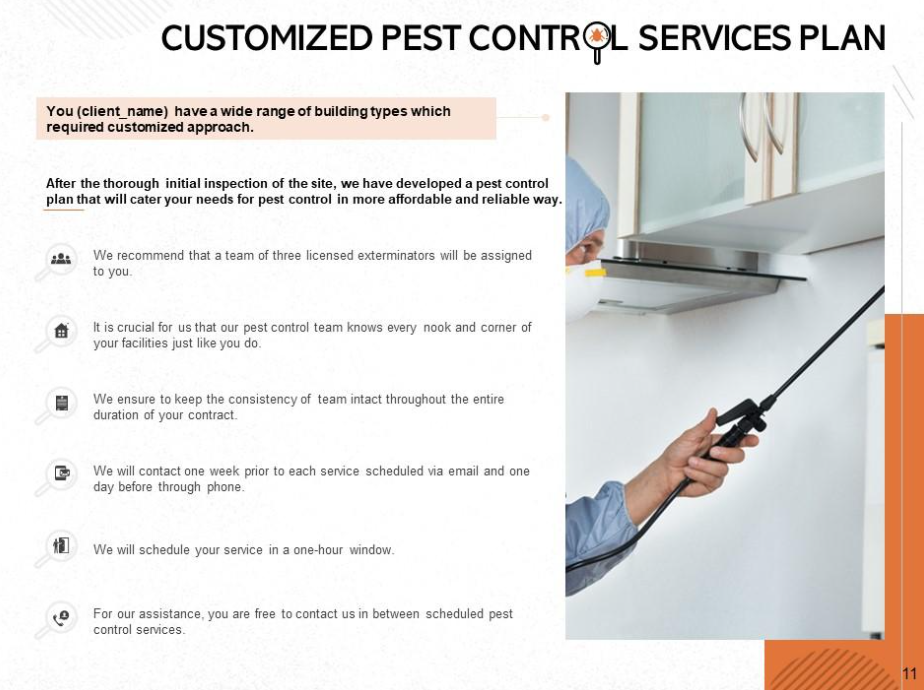
Template 4: Customized Pest Control Services Plan
This presentation theme covers preliminary site inspection followed by a plan that is consistent throughout the program. Major highlights include scheduling ahead of time using alerts sent by email and phone, providing a one-hour service window, and making sure that communication can be had in between scheduled pest control visits; A well-planned pest control service strategy enables easier communication, and ensures trust among clients. Download now.
Template 5: Agreement for Pest Control Services
This pest control service agreement includes important points of contract terms between provider of service and client. The contract will be one-year long, billing at the end of each month. The difference is the clients retain services under the contractor agreement while the contractors are obliged to provide them with quality and on-time executions. The contractor cannot be held liable for damages to the client. Get now.

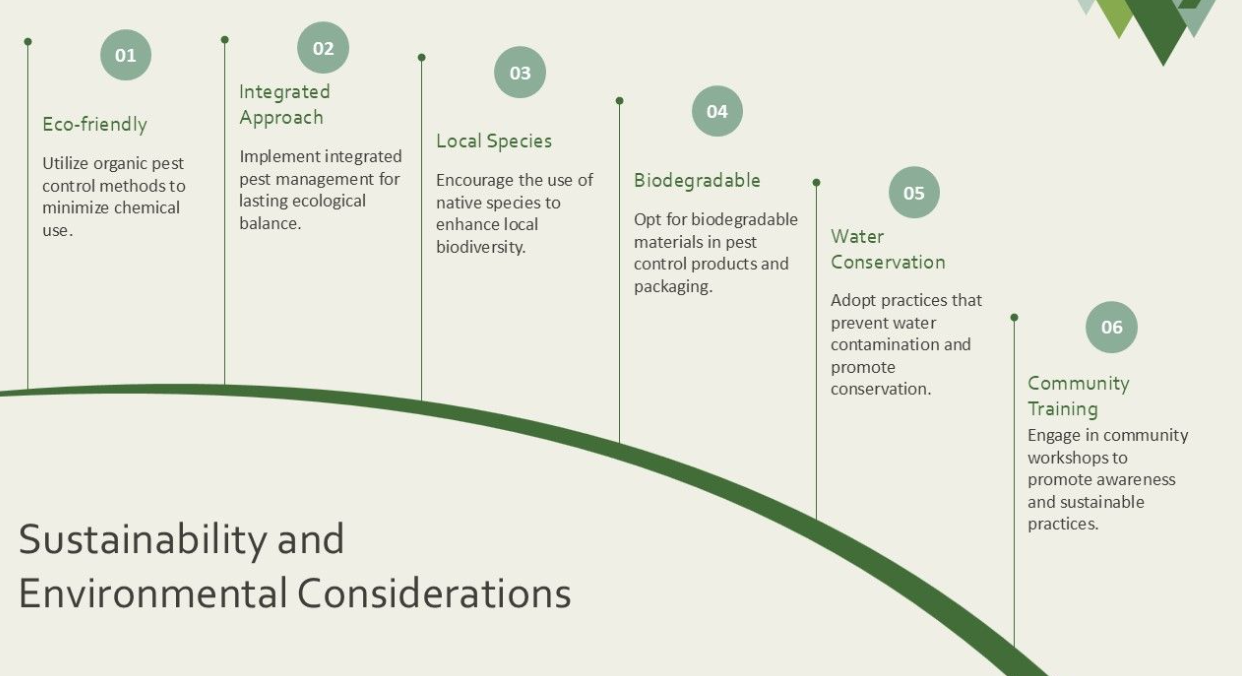
Template 6: Sustainability and Environmental Considerations
This PPT Theme points out the relevance of organic pest control techniques to cut down use of chemicals and promotes integrated management for not closing the need of balance in nature. Promoting diverse species is suggested to improve biodiversity. It finally includes community training initiatives to create awareness. These measures collectively ensure that pest control solutions are compatible with the dual goals of environmental stewardship. Download now.
Template 7: Evaluation of Existing Pest Control Methods
This PPT Theme shows chemical vs biological based pest control methods. Chemical pest control methods are highly effective but are non eco-friendly. Biological methods have low or no cost. Chemical control is said to be highly effective for rapidly reducing pest population, but impacts the environment. Biological control is slower, but is environmentally friendly. These pest control service estimates help identify the most appropriate pest management strategy. Get now.

Template 8: Pest Control Strategies and Techniques
This PPT Theme covers five methods: baiting uses strategically placed bait stations to eradicate pests, while trapping sets a range of devices to capture pest species. Closing the entry points to avoid pests entering buildings. Monitoring for signs of pest activity. Finally, sanitation minimizes breeding sites for pests. It serves as a comprehensive, and reactive pest control service for ensuring long-term protection. Get now.

Template 9: Cost Analysis of Pest Control Options
This PPT Theme compares four methods of pest control across parameters. Option C represents efficiency rate , highest level of customer satisfaction who prioritize effectiveness and environmental friendliness. Option A achieves a strong balance between efficacy and sustainability. while Options B and D are low cost and have lower efficacy and sustainability scores. This pest control pricing analysis lines up with the operational priorities. Download now.

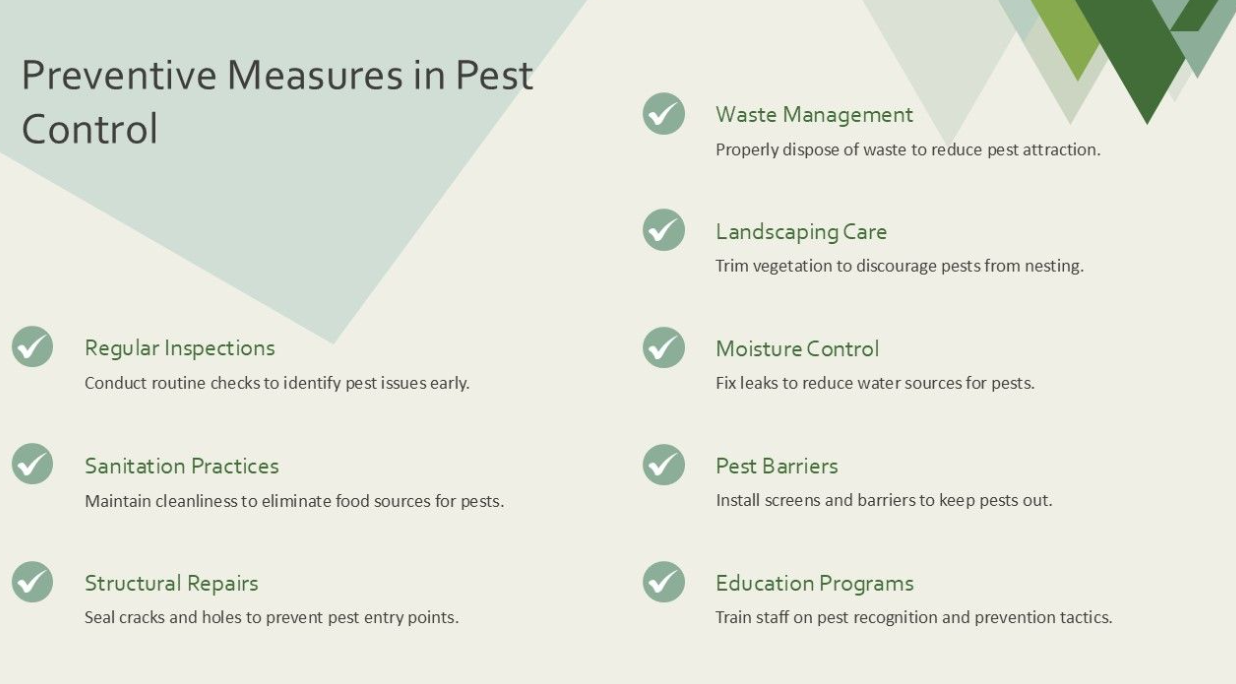
Template 10: Preventive Measures in Pest Control
This PPT Theme describes all practical methods of regulation. Key strategies involve routine checks that identify early pest signs, and sealing gaps or openings for structural repairs that block pest entry. It also highlights cleaning waste through proper waste disposal, controlling moisture by fixing leaks, and preventing pests by keeping them out. Collectively, these pest control service features take a proactive approach to minimize risks. Download now.
Present Professionally, Win Confidently!
Being a pest control professional, we know the industry is extremely competitive and just providing quality services to your clients does not mean that things will go your way. The proposal can either win you a long-term contract or cost you the opportunity altogether. Which is one of the reasons you should have access to professional pest control service proposal templates.
Using our Top 10 pest control services proposal templates can offer more than simple ease. These give you a framework to present your service offerings, pest control service quotes, pest control marketing and pest control service outline, which all add an element of clarity and professionalism. These proposals are used in multiple scenarios to establish trust and portray expertise from commercial property managers looking to implement a reliable extermination plan to residential clientele interested in safe eco-friendly treatments.
Get our templates now and start sending proposals that win deals more quickly.
PS: Check out our blog on Top 5 Pest Control Cover Letter Templates to offer help to people who need relief from pests.
PEST Control Services FAQs
What are the most common types of pests treated by pest control services?
Pest control services typically deal with a range of pests that can invade homes, businesses, and other properties. The most frequent include:
- Rodents (such as rats and mice) that can cause structural damage and carry viruses and diseases
- Mosquitos, flies, and other insects that are harmful to health including cockroaches, Junior ants, Junior ants, bed bugs and termites as well as pests that damage property.
- Termites and carpenter ants that can compromise wooden structures.
- Stinging insects like wasps and bees that are dangerous.
How do professional pest control services ensure long-term prevention?
Here how it does:
Routine inspection and monitoring of the property to detect any early signs of pest activity and determine property vulnerabilities.
Exclusion Methods includes sealing cracks, door sweeps and screens
Implement biological controls to keep pest populations in check with natural predators or beneficial insects (minimal chemical use.)
Judicious and safe chemical treatments as required to eliminate pest quickly with minimum health hazard.
Environmental management and sanitation to eliminate food sources, standing water and breeding sites to deter pests from an area.
Home owners are provided with education & recommendations for maintenance and best practices to avoid re-infestation.
It is a continuous process that provides appropriate monitoring, remediation, and maintenance to reduce long-term pest issues sustainably.
What should homeowners look for when choosing a pest control company?
Here are some of the most important factors when choosing a pest control company for effective and safe service:
Credibility and License : Make sure the company is licensed and certified for operating in the area under the local law.
Experience and expertise: Choose companies with experience and expertise in handling the pests affecting your property.
Use of Integrated Pest Management (IPM) system: It favours safe, environment-friendly, long term solutions instead of continued use of chemical insecticides.
Pricing Transparency & Service Guarantees : Validate the pricing structure is divulged and if any warranties/subsequent services would be provided in case pests are found again.
Good Reputation and Reviews: Research customer reviews, and inquire about references to determine the credibility, professionalism, and customer-oriented nature of the service provider.
Safety Protocols: The organization should practice industry-wide safety practices to protect family members, pets, and the environment.
Tailored Treatment Plans and Communication: The company should provide treatment plans tailored to the specific pest issue, as well as keep communication open.