





 0 Comment
 Customer Reviews

From Television to mobile phones, washing machines to other home appliances- big or small, Samsung has been one of the most sought-after brands for decades now. It has become one of the most trusted brands among users, and Samsung has knocked most doors globally with quality and diversity in its products. Started in 1938 as a small trading company, Samsung is today one of the largest technology companies in the world, with 99 out of 100 people knowing its brand name! Isn’t that a massive success?
Interested in launching a startup based on electronics? Start right with our Electronics Startup Company Profile Templates!
Well, like every other successful company, even Samsung had its own roller coaster journey with skyrocketing successes and disastrous failures. However, the company has stood rock-solid and still gives its competitors jitters. In 2016, Samsung saw a major setback with its Galaxy Note 7 batteries overheating and catching fire. Yet the company made a great comeback by 2025! For example, in the present day, most people still consider buying Samsung phones if they choose to stick to Android instead of Apple products.
How did Samsung manage to grow, and what was the company’s journey like? How did Samsung handle failures and what lessons did it learn from them? These are some of the crucial questions that the newly incepted startups and companies must ask themselves because companies like Samsung make up for a great encyclopaedia for newly growing companies coping with the present unpredictable business landscape.
Understand everything about the company, right from Samsung overview to corporate profile, company background to business overview, organizational profile, Samsung introduction, company description, etc, through this blog. And in the end, download our 100% editable templates to help build your own company profile.
Want to learn how to do competitor research? Use our Competition Analysis Templates with samples and examples so you can make a start.
Let’s explore!
Template 1: Samsung Company Profile
If you have ever tried to put together your business profile in a deck, you would have known that it is not very easy because it’s a juggle with facts, numbers, vision and mission statements, etc. Besides, all the slides must be stitched together in the form of a story. That’s where this template comes in handy. It includes business summary, mission, about the company highlights, etc, and gradually moving into R&D spend, shareholder details, major clients, and the works. It is everything an analyst, marketer, or strategist would ever want. It also encompasses timelines, org charts, and even global presence, so you’re not just presenting numbers, you’re showing the bigger picture. Download now!
[product_image id=1146090]
Template 2: Samsung Company Profile Presentation
This Samsung Company Profile presentation gives information on the company. It pulls together the history, the values, the product lines, the numbers, and the global footprint. You get to see not just where Samsung came from, but how it positions itself today in the market. It also includes the financial information, R&D expenditure, and growth metrics, and how the brand builds loyalty, how it talks to its audience, and where it’s betting on future tech trends. That combination makes it useful for investors who want a clear picture, marketers looking for inspiration, or even students studying how a trading company turned into a global powerhouse. At the end of the day, it makes your work easy by putting together everything a company must present in its company profile.
[product_image id=1472366]
Template 3: Executive Overview
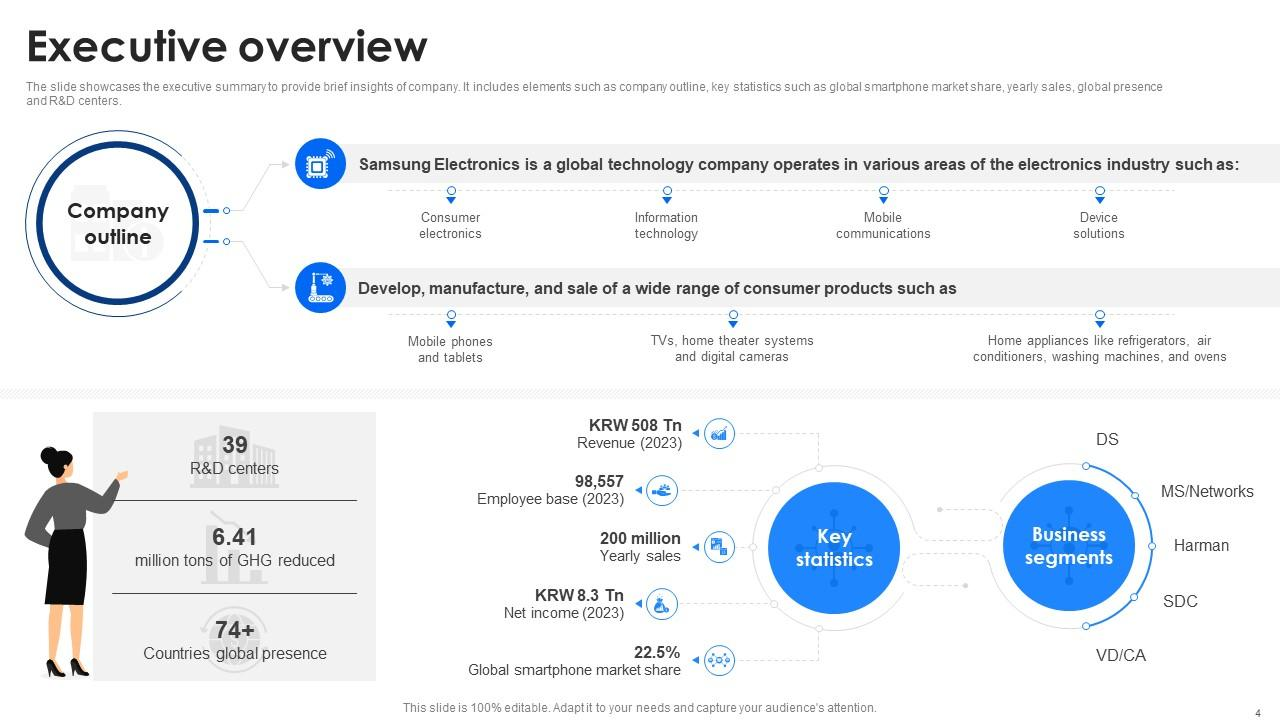
Use this firm overview slide as a cheat sheet to grasp the company without having to do hours of research. It covers what Samsung does, where it operates, how much money it’s making, and even the size of its global footprint. It also talks about the scale of its production, the number of R&D centers for innovating, and the volume of products generated each year. It helps the strategy folks to spot competitive angles, while investors can see the financial pulse without having to read the reports. And students or professionals who want a clean case study on how a tech giant stays relevant across so many divisions, this template is useful. Download now!
Template 4: Company Overview
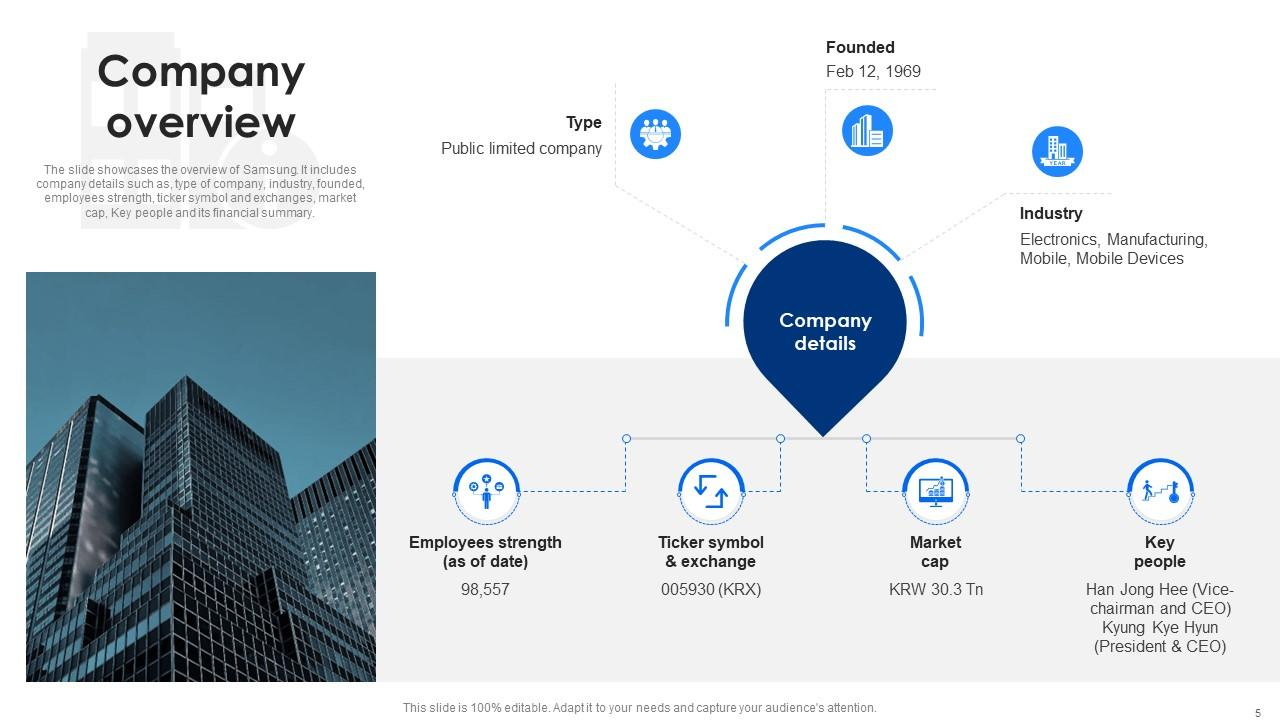
Here’s Samsung’s corporate background, which gives a glance at when the company was founded, what industries it’s in, how many people it employs, even market cap and ticker symbol. You also get a peek at the key leadership, and it is useful for investors and analysts as it gives a quick reference to see scale and value. For marketing or strategy teams, it helps put Samsung in context within electronics, manufacturing, and mobile devices. And for students or anyone studying business, it’s a clear example of how to present company info without drowning in details. Download now!
Template 5: Mission, Values and Principles
If you want to know how Samsung actually thinks and operates, this slide is for you. Sometimes, it's not about products or numbers but about mission, values, and the principles that guide every decision in a company. On one hand, you will understand how people and technology influence the company’s growth in creating the best products, but still give back to society in many ways. That is a clear mix of internal goals and social responsibility. It shows what matters most to the company and how they want to run the business. The business principles at the bottom bring it home: ethics, safety, respecting customers and employees, and caring for the environment. For business folks, marketers, or even students, this slide is a mini blueprint of mission-driven leadership. Download now!

Template 6: Core Values and Business Philosophy
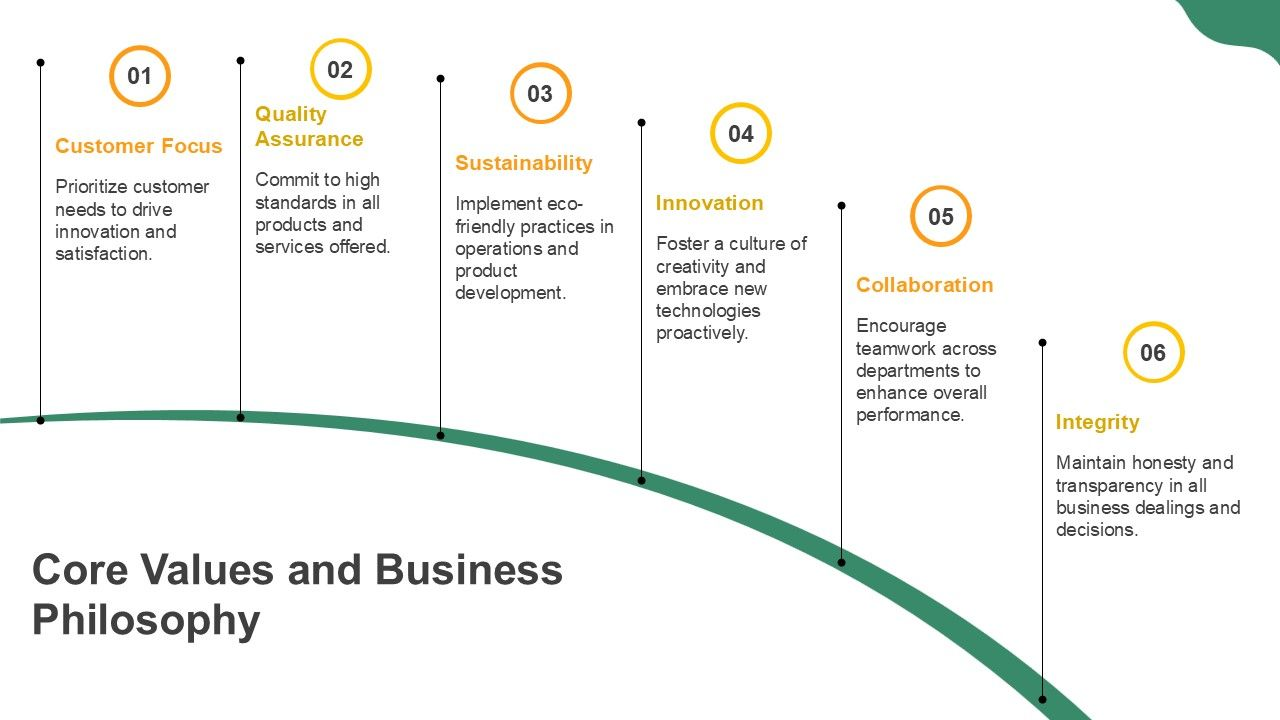
This slide talks about what really drives a company—its core values and business philosophy. It includes details on customer focus, quality assurance, sustainability, and various other factors that influence the company’s day-to-day operations successfully. This slide is useful for managers who strive hard to align employees with the company’s goals. For marketing or HR, this slide gives a hint on how to connect with potential leads, promote teamwork, and build a culture that works and manifests. It also helps the investors and stakeholders to think long-term and gives them a sense of accountability. It also acts as a clear example for students and anyone who is starting now in their business on how values, philosophies and ethics shape business and its future.
Template 7: Product Portfolio: Overview of Key Products
This slide gives an overview of key products. It includes a collage of seven images- all related to the workspace that give a sense of how these products fit into the bigger picture. It is useful for marketing or product teams as it reveals a story in client or investor meetings. For executives, it’s handy for showing how offerings tie into strategy and market positioning. And for students or professionals studying business, it’s an example of how to combine visuals and context to make a product portfolio feel alive, relevant, and easy to grasp. Download now!

Template 8: Market Segmentation and Target Audience
This slide gives a clear picture of the company’s market segmentation and target audience. As you can see in the table, it includes details like market share, target age, key features, consumer preference, growth rate, etc. It also includes various products in a column, giving insights into their market presence and the value they produce. Understanding the market segmentation and target audience helps in creating messaging in a way that resonates with the particular target audience or a potential buyer. Having a clear market segmentation keeps the marketing efforts focused and concentrated so that resources are not wasted chasing uninterested buyers.

Template 9: Competitor Analysis: Key Rivals and Market Position
This slide gives you a comparison between the performance of Apple and Huawei. It talks about Apple’s strengths, such as sleek design, a connected ecosystem, and premium pricing. Huawei has more cutting-edge tech, competitive pricing, serious R&D, etc. This analysis is useful for marketers or product teams to help them understand how to differentiate between products, tweak messaging, or spot new opportunities. For stakeholders and investors, it helps in understanding where to invest attention and resources by looking at who’s strong where and where the potential lies. Download now!

Template 10: Feedback and Conclusion on Samsung Profile
This slide explains what makes Samsung a big company. The reasons behind it are being an innovative leader in the market, having a variety of products, being present globally, and being known by everyone, including the trust it has built. It’s simple, but it tells you a lot about why the company keeps winning in tech. Any company like Samsung has its unique strengths that make it stand out in the crowded market. This conclusion slide also defines the same thing- Samsung’s overall strengths and why it is successful today. Include this slide in your company profile as an ending note where the audience gets a clear picture of why you are different than others.

Over to you!
By now, you know how Samsung was started, how it thrived, and how it succeeded. And if you are willing to take inspiration from Samsung’s journey, you are already on the right track. Now, download our 100% editable and customizable templates from this blog to help draft your company profile with the help of the already existing details, format, and ideas in the templates, but by simply tweaking them. Besides, our templates also offer you fresh perspectives on how you should own even the minute details of the company and stand out while presenting them to investors and stakeholders.
Check out our top 10 Kantar Company Profile templates to get more leads here.
FAQs on Samsung Company Profile:
How did Samsung evolve from a trading company into a global conglomerate?
Samsung began in 1938 as a trading company and gradually expanded into electronics, semiconductors, and global technology leadership.
What percentage of Samsung’s revenue comes from the electronics division?
Roughly 70–75% of Samsung’s total revenue comes from its electronics division, especially semiconductors and mobile devices.
How does Samsung compete with Apple in the global smartphone market?
Samsung competes with Apple by offering a wider range of smartphones, innovative features, and competitive pricing across markets.