





 0 Comment
 Customer Reviews

In 2019, Gartner introduced a term called SASE—Secure Access Service Edge that would change how enterprise security is approached. It wasn’t only a trendy term. It was created to address the fast changes happening in cloud-first, hybrid workplaces, mobile users, and the rise of cyber threats.
Today, SASE is an architectural shift. By converging networking and security into a unified cloud-native model, SASE frameworks offer businesses the agility to scale securely, connect users from anywhere, and protect data everywhere. But while the concept is powerful, explaining it is not so simple.
That’s where SlideTeam’s SASE Framework Templates come into play. These templates, designed by experts, allow IT leaders, cybersecurity architects, and tech consultants to explain the SASE model using easy-to-understand visuals, including its main parts, when it will be implemented, its advantages, and a comparison of vendors.
Need help with preparing an extensive cloud security strategy roadmap? Explore SlideTeam’s blog with downloadable templates with a click here.
Each template is 100% customizable, allowing you to tailor your message for stakeholder presentations, board-level briefings, or technical team discussions.
Let’s explore the templates that simplify SASE—so you can present security without the complexity.
Access SlideTeam’s best-in-class information security framework templates with a click here.
Template 1: SASE Framework Components PPT Presentation
This PPT Presentation covers the main points of the Secure Access Service Edge (SASE) framework. It starts by explaining the main ideas of SASE: secure access, cloud integration, performance, and easy management. It lists the main components—Secure Web Gateway, CASB, Zero Trust Network Access, and Firewall as a Service—and explains what they do and when to use them. It examines principles in architecture, including cloud-native design, zero trust, data-centricity, and automation. The main benefits of SASE, such as lower costs, better security, and easy scalability, are discussed, and then SASE is compared to traditional security models.
[product_image id=1406318]
Template 2: SASE Network Architecture PPT
This PPT explains in detail how SASE networks are designed. First, the course introduces SASE’s main functions: secure access and cloud integration. Then, it explores the Zero Trust model by discussing user verification, least privilege access, and threat detection. The slides also discuss the advantages of using SASE, such as lower costs, better security, and improved performance. The presentation highlights that SASE makes it easier for users by ensuring smooth connections and centralized control. It also suggests cloud services that can grow with the business and covers important rules such as GDPR, encryption standards, and audit trails.
[product_image id=1405299]
Template 3: SASE Architecture PowerPoint Template
This PPT explores SASE architecture, what it consists of, and the benefits it offers. It presents an overview of SASE, then explains its structure and goals, including cloud-based security services such as SWG, CASB, ZTNA, and FWaaS. The presentation highlights that SASE is focused on identity, with access decisions based on who the user is and what device they are using. It points out that SASE offers reduced latency, a better experience for users, and makes operations simpler than traditional security models. It also presents real-world situations and explains features, such as SD-WAN, secure service edges, and digital experience monitoring. The deck covers all the main points about SASE, which makes it a valuable resource for anyone interested in modern network security frameworks.
[product_image id=1412346]
Template 4: SASE Architecture and Design Principles
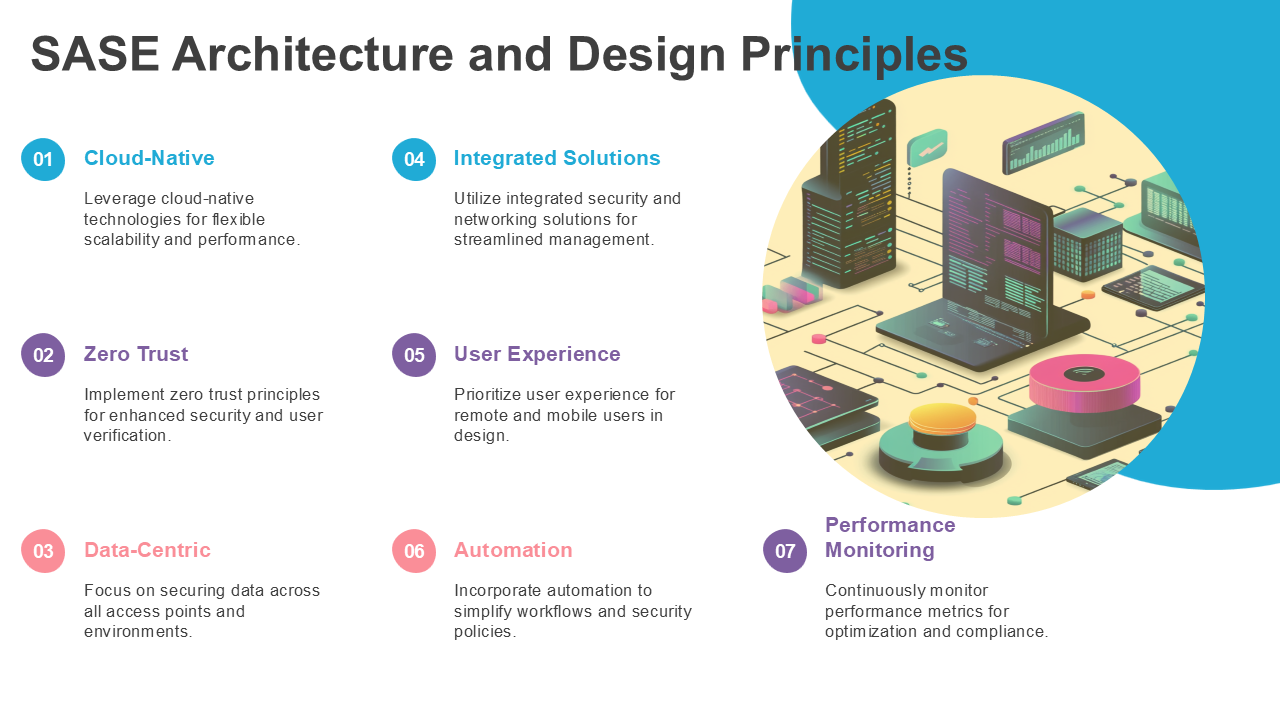
This PPT outlines the main design principles behind SASE (Secure Access Service Edge) architecture. The framework includes seven main parts: Cloud-Native for better performance and scalability, Zero Trust for strict user verification, and Data-Centric for protecting data in all environments. With Integrated Solutions, security and networking are easier to manage, and User Experience makes it simple for users to access the system remotely. Automation makes security tasks easier, and Performance Monitoring helps ensure that operations are efficient and follow the rules. All of these principles come together to create a strong, flexible, and safe framework for today’s enterprise networks.
Template 5: Benefits of Implementing SASE
This slide explains the main advantages of using the SASE framework in today’s networks. It points out benefits such as lower IT expenses because of service consolidation, more flexibility thanks to easy cloud integration, and better security with a single threat management system. SASE makes it possible to handle more data as a business grows, enhances how data is routed for better performance, and manages everything from one central point. It also guarantees that users have the same experience no matter where they are and helps meet the rules. All of these benefits make SASE a strong and flexible way to secure, manage, and prepare for future digital infrastructure.

Template 6: Comparison with Traditional Security Models
This PPT presents a comparative analysis between SASE and traditional security models across four key aspects: integration, deployment, scalability, and user focus. SASE integrates networking and security into a unified cloud service, while traditional models remain fragmented. It supports faster deployment compared to the complexity of hardware-centric systems. SASE offers automatic scalability to meet growing business needs, unlike traditional models that incur higher operational costs. Lastly, SASE delivers user-centric security tailored to device and location context, whereas traditional approaches are rigid and less adaptable. This comparison highlights SASE’s advantages in agility, cost-efficiency, and modern enterprise adaptability.

Template 7: Zero Trust Security in SASE
This PPT Framework explains the main principles of Zero Trust Security in SASE, highlighting User Authentication and Least Privilege Access. It suggests using multi-factor authentication to make sure only authorized users can access important information, which greatly reduces the chance of a breach. It also encourages giving users access only to the resources they need for their jobs. By using this approach, organizations can reduce their risks, protect more areas, and improve how they protect their data. Zero Trust principles are key parts of today’s security strategies and match SASE’s aim to provide safe access to resources from anywhere.

Template 8: SD-WAN Integration with SASE
This PPT Slide explains how to integrate SD-WAN with SASE in three steps. The first step is to check if the existing network design is compatible with SASE. At this stage, you should set up SD-WAN solutions that satisfy the security and performance requirements of SASE. In Step Three, it is important to keep monitoring and improving the system to ensure both performance and security are maintained. The timeline-based design clearly shows the order in which SD-WAN and SASE should be integrated, making it simpler for organizations to improve their network security and efficiency as their infrastructure changes.

Template 9: Cloud Security Solutions in SASE
This PPT Design highlights four important cloud security solutions that are part of the SASE framework. Sensitive information is kept safe by being encrypted while it is sent. AI helps Threat Intelligence to find and deal with security risks before they become serious. Access Control uses zero trust to confirm users and control who can access resources, thus minimizing risks. The main aim of Incident Response is to create guidelines for fast action if a security breach occurs. All of these factors help organizations establish a strong, secure, and flexible cloud infrastructure that meets today’s cybersecurity needs and protects networks everywhere.

Template 10: Data Protection and Privacy in SASE
This PPT Set explains important ways to secure data and privacy using the SASE approach. It points out seven main aspects: Data Encryption for secure data transfer, Access Control according to user roles, and Compliance Monitoring. The service also provides Data Loss Prevention to protect important data, Secure Backup to regularly copy critical information, and a clear Privacy Policy for openness. When used together, these components help organizations protect their information, reduce risks, and maintain trust in cloud and distributed networks, allowing them to meet both security and compliance requirements.

Simplify Security. Strengthen Strategy.
As organizations adapt to cloud-first environments, distributed workforces, and escalating cyber risks, SASE isn’t just a framework—it’s the future of secure, scalable connectivity. But like any powerful shift in infrastructure, the real challenge lies in communicating it clearly.
SlideTeam’s SASE Framework Templates equip you with the structure to do exactly that. Whether you’re guiding a CISO through architecture decisions or aligning your IT team around deployment milestones, these templates turn complex security concepts into compelling, boardroom-ready visuals.
Because in a world where threats move fast, clarity is your first layer of defense.
Download these templates today and start presenting SASE not just as a framework, but as a strategic advantage.
FAQs
-
Why is SASE important for modern networks?
SASE (Secure Access Service Edge) is important for today’s networks since it merges networking and security into a single cloud-based service. Because organizations are now using remote work, cloud applications, and have distributed users, the old perimeter-based security is no longer effective. SASE makes it possible to safely access resources from any location by combining SD-WAN with zero trust, firewall-as-a-service, and secure web gateways. This simplifies things, improves how the system works, and ensures that all endpoints are secure. Because it can be scaled and managed centrally, it is well-suited for today’s fast-changing digital world, allowing companies to secure their data and operate efficiently.
-
How does SASE merge networking and security?
SASE combines networking and security by bringing together important features in a single cloud environment. It relies on SD-WAN to manage and improve the flow of data between different offices. Security tools in this area are Zero Trust Network Access (ZTNA), Firewall-as-a-Service (FWaaS), Secure Web Gateways (SWG), and Cloud Access Security Brokers (CASB). All of these components are needed to make sure users can safely access applications and data from anywhere. Having both functions in one platform allows SASE to streamline management, boost performance, and provide the same security policies everywhere in the company.
-
What tools support analytics and threat detection?
Analytics and threat detection tools are crucial for keeping today’s networks safe. SIEM systems, including Splunk and IBM QRadar, collect log data from different sources to quickly spot threats. Tools such as CrowdStrike and SentinelOne are designed to watch over and defend each individual device. NDR tools, for example Darktrace, watch the network’s traffic to spot any unusual activity. UEBA tools use machine learning to spot unusual behavior, while CASBs help monitor cloud application use and find threats in SaaS systems. With these tools, organizations can track their security, spot issues, and respond automatically to threats.