





 0 Comment
 Customer Reviews

Visualise yourself in a classroom. The teacher is explaining a mathematical problem, but one student is gazing at the board in absolute silence. Their brain is likely built differently; it is not a result of their lack of effort. The student in question may be experiencing a Specific Learning Disability. SLD is a condition that significantly complicates the process of information processing, making it more difficult to perform tasks such as reading, writing, or arithmetic.
Dyslexia, dysgraphia, and dyscalculia are among the learning and attention issues that affect one in five children in the United States, according to the National Center for Learning Disabilities. However, a significant number of these children remain undiagnosed.
Have a look at our blog on the Top 10 Disability PPT Templates.
Here is a quote that resonates: "Everyone is a genius." However, if a fish is assessed solely on its capacity to ascend a tree, it will spend its entire existence believing that it is a fool. — frequently ascribed to Einstein. This succinctly encapsulates the experience of individuals with SLDs. They are not incapable; rather, they acquire knowledge in a distinct manner.
It is imperative to raise awareness and comprehension regarding these disabilities, particularly among educators, therapists, parents, and school administrators. However, it is not a simple task to explain terms such as phonological processing disorder or working memory deficits. This is where the effectiveness of presentations that are well-designed and lucid is realized.
Explore our blog on the Top 10 Learning Management System PPT Templates .
The Top 10 Specific Learning Disability PowerPoint Templates are presented in this blog to assist you in the explanation, advocacy, and education of your audience. All these templates are 100% editable and can be customised to suit your needs.
Let’s explore them one by one.
Template 1: Assessments For Specific Learning Disability PPT
This PowerPoint presentation highlights methods to detect problems in learning, such as cognitive testing, standardised achievement tests, behavioural checklists, and observational methods. The slides show how each test can help identify specific problems with reading, writing, and math by comparing a person's performance to standard statistics. It also mentions ways to interpret results and how they affect Individualised Education Programs (IEPs) and personalised interventions. The presentation helps teachers and specialists give accurate, data-driven evaluations and communicate them clearly, using structured layouts and process diagrams.
[product_image id=1330541]
Template 2: Understanding Specific Learning Disabilities
This presentation gives an overview of intervention techniques for treating Specific Learning Disabilities (SLDs). It shows how important it is to tailor interventions to each learner's specific strengths and weaknesses, as shown by the assessment findings. The curriculum explains how to use multisensory teaching methods, keep track of development over time, and help with executive function abilities. These ideas are meant to help teachers change their teaching approaches to fit the needs of each student better. The presentation shows how to use individualised educational support by combining teaching methods with planning based on assessment.

Template 3: Importance of Early Identification
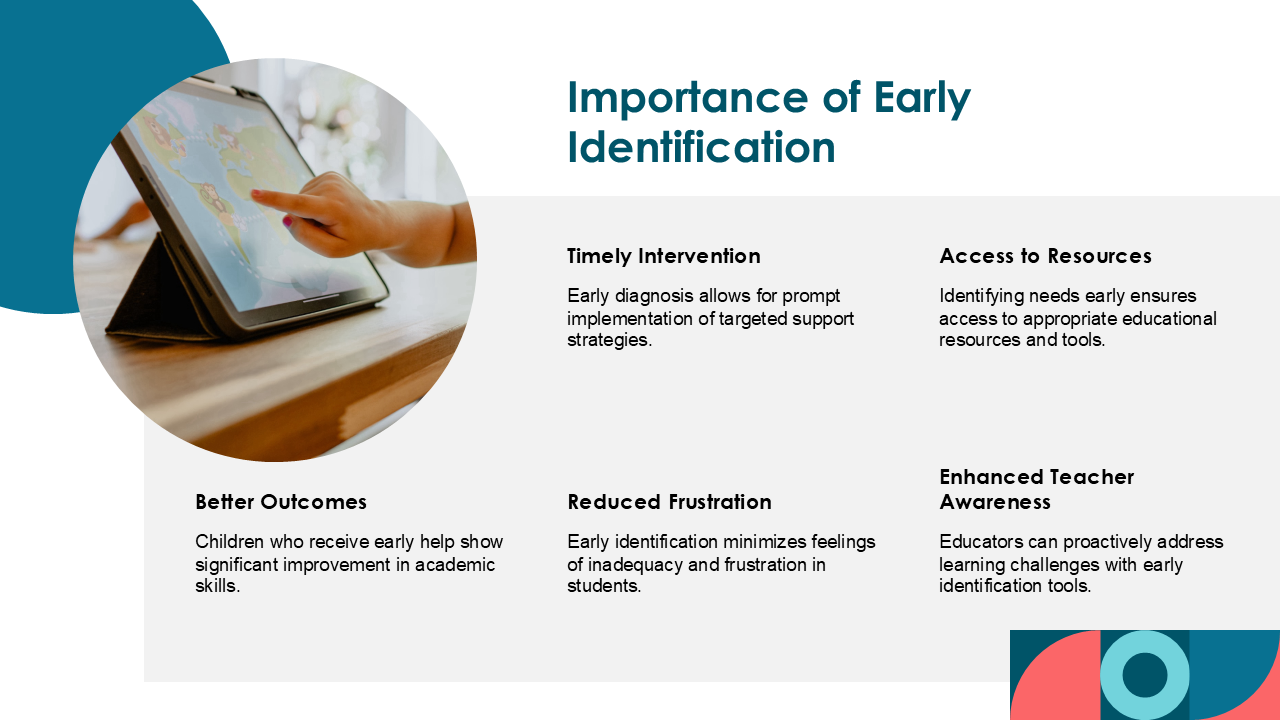
This presentation lists six main benefits of detecting SLP early. It stresses quick intervention, which makes it easier to put a quick assistance approach into action. It stresses how important it is to get better results, such as the big academic gains that come from getting help early on. To ease dissatisfaction, students' feelings of inadequacy are lessened. The slide also covers how important it is for teachers to be more alert. It stresses how important it is to find out what needs to be done early on in order to give good support, and it makes sure that the right educational tools are available by giving people access to resources.
Template 4: Types of Learning Disabilities
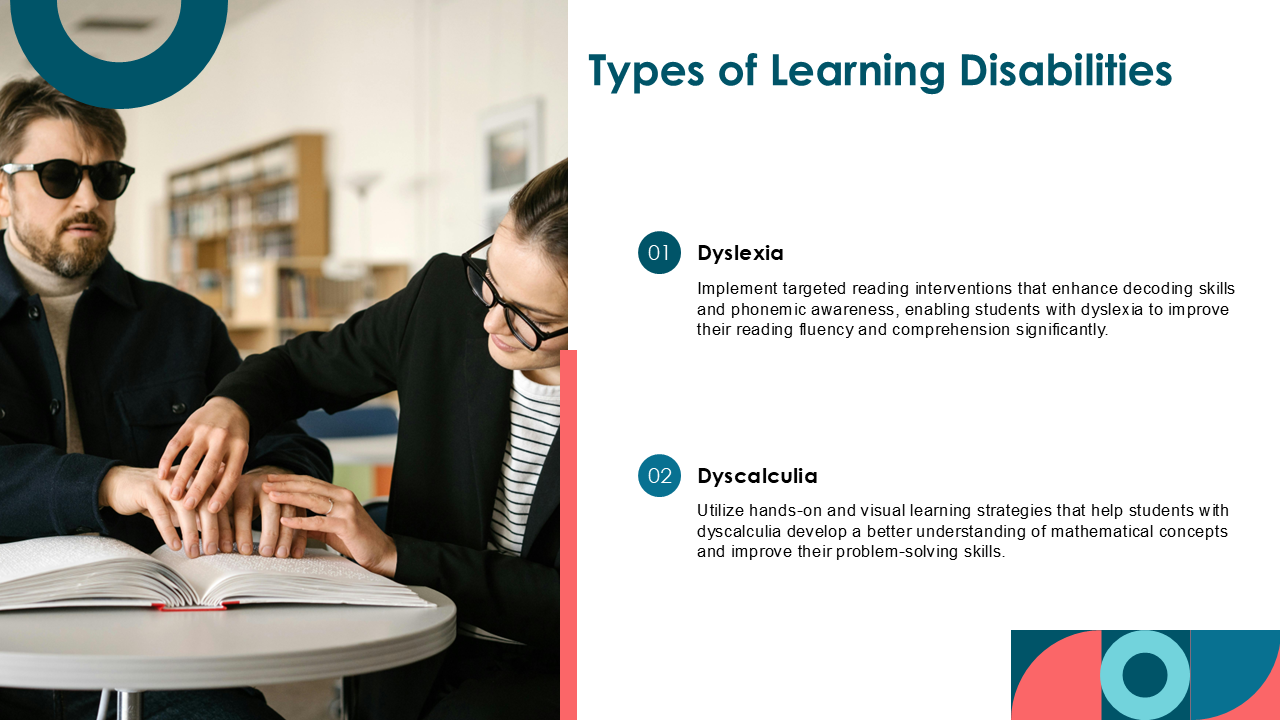
This slide shows two different types of cognitive disabilities: dyslexia and dyscalculia. It says that dyslexia support includes specific reading therapies that help kids read more fluently and understand what they read by improving their decoding skills and phonemic awareness. The presentation gives an overview of methods to utilize visual and hands-on learning tactics to help kids with dyscalculia understand better. Each point stresses teaching methods that are tailored to the specific challenges that come with these disabilities. The slide is good for training sessions, awareness campaigns, or program development that focus on the diversity of learners and teaching that includes everyone.
Template 5: Common Signs and Symptoms
This slide shows the main signs of several cognitive disorders in kids and teens. It lists eight common symptoms: low self-esteem, trouble in paying attention, remembering things, trouble with social skills, math, and reading. A short description of each symptom makes it clear how they affect schoolwork, managing tasks, getting along with peers, and mental health. The slide is a useful tool for teachers, parents, and professionals to see early warning signs and help with planning for further evaluation or support. It is a useful tool for increasing awareness and encouraging early intervention in schools and clinics.

Template 6: Assessment Overview and Types
This slide presents ways to check on the progress and needs of learners. Standardised tests use norm-referenced exams to get an accurate picture of a student's academic skills. Initial Screening helps detect these problems early by using questionnaires, etc. Dynamic Assessment focuses on using interactive and responsive methods to find out how much a student can learn. Curriculum-Based Assessment conducts regular performance reviews to keep an eye on how well students are doing. Behavioural assessment is the act of finding and evaluating emotional and social behaviours that could affect learning. Observation methods are used to obtain qualitative data by watching people learn in real time in natural settings. Finally, Informal Assessment gets useful information from parents and teachers on a student's general growth and achievements.

Template 7: Role of Standardized Testing
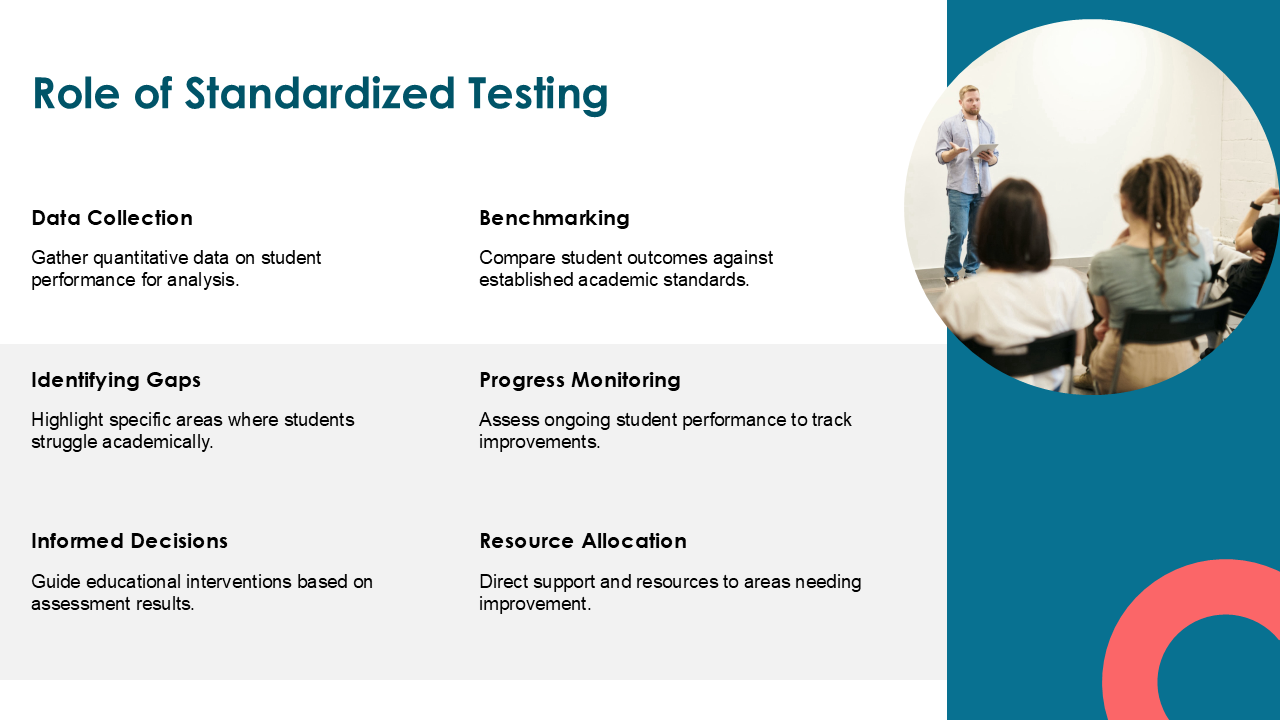
This presentation shows how standardized tests help schools run smoothly. These assessments make it easier to collect data by specifying performance measures and help with benchmarking by comparing student achievements to recognize academic criteria. They are very important for finding gaps where children are having trouble with schoolwork and for keeping track of development by monitoring improvements. Standardized exams also help people make better choices by pointing out areas that need improvement and directing targeted educational interventions. They help with resource allocation by focusing on those areas. Together, these duties help pupils do better in school and plan for the future.
Template 8: Observation and Informal Assessments
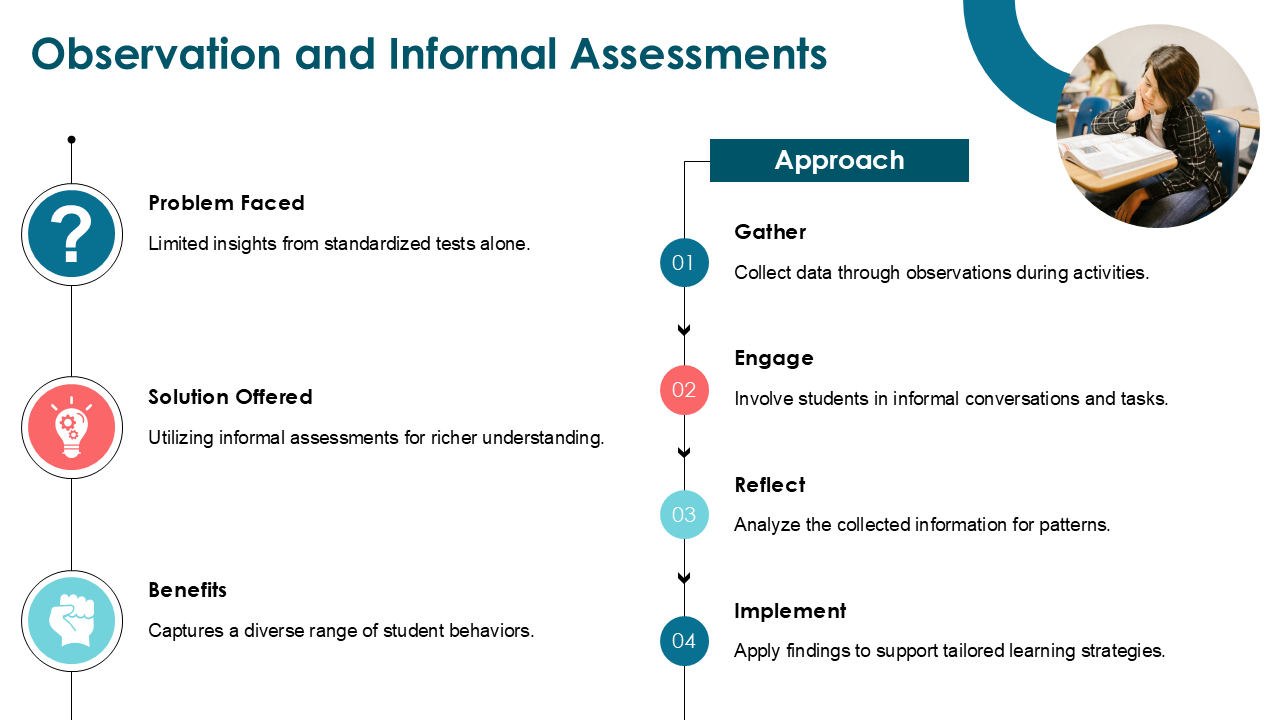
The PowerPoint talks about the problems with only using standardised tests and suggests that informal assessments could be a useful option. These informal methods offer more detailed and richer information because they capture a wider range of student actions. The proposed method has four steps: gathering data through activity-based observations, getting students to talk to each other in informal settings, looking at the data to find patterns, and then using those patterns to come up with ideas. This method helps teachers better understand what their students need and lets them tailor their lessons accordingly, which leads to more inclusive and responsive learning environments.
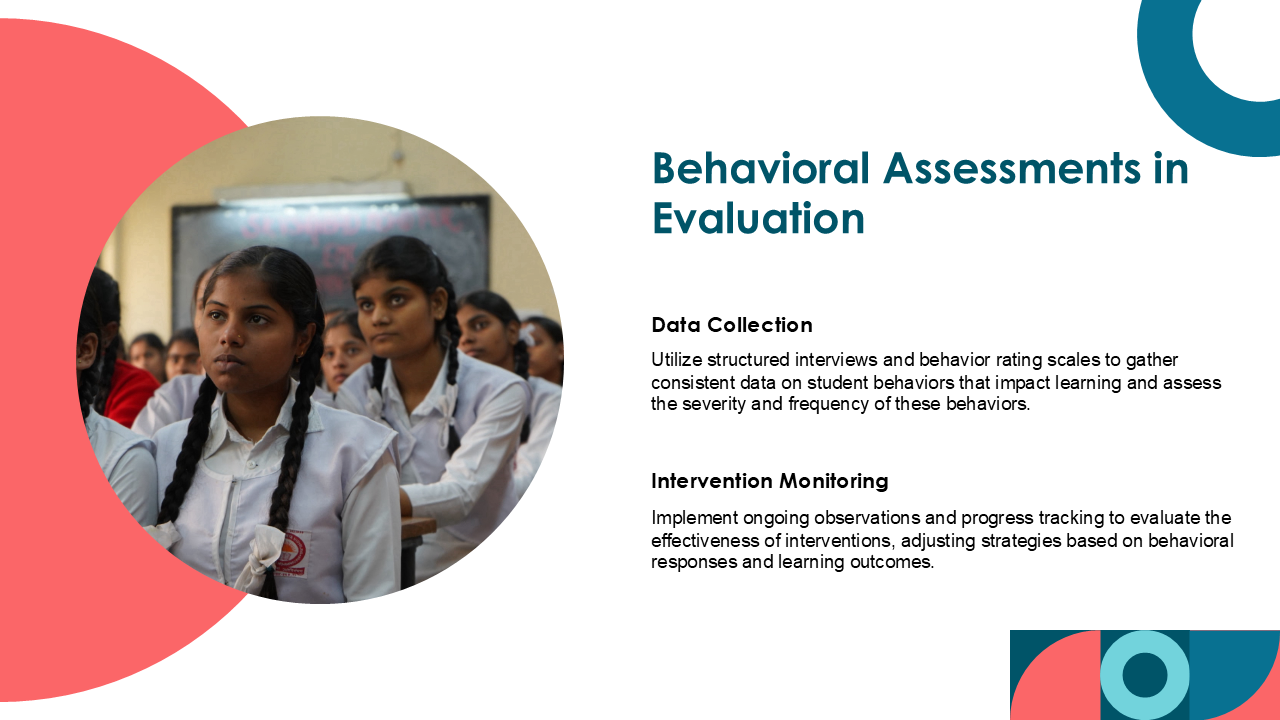
Template 9: Behavioral Assessments in Evaluation
The slide highlights the importance of understanding how students act in order to help them learn better. It explains how to collect data, such as structured interviews and behaviour rating scales, which help provide consistent information about how often or how severe certain behaviours are and how they affect learning. It also stresses Intervention Monitoring, which is the ongoing monitoring and recording of progress to monitor how techniques are working and make improvements based on how kids behave. This strategy makes sure that interventions are more responsive and more suited to the needs of each kid.
Template 10: Cognitive Assessment Techniques
This presentation presents three main methods to test cognitive function. Structured cognitive tests make it easier to find out which students have specific learning problems. They objectively measure different parts of cognitive capacity. Structured observation in classrooms is used in observational methods to collect qualitative data on how students act and perform tasks. This gives us useful information about possible learning impairments. Informal assessments use tools like checklists and anecdotal records to collect individualized information about a student's strengths and limitations. This information helps teachers come up with targeted intervention tactics to help students who are having trouble learning.

Enhancing Understanding of Specific Learning Disabilities Through Targeted Presentations
The 10 Most Common Learning Disabilities PowerPoint Templates give teachers, therapists, and administrators organized, evidence-based tools to help detect, evaluate, and fix SLDs. These templates cover important topics such behavioral evaluation, intervention options, the benefits of early detection, and ways to assess. Each template offers useful tools and simple explanations to raise awareness about learning difficulties. These concentrated presentations help stakeholders better spot symptoms, understand diagnostic data, and carry out individualized instructional strategies. Download them today!
FAQs
What are Specific Learning Disabilities?
Specific Learning Disabilities (SLDs) are learning disorders that change how the brain takes in, processes, or sends information. These limitations make it hard for people perform certain tasks like reading, writing, and math. SLDs are not about how smart someone is, but rather how they learn. People with SLDs may need extra help and instruction to do well in school. Finding and helping them early on is very important for assisting them to reach their full potential.
What are the 5 Specific Learning Disabilities?
Auditory processing disorder, dyslexia, dysgraphia, dyscalculia, and nonverbal learning disability are the five most common types of Specific Learning Disabilities. Dyslexia makes it hard to read and understand words. Dysgraphia makes it harder to write and coordinate your fine motor skills. People with dyscalculia have trouble with mathematical concepts and calculations. Auditory processing disorder makes it hard for the brain to understand sounds, and nonverbal learning disability makes it difficult to understand and use social and visual-spatial skills.
What is the Meaning of SLD?
SLD stands for "Specific Learning Disability." It refers to a group of characteristics that make it difficult to learn and use certain academic skills, such as reading, writing, and math. These problems have nothing to do with intelligence; they just show that the brain processes information in a different way. By knowing what SLD means, teachers and parents can offer the help and adjustments that are needed. The goal is to help people with SLDs do well in school by using personalised interventions.