





 0 Comment
 Customer Reviews

The deck's due Friday. Everyone's waiting on the data.
Not because the numbers aren't there. They are—somewhere across four dashboards, two spreadsheets, and a shared drive folder nobody's touched since Q2. The problem isn't data. It's that nobody agreed, upfront, on how the data should talk to each other.
That's what a business intelligence framework actually is. Not a tool. Not a software. A shared agreement about how decisions get made—what gets measured, where it lives, who sees it, and what happens when the numbers say something uncomfortable.
Most organizations skip that agreement. They buy a BI platform, hook it up to the warehouse, and assume the insights will surface themselves. They don't. Six months later, the sales team's numbers don't match the finance team's numbers, and two VPs are arguing in a meeting because they're both right—just using different data.
There's a specific moment most BI projects hit: the one where someone asks "wait, which version of this metric are we using?" and the room goes quiet. That silence is expensive. It's where trust in the data starts to erode. Once people stop trusting the dashboard, they go back to gut instinct. And then the whole investment collapses.
Building a proper framework means front-loading the uncomfortable decisions. What are the KPIs that actually matter? Who owns data quality? How does the ETL process connect raw sources to reportable outputs? What does self-service BI access look like for teams that aren't analysts? None of these questions are fun to answer in a committee. But they're less painful than rebuilding everything a year from now.
That's why the templates exist. Not because the concepts are new—data-driven decision making has been around long enough that it probably has its own Wikipedia disambiguation page. They exist because structuring these decisions is hard, and most teams don't know where to start.
SlideTeam's business intelligence framework templates give you a starting point that isn't a blank slide. Pre-designed layouts that already account for architecture diagrams, KPI dashboards, governance models, and roadmap structures. The kind of thing you'd spend three days building from scratch, ready in an afternoon.
Here's what's available.
Template 1: Market Intelligence Framework PowerPoint Presentation Slides
Commanding market intelligence starts with structured, visually sharp presentation. This 34-slide complete deck delivers comprehensive coverage of your market data story. Edit fonts, backgrounds, colors, and shapes to align with your brand identity. Switch file formats instantly—PowerPoint, PDF, PNG, or JPG—for flexible sharing. Every layout renders crisp on both standard and widescreen resolutions. Google Slides compatibility means your team accesses it anywhere, anytime. Drive sharper market positioning decisions with every slide you present. Download this dynamic template now and take control of your market intelligence narrative.
[product_image id=261831]
Template 2: Building a Comprehensive Business Intelligence Framework PPT Slides
A BI implementation guide is only as clear as the structure holding it together. This PPT template is built for data leads and strategy teams who need to present a business intelligence framework — from data warehouse architecture to KPI dashboard design — in one coherent flow. It works well for enterprise reporting system reviews where data governance framework decisions need stakeholder alignment fast. The slide keeps data-driven decision making visible and traceable across layers. The template is 100% editable and customizable.
[product_image id=1826396]
Template 3: 10 Steps Framework for Developing Business Intelligence Strategy
Mapping a BI strategy across ten clear stages gives your team a concrete action plan. This template covers everything from defining your vision to aligning IT with core business needs. Identify KPIs, build a data structure, and create a BI competency checklist—all in one deck. A dedicated slide for prioritizing initiatives keeps your BI roadmap on track. Track ROI with clear metrics that connect every decision to measurable outcomes. Fully editable design lets you tailor content, colors, and layout in minutes. Transform your BI strategy presentations today. Download this template now and build your data-driven decision making foundation step by step.

Download this PowerPoint Template
Template 4: Business Intelligence Framework Overview PPT Information
A clear BI framework overview sets the foundation for every data conversation your team has. This complete deck grabs audience attention instantly with purposeful, engaging design. Adjust elements, color themes, and layouts effortlessly across Microsoft or Google Slides. PDF, JPG, JPEG, and PNG export options make sharing fast and format-flexible. Tailor color schemes to match your audience or corporate brand preferences. Every slide communicates your BI architecture with clarity and professional authority. Elevate your business performance metrics presentations from generic to precise. Download this template now and make your BI framework overview impossible to ignore.
[product_image id=1753790]
Template 5: Data Management Framework for Business Intelligence
Effective data management is the engine behind every reliable BI reporting system. This template maps the three core layers: analytic-driven, data-driven, and data management structures. Visualize cloud software integration, data warehousing, and data quality controls in one clear slide. The clean three-stage layout communicates complex information without overwhelming your audience. Fully editable design means you adapt the content to your organization's specific data architecture. Instant download gets this framework into your workflow without delay. Transform your data management presentations with clarity and structure. Download this template now and give your enterprise reporting system a professional visual foundation.

Download this PowerPoint Template
Template 6: Data Analytics Operations Framework for Business Development
Strong data analytics operations require clear alignment across talent, process, and insight. This template covers organization structure, talent strategy, and capability development in a unified visual framework. A dedicated section on converting raw data into analytic insights drives action, not just awareness. Immediately available and fully customizable, this deck adapts to your business development narrative quickly. Adjust content, layout, and design to match your team's priorities and communication style. Built for analysts, strategists, and operations leads who need clarity fast. Transform your analytics operations presentations into compelling business cases. Download this template now and align your data analytics framework with real organizational impact.

Download this PowerPoint Template
Template 7: Business Intelligence Software Comparison Framework PPT Example
Picking the right BI tool is rarely straightforward — the tradeoffs across data governance framework support, KPI dashboard design, and total cost of ownership are real. This PPT template gives data strategy leads and IT architects a structured side-by-side view of competing platforms. It works well when a BI architecture design decision needs sign-off from both technical and business stakeholders in the same room. For context, the slide fits neatly into an enterprise reporting system evaluation or a cloud BI solutions shortlist review. The template is 100% editable and customizable.
[product_image id=1836860]
Template 8: Business Intelligence Governance and Security Framework PPT Summary
Data governance and security aren't optional—they're the backbone of any trusted BI framework. This complete deck presents governance and security structures with visual clarity and brand-ready design. Customize color schemes and layout elements to align precisely with your organization's identity. Full compatibility with Microsoft versions and Google Slides fits every team's workflow without friction. Downloadable in JPG, JPEG, and PNG formats for fast, flexible distribution. Pre-designed layouts cut preparation time so you focus on the governance decisions that matter. Elevate your data governance framework presentations to executive-grade quality. Download this template now and build stakeholder confidence in your BI security architecture.
[product_image id=1866693]
Template 9: Schematic Data Architecture Five-Year Roadmap for Business Intelligence Programs
A five-year data architecture roadmap gives BI programs the long-term structure they need. This slide maps schematic data architecture across a multi-year timeline with visual precision. Available in both 4:3 and 16:9 aspect ratios for any presentation format or venue. Customize font size, type, color, and shapes to match your organization's reporting standards. Google Slides compatibility ensures your team can access and present from anywhere. Export to PDF, PNG, or JPG for seamless distribution to stakeholders at every level. Transform your BI program planning presentations into clear, executive-ready roadmaps. Download now and give your data warehouse architecture a credible, structured visual plan.

Download this PowerPoint Template
Template 10: Data Science Analysis Performance Framework Techniques Business Intelligence
Deep data science analysis demands a presentation framework that matches its complexity. This 11-slide complete deck covers the core performance areas of business intelligence with clarity. Professionally designed visuals pair with subject-driven content across every slide. Edit color, text, and font size to fit your specific analysis and audience requirements. Add or remove content sections to match the scope of your BI performance review. Ready-made layouts mean you move from raw analysis to polished presentation in minutes. Transform your data science performance framework presentations today. Download this deck now and present your predictive analytics insights with authority and precision.
[product_image id=248990]
Template 11: Building a Data Governance Framework for Business Intelligence PPT
Data governance frameworks only work when they're communicated with clarity and conviction. This complete deck presents your governance model with a seamless blend of creativity and structure. Customize color schemes and design elements to align with your brand identity without effort. Compatible with Microsoft PowerPoint and Google Slides for consistent access across your team. Downloadable in JPG, JPEG, and PNG formats for fast, flexible sharing with stakeholders. Pre-designed layouts remove the formatting burden so you focus on governance decisions. Elevate your BI governance presentations to a level that builds real organizational trust. Download this template now and establish a data governance framework that commands respect.
[product_image id=1598970]
Template 12: Business Intelligence Transformation Toolkit Multistep Business Intelligence Project Roadmap
A multi-step BI project roadmap keeps design, development, and integration on track and visible. This slide maps every project stage clearly, including time allocations for each task involved. Visual structure gives leadership and project teams a shared, unambiguous view of progress. Fully editable design lets you adapt the roadmap to your organization's specific BI timeline. Use it as a discussion tool to align stakeholders before and during implementation. Instant download means your BI transformation planning starts today, not next week. Transform your BI project management presentations into clear, accountable delivery plans. Download this template now and keep your BI implementation guide on schedule.

Download this PowerPoint Template
Template 13: Integrating AI into Existing Business Intelligence Frameworks PPT Slides
AI-powered BI is only as effective as the framework you build to absorb it. This complete deck addresses the specific challenge of integrating AI into existing BI systems. Purposeful slide design grabs audience attention and holds it through complex AI-related content. Compatible with Microsoft PowerPoint and Google Slides for flexible team-wide access. Export in JPG, JPEG, PNG, or PDF formats for straightforward sharing and editing. Color theme customization lets you tailor every slide to your audience's preferences. Transform your AI-powered business intelligence presentations into compelling strategic narratives. Download this deck now and make your AI integration roadmap clear, credible, and actionable.
[product_image id=1507601]
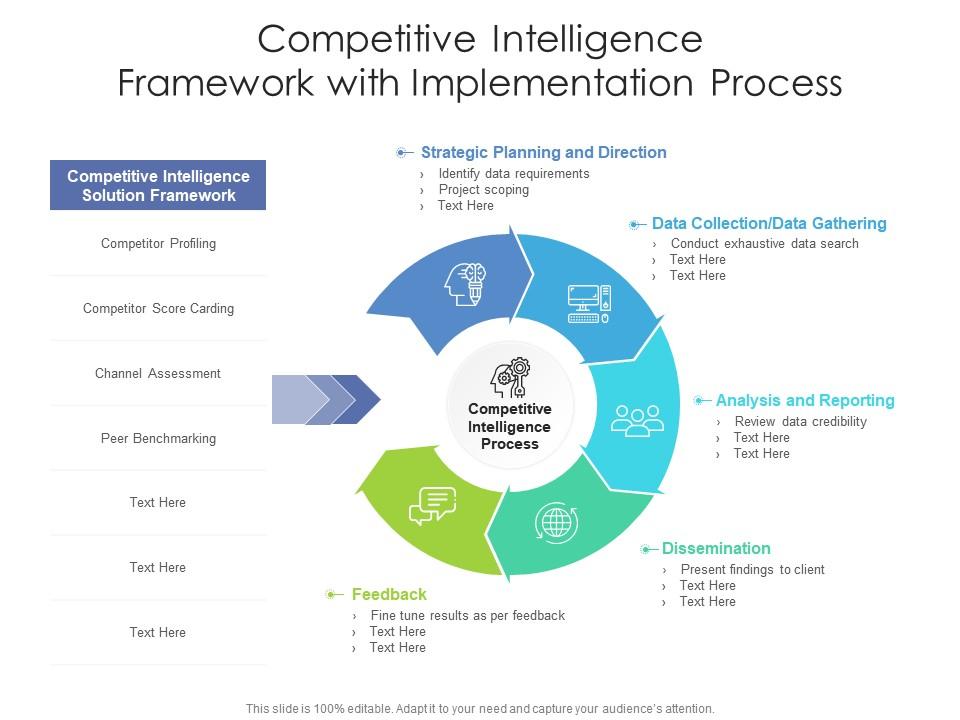
Template 14: Competitive Intelligence Framework with Implementation Process
Competitive intelligence only creates value when it follows a disciplined, repeatable process. This five-stage template covers strategic planning, data collection, analysis, and reporting in sequence. Each stage is clearly visualized, giving your team a shared framework for competitive tracking. Fully editable design lets you adapt language, color, and layout to your specific context. Download immediately and start structuring your competitive intelligence process without delay. Built for strategy leads and analysts who need structure, not starting-from-scratch friction. Transform your competitive intelligence presentations into action-ready strategic assets. Download this template now and give your competitive analysis the rigorous framework it deserves.
Download this PowerPoint Template
Template 15: Business Intelligence Hybrid Architecture Framework HR Analytics Implementation
Hybrid BI architecture combining data marts and OLAP cubes demands precise, structured communication. This template maps structured, semi-structured, and unstructured data flows within a single visual framework. Key implementation recommendations—including data security and aggregation best practices—are built directly into the slides. HR analytics implementation context makes this ideal for organizations connecting people data to BI systems. Fully editable design lets you personalize the architecture diagram to your technology stack. Available for immediate download so your BI architecture presentations are ready when your audience is. Transform your hybrid BI architecture reviews into authoritative technical briefings. Download now and present your BI architecture design with the clarity every stakeholder needs.

Download this PowerPoint Template
Transform Your Bi Strategy with SlideTeam
SlideTeam's PowerPoint templates are the best in the industry for building and presenting a business intelligence framework. These content-ready slides save hours of design work while delivering the professional structure your BI strategy demands—from KPI dashboards to data governance models. Use these ready-made templates to align stakeholders, clarify architecture decisions, and communicate data-driven insights with confidence. Deploy SlideTeam's pre-designed BI framework slides to drive smarter decisions and measurable business outcomes.
FAQs on Business Intelligence Framework
What are the core components that every robust business intelligence framework must include to drive actionable insights?
Every solid BI framework needs four things: a data source layer (where data originates), a processing layer (ETL), a storage layer (data warehouse or data mart), and a presentation layer (dashboards and reports). Add a data governance policy to maintain quality and trust. Without all four working together, insights become unreliable and decisions suffer.
How does a business intelligence framework differ from traditional data management approaches in modern enterprises?
Traditional data management stores and protects data. A BI framework goes further—it connects data to decisions. It defines how data is collected, transformed, analyzed, and visualized for business use. Traditional systems answer 'what happened.' A BI framework answers 'what should we do next.' The key shift is from data storage to decision support.
Which KPIs should organizations prioritize when building a business intelligence framework from scratch?
Start with KPIs directly tied to revenue, cost, and customer outcomes. Operational KPIs—like cycle time or error rate—come next. Avoid building 30 KPIs at launch; pick five to eight that leadership actually uses to make calls. Measure what changes behavior, not what looks complete on a dashboard.
How can small and mid-sized businesses implement a scalable BI framework without overwhelming their existing IT infrastructure?
Start small. Pick one business question, not the entire data strategy. Use cloud-based BI tools—they require no heavy IT infrastructure. Prioritize self-service BI platforms that non-technical users can operate. Avoid building a full data warehouse upfront; a single data mart connected to one reporting tool is enough to prove value and build confidence.
What role does data governance play in maintaining the integrity of a business intelligence framework?
Data governance defines who owns data, who can access it, and what 'correct' means for each metric. Without it, two teams report different numbers for the same KPI—and trust collapses. Governance also ensures compliance with regulations like GDPR. Think of it as the rulebook that keeps your BI framework credible over time.
How should organizations align their BI framework with overall business strategy to maximize ROI?
Map your top three to five business goals first. Then identify what data is needed to track progress against each. Build your BI framework around those data needs—not around available tools. Review alignment quarterly. If a dashboard isn't influencing a decision, it's not serving the strategy. Cut it and refocus resources.
What are the most common pitfalls companies face during business intelligence framework implementation and how can they be avoided?
The biggest pitfalls are unclear ownership, poor data quality, and building for IT instead of end users. Fix these by assigning a data owner for every key metric, establishing data quality checks at ingestion, and involving business users in dashboard design from day one. Most BI failures are people and process problems, not technology ones.
How does real-time data processing change the architecture of a traditional business intelligence framework?
Real-time processing replaces batch ETL with streaming data pipelines. This means your architecture needs event-driven ingestion tools and low-latency storage layers. Traditional nightly data loads no longer work when decisions depend on live data. The trade-off: real-time systems cost more and require tighter data governance to prevent noise from overwhelming signal.


