





 0 Comment
 Customer Reviews

The deck's built. The sprint's planned. And somehow nobody agrees on what happens next.
That's the thing about agile—everyone understands the philosophy until there's a deadline. Iterations sound clean on a whiteboard. In practice, someone's still waiting on requirements, someone else changed the priority list at 4pm, and the retrospective notes from last week are sitting unread in a shared folder nobody bookmarked.
The gap isn't motivation. It's structure. Not rigid, top-down structure—but the kind that holds a team together when things shift mid-sprint. An agile action plan is that structure. It's not a Gantt chart dressed up in agile vocabulary. It's a living document. One that captures what the team is doing, who owns what, what done actually looks like, and when to stop and reassess.
Most teams know they need one. The hard part is building one that doesn't collapse the moment a stakeholder changes scope.
There's also a quieter problem. Even experienced project managers struggle to make agile action plans look credible to leadership. The iterative planning approach—fluid, responsive, constantly revising—can read as disorganized to someone who wants a fixed timeline and a clean deliverable column. The presentation layer matters. A lot.
That's why pre-designed templates exist. Not because agile is complicated—it is, but that's not the point. They exist because structuring the work is one thing, and communicating it clearly to a room of mixed stakeholders is another thing entirely. SlideTeam's agile action plan templates handle exactly that gap—ready-made frameworks that give teams the visual language to present iterative work without it looking unfinished.
Here are the templates worth using.
Template 1: High Level Action Plan for Agile Project Management
Agile project timelines rarely survive first contact with changing requirements. This PowerPoint slide is built for project leads who need to map actions against a clear timeline roadmap. It captures actions required, progress tracking, plan start and end dates, and total plan days in one structured view. Use it for agile action plan presentations covering requirement mapping and feature designing. The template is 100% editable and customizable.

Download this PowerPoint Template
Template 2: Tactical Action Plan with Objectives and Opportunities
Connecting tactical moves to measurable outcomes is where most action plans fall short. This PPT template is designed for business analysts and team leads who need to align opportunities with objectives. It covers key metrics, tactical priorities, and specific action items in a single coherent view. Real sprint reviews and quarterly planning sessions both benefit from this kind of structured layout. The template is 100% editable and customizable.

Download this PowerPoint Template
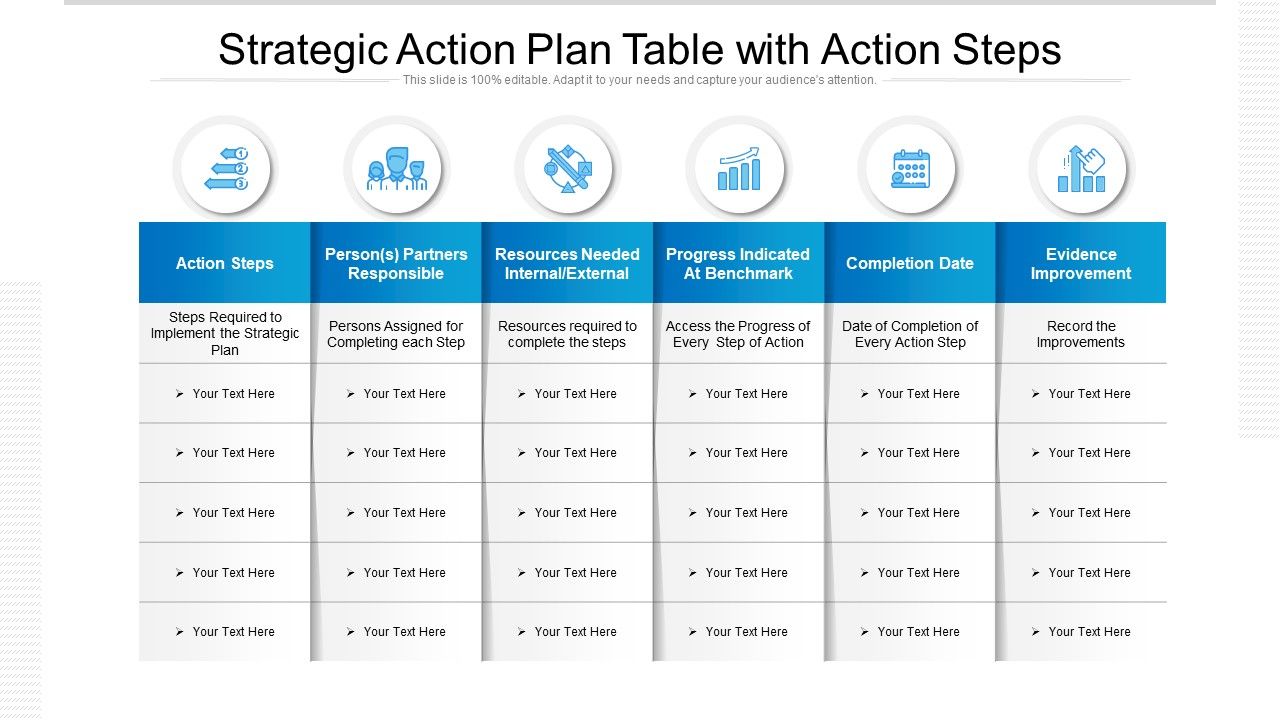
Template 3: Strategic Action Plan Table with Action Steps
Accountability in agile work depends on knowing who owns what and what done looks like. This PPT preset is built for project managers tracking action steps across teams with shared resources. It maps persons and partners responsible, internal and external resources needed, and completion dates. Progress is indicated at benchmarks, with evidence of improvement captured alongside. It fits neatly into agile team collaboration reviews and post-sprint reporting. The template is 100% editable and customizable.
Download this PowerPoint Template
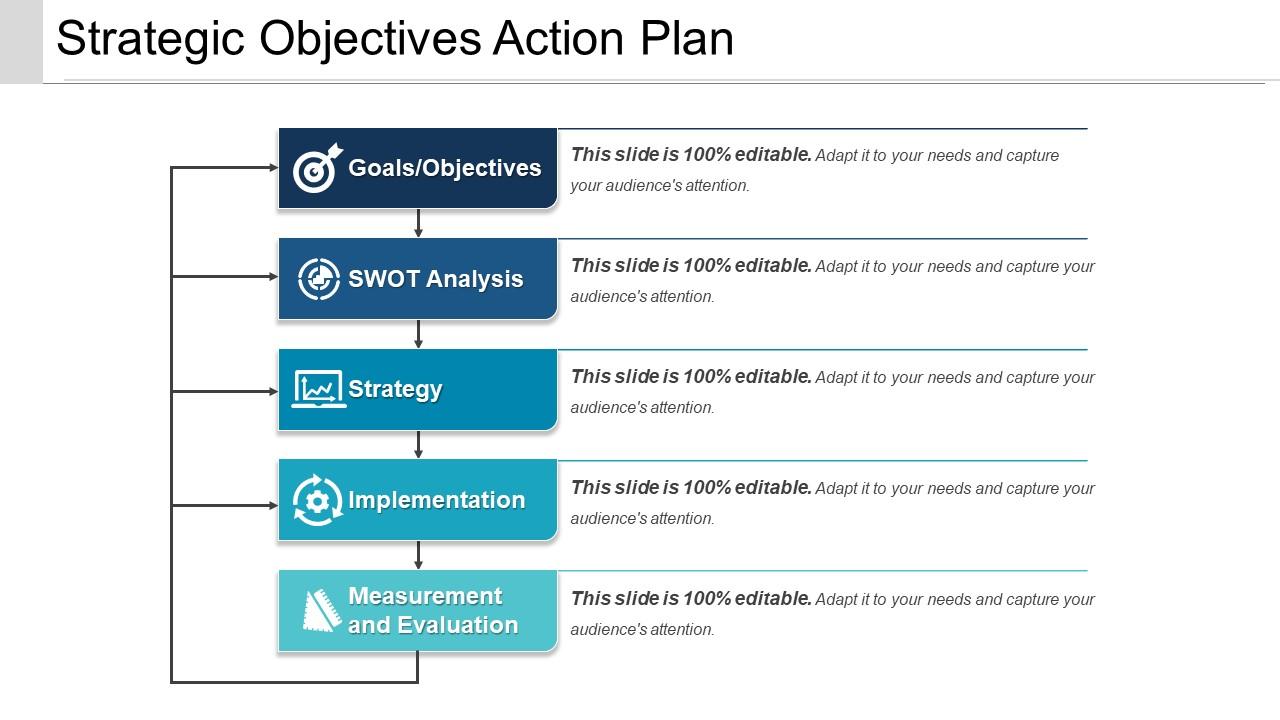
Template 4: Strategic Objectives Action Plan
Clarity on strategic objectives drives every successful agile execution cycle. This template delivers a structured framework for mapping organizational goals to actionable steps. Intuitive layout design ensures your audience grasps priorities at a glance. Flexible visual elements let you tailor the slide to any industry or business context. Use this to present agile objectives and aligned initiatives in board reviews or stakeholder updates. Transform your strategic planning presentations today. Download this dynamic template now and unlock sharper goal alignment.
Download this PowerPoint Template
Template 5: Business Project Management Strategy with Action Plan
Business project management decisions rarely happen in isolation—they need a clear visual context. This slide is made for project managers and PMO leads presenting integrated management and action planning. It ties business project management to a concrete action plan in one consolidated view. For teams running strategy implementation action plans, this PPT bridges the gap between planning and execution. The template is 100% editable and customizable.

Download this PowerPoint Template
Template 6: High-Level Action Plan for Project Management
Building a PMO from scratch requires more than a to-do list—it needs a sequenced implementation map. This template captures a five-stage high-level action plan for managing business projects end to end. Each stage—from confirming the PMO team to developing governance frameworks—is clearly visualized for leadership review. Flexible design makes it easy to adapt across industries and project scales. Use this to present agile project management rollouts with confidence. Transform your project governance presentations today. Download this dynamic template now and accelerate your PMO launch.

Download this PowerPoint Template
Template 7: Project Pilot Strategy Action Plan
Pilot projects fail quietly when nobody tracks commitments against actual deliverables. This template gives project leads a structured view of pilot strategy execution. It maps deliverables, responsible parties, review durations, and objectives in one clean layout. Commitment calendars, project proposals, and review meeting schedules all fit within the framework. Use it to present agile implementation plans to clients or internal stakeholders. Transform your pilot project presentations today. Download this dynamic template now and drive cleaner project delivery.

Download this PowerPoint Template
Template 8: Tactical Action Plan with Strategic Objectives
Sales teams move faster when tactical actions connect directly to measurable strategic goals. This template aligns business unit objectives, sales objectives, sales tactics, and sales metrics in a single structured view. Clear visual hierarchy ensures leadership sees how tactical execution supports broader agile strategy. Every element is purpose-built for quarterly business reviews and cross-functional planning sessions. Use this to present agile goals alongside sales performance data. Transform your tactical planning presentations today. Download this dynamic template now and unlock strategic sales alignment.

Download this PowerPoint Template
Template 9: Proposed Action Plan for Customer Service Team
Customer complaint backlogs grow fast when there's no structured response framework in place. This template maps a proposed action plan for customer service teams with precision. It covers improving service standards, handling urgent complaints, soft skills training, and enhancing the overall customer experience. Clear columns for responsible persons, proposed actions, and task activities make ownership immediately visible. Use this to present service improvement plans that drive measurable agile deliverables. Transform your customer service presentations today. Download this dynamic template now and elevate your team's responsiveness.

Download this PowerPoint Template
Template 10: Agile Change Management Communication Action Plan
Change management communication breaks down when the right message doesn't reach the right audience on time. This PPT template is built for change managers and HR leads defining communication timelines across stakeholder groups. It maps target audiences—business customers, project teams, development teams—against scheduled information delivery. Timeframes for each communication are clearly laid out, supporting agile workflow and organizational transparency. This PPT handles the planning layer so the messaging layer gets the attention it deserves. The template is 100% editable and customizable.

Download this PowerPoint Template
Template 11: Advocacy Action Plan with Objectives and Activities
Advocacy work requires clear goals, defined activities, and visible progress against both. This slide is built for program managers and nonprofit leads who need to present advocacy action plans with structured objectives. It pairs specific activities with outcomes, making it easy to track agile milestones and report impact. For teams exploring strategy implementation action plan templates, this PPT bridges advocacy planning and execution. The template is 100% editable and customizable.

Download this PowerPoint Template
Template 12: Action Plan Icon for Software Development
Software development teams need clear visual cues to track action ownership across sprint cycles. This three-stage template delivers a focused action plan icon framework for development workflows. Strong iconography makes task categorization and progress tracking immediately intuitive for technical and non-technical audiences alike. Flexible design supports rapid iteration—matching the pace of agile sprint planning reviews. Use it in stand-ups or sprint retrospectives to anchor team discussion visually. Transform your software action plan presentations today. Download this dynamic template now and sharpen your development team's focus.

Download this PowerPoint Template
Template 13: Action Plan Development PowerPoint Slide Introduction
Development action planning works best when each stage is visible and sequenced. This five-stage template walks teams through self-assessment, analysis, goal setting and plan development, implementation, and formative and summative evaluation. The logical progression helps teams spot gaps before they become blockers. Adaptable design supports iterative planning across product, HR, and operational development contexts. Use this to present structured development action plans in team reviews or leadership briefings. Transform your planning presentations today. Download this dynamic template now and build a stronger execution framework.

Download this PowerPoint Template
Template 14: Strategic Action Plan with Objectives and Action Items
Breaking project timelines into trackable objectives is where agile task management gains its real edge. This template presents a strategic action plan with objectives, action items, descriptions, start and end dates, and task completion percentages. Every field is purpose-built for managing deliverables within sprint cycles efficiently. Color-coded progress indicators deliver instant visual clarity on where work stands. Use this to present agile backlog progress and sprint milestones in stakeholder reviews. Transform your project management presentations today. Download this dynamic template now and drive sharper task accountability.

Download this PowerPoint Template
Template 15: High Level Action Plan for Agile Project Management PPT Guidelines
High-level agile project plans often lose credibility when they lack visual structure. This PPT deck is built for project leads who need to present agile project roadmaps with authority. It maps actions, timelines, and progress clearly across the planning horizon. The structured layout supports discussions around requirement mapping and feature design sequencing. Teams running continuous improvement plans will find this deck particularly useful for stakeholder alignment sessions. The template is 100% editable and customizable.
[product_image id=1474005]
Template 16: Project Iteration Action Plan and Status Report
Iteration reviews stall when nobody has a clear record of task status going into the meeting. This template covers key tasks in the project iteration process, including progress status, type, completion, and priority. Task ownership is explicitly captured, so accountability stays visible across sprint cycles. It tracks detailed activities like regression testing, system fixes, and manual updates. Use this to run tighter iteration reviews and present agile performance metrics with confidence. Transform your sprint review presentations today. Download this dynamic template now and build cleaner iteration accountability.

Download this PowerPoint Template
Template 17: Action Plan for Project Managers PPT Structure
Project managers presenting action plans need visual structure that matches the complexity of their work. This PPT deck is designed for practitioners who need to communicate project action plans clearly to mixed audiences. It balances creative design with practical structure, making it adaptable to any project management context. Brand alignment is straightforward—color schemes and elements adjust to match organizational identity. This deck suits Scrum action plan reviews and cross-functional project updates alike. The template is 100% editable and customizable.
[product_image id=1528671]
Template 18: Quarterly Agile Sprint Planning Roadmap PPT Mockup
Quarterly sprint planning needs a roadmap that teams and leadership can both read at a glance. This PPT mockup is built for Scrum masters and agile coaches presenting quarterly agile sprint planning roadmaps. It captures sprint cycles, priorities, and milestones in a visually structured format that holds up in executive reviews. The adaptable color theme fits any team's brand or reporting convention. Use it to anchor agile roadmap conversations and keep stakeholders aligned across quarters. The template is 100% editable and customizable.
[product_image id=1771138]
Deliver Agile Project Success with SlideTeam
SlideTeam's PowerPoint templates are the best in the industry for agile action plan presentations. These content-ready slides give teams the visual structure to communicate sprint goals, track milestones, and present iterative progress with authority. Use these ready-made PowerPoint slides to align stakeholders, manage agile workflows, and keep delivery on track. Grab these templates today and turn your agile planning into clear, compelling execution.
FAQs on Agile Action Plan
How does an agile action plan differ from a traditional project management plan in terms of structure and flexibility?
A traditional plan fixes scope, timeline, and tasks upfront. An agile action plan sets short-term goals in sprints and revises them regularly based on feedback. Structure is lighter—tasks live in a backlog, not a locked Gantt chart. Flexibility is built in: priorities shift between iterations without restarting the entire plan. The key difference is that change is expected, not treated as a failure.
What are the core components that every agile action plan must include to ensure sprint success?
Every agile action plan needs a prioritized backlog, clear sprint goals, defined task owners, and acceptance criteria for each item. Add a timeline showing sprint start and end dates. Include a method to track progress—typically a burndown chart or Kanban board. Without these five elements, teams lose alignment fast and sprint reviews become guesswork rather than structured accountability checks.
How can teams prioritize backlog items effectively when building an agile action plan for a new product launch?
Start with user value. Ask which backlog items directly affect the end user's experience or the product's core function. Use a simple scoring method—impact versus effort works well. Involve the product owner and team leads in a short prioritization session before sprint planning. Don't try to rank everything at once; focus on the top ten to fifteen items most relevant to the launch goal.
What role does the product owner play in shaping and revising an agile action plan across multiple iterations?
The product owner owns the backlog. They decide what gets built, in what order, and whether a completed item meets the original intent. Across iterations, they refine requirements based on stakeholder feedback and team output. Their core job in agile action planning is making priority calls quickly and clearly—so the team never stalls waiting for direction between sprints.
How do you measure the effectiveness of an agile action plan without undermining the team's adaptive workflow?
Track velocity—how much work the team completes per sprint—over three to five cycles. Compare planned versus delivered items each sprint. Watch cycle time: how long a task takes from start to done. Review retrospective actions to see if process changes actually stuck. These four measures tell you whether the plan is working without locking the team into rigid output targets.
What are the most common pitfalls teams encounter when transitioning from a static action plan to an agile framework?
The most common mistake is treating the agile action plan like a static document—updating it only at the start of a new sprint. Teams also tend to over-plan the backlog too far in advance, making it stale quickly. Another pitfall is skipping retrospectives, which removes the feedback loop agile depends on. Without regular revision, the plan stops being agile and becomes a relabeled waterfall schedule.
How can Kanban boards be integrated into an agile action plan to improve task visibility and team accountability?
Map your agile action plan's task categories directly to Kanban columns—typically To Do, In Progress, Review, and Done. Assign each action item a card with an owner and due date. Review the board daily in stand-ups. Kanban makes bottlenecks visible immediately: if cards pile up in one column, the team knows where to focus. It keeps the action plan alive rather than archived.
What strategies help distributed or remote teams maintain alignment when executing an agile action plan?
Shared visibility is the foundation. Use a single, always-updated project board that every team member can access in real time. Run daily async stand-ups with written updates, not just video calls. Assign clear task owners per sprint so accountability doesn't get lost across time zones. Schedule overlap hours for live decision-making. Remote agile teams fail most often from unclear ownership, not poor communication tools.


