




 0 Comment
 Customer Reviews

The deck's been shared. The client's read it. Now someone has to explain how the relationship actually works.
Not the deliverables. Not the timeline. The structure. Who does what, when, and why—and how both sides stay accountable through the whole thing.
That part's harder than it sounds. Most teams know what they're selling. Fewer know how to show it. The engagement model—fixed, dedicated, outcome-based, hybrid—is the thing clients actually make decisions on. And it rarely gets its own clear slide.
There's a specific awkwardness when a client asks "so how do we work together?" and the answer is a verbal ramble through three different options with no visual anchor. The person presenting knows the answer. They just can't make it land. Because the gap isn't knowledge—it's structure.
Stakeholder decks go sideways here more than anywhere else. The product's good. The pricing's fine. But the engagement model slides look like they were assembled in fifteen minutes from an old proposal template. Which, honestly, they usually were.
And the stakes aren't small. A poorly communicated B2B engagement model can stall deals that should close. A weak client engagement framework can cost renewals that should be automatic. The slides that explain how you work with someone are the slides that decide whether they work with you at all.
So the templates exist. Not because engagement models are complicated to build—they are, but that's not the problem. They exist because turning a working model into a presentation that makes sense to a room full of stakeholders is its own skill, and not everyone has time to develop it from scratch.
SlideTeam's business engagement model templates handle the structural part: the roadmaps, maturity stages, partner revenue models, delivery frameworks. Pre-designed slides that let teams focus on the conversation instead of the slide geometry.
Here's what's in the collection.
Template 1: Six-Month Customer Engagement Model Development Roadmap
Six-month planning horizons matter for teams building a customer engagement model from scratch. This PPT template gives practitioners a phased roadmap structure that breaks engagement development into trackable time blocks. Program leads and CX managers reach for this when pitching a client engagement framework to leadership. It works equally well for internal alignment meetings and external client onboarding conversations. The template is 100% editable and customizable.

Download this PowerPoint Template
Template 2: Value Co-Creation Customer Engagement Business Model Results-Driven PPT
Shared value creation drives the strongest business relationships—this template makes that case visually. The dependency between customer engagement and business relationship is mapped clearly, showing how each reinforces the other. Two interconnected stages capture the co-creation loop, translating complex dynamics into instant audience clarity. Outcomes like customer lifetime value, loyalty, and CX are presented with striking precision. Build persuasive customer engagement presentations that highlight what truly drives long-term growth. Download this dynamic template now and elevate your client engagement framework discussions.

Download this PowerPoint Template
Template 3: Customer Engagement Business Model Pyramid
Pyramid models work well for showing engagement depth—and this PPT preset applies that logic directly to customer relationships. It maps five stages from basic survival-level engagement through to self-actualisation, giving teams a clear way to communicate how deeply customers are connected to a brand. Customer success leads and account managers use this when presenting a tiered engagement plan to senior stakeholders. The template is 100% editable and customizable.
[product_image id=1182166]
Template 4: Sales Enablement Maturity Model for Customer Engagement
Sales maturity models are a practical tool for diagnosing where a team actually sits in the sales process. This PPT template maps five stages—from undefined to optimised—so sales leaders can show exactly where capability gaps exist. It's built for practitioners presenting a sales enablement roadmap or a B2B engagement model review to revenue leadership. The stage-by-stage structure keeps conversations grounded in evidence, not opinion. The template is 100% editable and customizable.

Download this PowerPoint Template
Template 5: Quarterly Customer Engagement Model Development Roadmap
Quarter-by-quarter planning gives customer engagement initiatives a structure stakeholders can actually hold teams accountable to. This roadmap template converts a full engagement development plan into four clear quarterly phases. Each phase anchors goals, milestones, and ownership—removing the ambiguity that stalls client retention programs. Use it to present a customer success strategy or a corporate engagement strategy to leadership with confidence. Transform your quarterly engagement presentations today. Download this template now and drive measurable progress every quarter.

Download this PowerPoint Template
Template 6: Strategic Engagement Process Customer Engagement Model Framework
Customer journeys are easier to manage when every stage has a named goal and a measurable metric. This framework template maps awareness through evaluation, capturing stages, responses, and opportunities in one structured view. Teams presenting a customer engagement model framework to cross-functional stakeholders use this to align everyone on priorities fast. The built-in metrics layer makes it easy to connect the journey to real business outcomes. Deploy this template to anchor your next strategic engagement process review. Download now and present a framework your audience will act on.
[product_image id=1117235]
Template 7: Online Engagement Platform Business Model PPT Sample
Digital engagement platforms need a business model that's clear enough for investors and operators alike. This deck is built for teams presenting an online engagement platform model to commercial or product stakeholders. It handles the structure of a digital engagement model review without requiring any design effort from the presenter. Revenue leads and product managers reach for this when pitching a platform model to a room that needs both clarity and polish. The template is 100% editable and customizable.
[product_image id=1393638]
Template 8: Software Delivery Engagement Model Phases
Software delivery projects tend to break down not because of the technology, but because of unclear phase handoffs. This slide maps four delivery phases—business qualification, customer communication, implementation, and delivery—into a single coherent view. Project managers and delivery leads use this PPT when presenting a software engagement model to clients or internal governance teams. It's a practical tool for any B2B partnership model discussion involving phased technical delivery. The template is 100% editable and customizable.

Download this PowerPoint Template
Template 9: Business Engagement Model Overview
Getting a room to agree on how a business engagement works requires more than a verbal explanation. This business engagement model overview deck gives presenters a visual anchor for boardroom meetings and client pitches alike. Business development leads and account managers use it when the engagement model itself is the decision on the table. It covers the structure, accountability, and relationship logic that stakeholders need before committing. The template is 100% editable and customizable.
[product_image id=1522191]
Template 10: Four Stage Customer Engagement Maturity Model
Maturity models give leadership teams a shared language for evaluating where engagement capabilities actually stand. This four-stage framework moves from undefined through world-class, anchoring each stage in orientation, leadership, and platform tools. Customer success directors and enterprise engagement leads reach for this when building a case for investment in engagement infrastructure. It pairs well with any account management strategy review that needs a capability baseline. Transform your engagement maturity presentations with structured, persuasive clarity. Download this template now and show stakeholders exactly where the organization stands.

Download this PowerPoint Template
Template 11: Consumer Engagement Plan Model Framework PowerPoint
Consumer engagement plans work best when every team sees the same journey in the same way. This PPT preset maps awareness through customer support and transaction facilitation, covering goals, metrics, and response points at each stage. CX leads and marketing operations teams use this slide when aligning cross-functional stakeholders on a shared engagement plan. For context, it's also a strong fit for any customer experience strategy review that needs a clear framework. The template is 100% editable and customizable.
[product_image id=1118211]
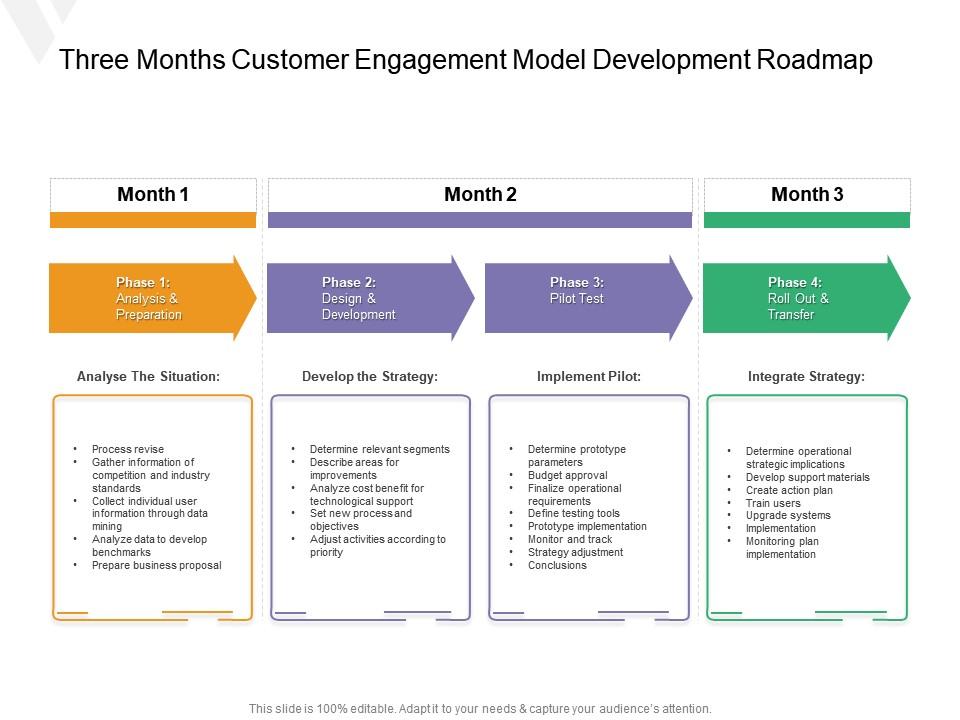
Template 12: Three-Month Customer Engagement Model Development Roadmap
Three-month roadmaps work when teams need to show near-term momentum without over-committing to a long horizon. This template structures a customer engagement model development plan into a focused 90-day view. Program managers and client success leads use it when presenting a short-cycle engagement rollout to leadership or clients. It keeps milestones tight and progress visible—exactly what a client onboarding plan needs in its early stages. Transform your short-term engagement presentations with a structured, professional roadmap. Download this template now and build stakeholder confidence from week one.
Download this PowerPoint Template
Template 13: Five-Stage Client Engagement Model PowerPoint
Client engagement rarely follows a straight line, but presenting it that way builds credibility. This five-stage slide structures the engagement journey—from initial attraction through progress review—into a clean, sequential flow. Account managers and client relationship leads use this PPT when walking stakeholders through a structured client engagement model in formal review meetings. It's concise enough for a quick briefing and detailed enough for a full client planning session. The template is 100% editable and customizable.

Download this PowerPoint Template
Template 14: Five-Year Customer Engagement Model Development Roadmap
Five-year plans need a visual structure that makes long-range commitments feel credible and trackable. This roadmap template spans a full five-year horizon, breaking customer engagement model development into year-by-year milestones. Strategic planners and enterprise engagement leads use this slide when presenting a long-term business development model to boards or investors. The extended timeline view supports conversations about sustainable customer relationship management without losing the detail. Elevate your long-range engagement planning presentations with a framework that commands trust. Download this template now and make your five-year vision impossible to dismiss.

Download this PowerPoint Template
Template 15: Partner Engagement Business Revenue Growth Model PPT
Partner revenue growth depends on a clear model that shows how relationships move from entry point to expansion. This PPT slide maps the partner engagement lifecycle—from closing the first deal through broadening the customer footprint—into five defined stages. Partner program managers and revenue leads use this when presenting a B2B partnership model or a partner engagement program to leadership. It keeps revenue growth logic visible and the accountability chain clear. The template is 100% editable and customizable.

Download this PowerPoint Template
Template 16: Employee Engagement Model Development Key Points
Employee engagement models don't exist in isolation—they connect directly to customer outcomes and overall business engagement. This eight-stage slide captures the key development points in building an engagement model that covers both staff and customer-facing dimensions. HR leads and organizational development managers reach for this PPT when presenting engagement model development priorities to executive stakeholders. It's a grounded tool for any team working to connect internal engagement to external business results. The template is 100% editable and customizable.

Download this PowerPoint Template
Template 17: Delivery Engagement Model Key Focus Areas
Delivery success often comes down to how clearly both sides understand their roles from day one. This template maps four key focus areas—client-first mindset, requirement gathering, fixing pain points, and expectation alignment—into a single delivery engagement view. Vendor engagement leads and project delivery managers use this when presenting a vendor engagement strategy or a collaboration model to client stakeholders. It turns abstract delivery principles into concrete, discussable commitments. Transform your delivery engagement presentations with a framework that builds immediate client confidence. Download this template now and set every project up for a stronger start.

Download this PowerPoint Template
Template 18: Customer Engagement Model to Enhance Business Relationship
Long-term business relationships need a repeatable process for engaging, re-engaging, and reviewing customer connections. This template maps three core stages—engaging, re-engaging, and analysis—into a diagram that shows how organizations sustain customer relationships over time. It includes specific activities like connecting with prospects and introducing new products, grounding the framework in real actions. CRM leads and business relationship managers use this when presenting a customer engagement model to commercial stakeholders. Strengthen your customer relationship management presentations with a clear, actionable structure. Download this template now and build the lasting partnerships your business depends on.
[product_image id=1182168]
Template 19: Business Engagement Model Engagement Leads PowerPoint Presentation
A business engagement model that can't be shown clearly is one that won't be approved. This full PowerPoint presentation gives teams a complete, visually coherent way to present their engagement model across multiple slide formats. Business development directors and enterprise engagement leads use this deck for boardroom sessions, client pitches, and internal model reviews alike. It covers the relationship logic, accountability structure, and model overview that decision-makers need in one place. The template is 100% editable and customizable.

Download this PowerPoint Template
Template 20: Engagement Model for Delivery Excellence
Delivery excellence starts with a shared understanding of what the engagement model is supposed to achieve. This template gives project and delivery teams a structured framework for presenting engagement expectations, milestones, and accountability in one clear view. Delivery managers and operations leads use it when aligning internal teams or client stakeholders at the start of a project cycle. It's a practical tool for any team presenting a business collaboration model where delivery quality is the central commitment. Achieve delivery excellence in every stakeholder presentation with a framework built for clarity. Download this template now and set the standard your teams will consistently meet.

Download this PowerPoint Template
Ace Every Engagement Conversation with SlideTeam
SlideTeam's PowerPoint templates are the best in the industry for presenting a business engagement model with clarity and confidence. These content-ready slides cover everything from partner revenue growth to client maturity frameworks, saving hours of design time. Use these ready-made PowerPoint slides to communicate your engagement model, retain clients, and align stakeholders fast. Deploy SlideTeam's pre-designed templates to turn complex engagement structures into decisions that move deals forward.
FAQs on Business Engagement Model
How does selecting the right business engagement model impact long-term client retention and revenue stability?
The right engagement model sets clear expectations from day one—scope, accountability, and communication cadence. Clients who understand how the relationship works are less likely to churn and more likely to expand. Fixed-scope models suit short projects; dedicated or outcome-based models build deeper, longer-term ties. Aligning the model to client needs directly reduces friction, improves renewal rates, and stabilizes revenue over time.
What are the key differences between fixed-price, time-and-material, and dedicated team engagement models?
Fixed-price locks scope, cost, and timeline upfront—best for well-defined, short projects. Time-and-material bills actual hours and resources, giving flexibility when scope is uncertain or likely to shift. A dedicated team model embeds a committed group within the client's workflow, suited for ongoing, evolving work. The core difference is how risk and flexibility are distributed between the vendor and the client.
How can startups determine which engagement model aligns best with their growth stage and operational capacity?
Startups should map three things first: budget predictability, scope clarity, and team capacity. Early-stage teams with tight budgets and fixed deliverables fit the fixed-price model. Those in rapid iteration mode—where scope shifts weekly—do better with time-and-material. Dedicated teams make sense only when the startup has enough stable work to justify the overhead. Match the model to current operational reality, not future ambition.
What role does transparency play in building trust within a staff augmentation engagement model?
In staff augmentation, the client pays for people they can't fully see working day-to-day. Transparency—through regular reporting, clear KPIs, and open communication channels—replaces the visibility that physical co-location provides. Without it, trust erodes quickly and augmented staff feel disconnected from outcomes. Share progress, surface blockers early, and make accountability visible. That's what keeps the model working long-term.
How do businesses effectively transition from one engagement model to another without disrupting project continuity?
Transitions fail when they happen abruptly or without a documented handoff plan. Run both models in parallel for a defined overlap period to prevent gaps. Communicate the change to all stakeholders before it takes effect, not after. Reassign ownership of deliverables, timelines, and contacts explicitly. Treat the transition itself as a mini-project with its own milestones and a named owner on both sides.
What metrics should organizations track to evaluate the performance and profitability of their chosen engagement model?
Track three categories: financial performance (margin, cost per deliverable, revenue per engagement), delivery quality (on-time rates, defect counts, client satisfaction scores), and relationship health (renewal rate, expansion revenue, escalation frequency). Together, these show whether the model is profitable, functional, and sustainable. Review them quarterly. If two of the three are trending down, the model likely needs adjustment—not just better execution.
How does a hybrid engagement model balance flexibility and accountability in complex, multi-phase projects?
A hybrid model works by assigning fixed-price terms to well-defined phases and time-and-material terms to exploratory or evolving ones. Accountability is maintained through clear phase gates—each with defined outputs and sign-off requirements before moving forward. Flexibility is preserved by keeping scope open within agreed boundaries for the variable phases. The key is documenting which rules apply to which part of the project from the start.
What are the most common pitfalls companies face when implementing a managed services engagement model?
The biggest pitfalls are scope creep, unclear SLAs, and weak governance. Managed services contracts often under-specify what 'managed' actually covers, leading to disputes over ownership. Clients frequently underestimate the internal coordination still required on their side. Fix this by defining service boundaries explicitly, establishing a governance rhythm from week one, and building escalation paths before any issue arises—not after.