

 0 Comment
 Customer Reviews

The resume's been updated. Three times.
Not because anything's wrong with it—it probably reads fine. But somewhere between the last role and the one being applied for, there's a gap. Could be months. Could be longer. And the question that follows every application isn't really about dates.
It's about what happened during that time. Whether it counts. Whether it needs explaining or defending or reframing entirely.
That silence—between what you were and what you're trying to be—is where career gap analysis lives. Not as a formal HR process. As the thing you do at 11pm before sending an application, wondering if anyone's going to notice.
Most people don't actually think through the gap. They acknowledge it exists, maybe write a cover letter line about "personal development" or "family responsibilities," and move on. What they don't do is map it—what skills were maintained, what atrophied, what's genuinely missing and what can be learned in six weeks with the right course.
That's the uncomfortable part. Because analyzing a career gap means admitting you don't know exactly where you stand. It's not the gap itself that creates the dread. It's the inventory. Figuring out what you left behind, what's changed in the market, whether upskilling and reskilling will actually close the distance—or just look good on paper.
HR teams deal with this too, just from the other direction. Talent gap management reviews, competency gap analysis presentations, workforce planning documents. The same problem: what does the organization have, what does it need, and how honest can the presentation afford to be?
Templates exist for this reason. Not because the analysis is simple—it isn't—but because the structure is universal. Every version of this problem follows the same shape: current state, target state, gap, path.
SlideTeam's career gap analysis templates handle exactly that structure. Pre-designed frameworks that let you focus on the substance—what's actually missing—instead of spending two hours formatting boxes and arrows. The content-ready slides are built for both individual career planning and organizational HR contexts.
Here's what's available.
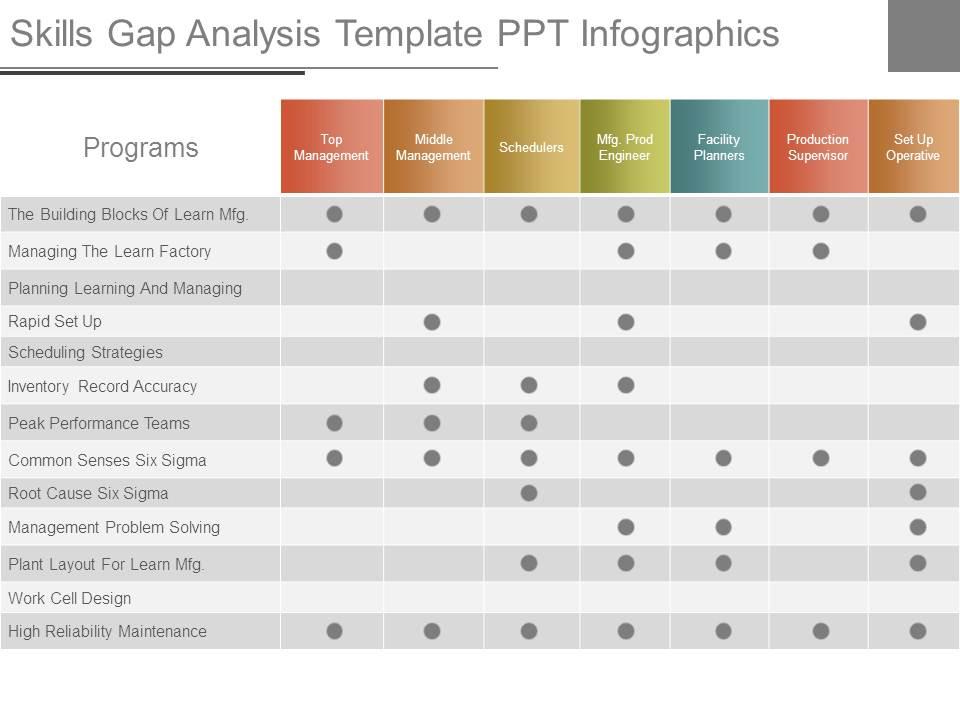
Template 1: Skills Gap Analysis Template PPT Infographics
A seven-stage visual framework drives instant clarity across every level of a skills gap analysis. This infographic maps roles from top management to production supervisors, creating a full organizational learning picture. Each stage covers specific competencies—scheduling, plant layout, work cell design, and more. You gain a structured view of where learning gaps exist across your entire workforce hierarchy. The layered layout makes presenting training needs analysis outcomes to leadership effortless and credible. Color-coded stages deliver instant visual differentiation between management tiers and operational roles. Use this infographic to build compelling competency gap analysis presentations that command boardroom attention. Transform your skills gap presentations today. Download this dynamic template now and unlock a clear path to workforce development planning.
Download this PowerPoint Template
Template 2: Career Gap Analysis Template PPT Outline
Structured career gap analysis presentations demand both clarity and visual engagement to truly land. This deck delivers a seamless creative framework that captures audience attention from the first slide. Versatile design elements let you align every visual with your personal or organizational brand identity. The pre-designed layout saves hours, giving you more time to focus on the actual career assessment content. Built for professionals presenting employment gap explanations, career transition planning, or professional development planning outcomes. Transform your career gap analysis presentations today. Download this content-ready template now and outshine every competitor in the room.
[product_image id=1448163]
Template 3: Career Gap Analysis for Professional Growth Planning PPT Graphics
Professional growth planning requires a visual story—not just bullet points and dates. This deck presents your career gap analysis for professional growth in a visually compelling, structured format. Creative layouts blend flexibility with a polished aesthetic that builds immediate credibility with any audience. Every element adapts to your brand, making career development strategy presentations feel intentional and professional. Use this framework to articulate career progression analysis outcomes with clarity and confidence. Transform your professional growth planning presentations today. Download this dynamic template now and close the gap between where you are and where you need to be.
[product_image id=1799944]
Template 4: Career Gap Analysis Identifying Missing Skills PPT Designs
Identifying missing skills is hard enough without a slide deck that muddles the message. This PPT template is built for HR professionals and career coaches who need to surface skill deficiencies clearly. It works well when presenting competency gap analysis findings to leadership or during individual performance gap reviews. The structured layout keeps attention on what matters: the gap, its size, and the path forward. The template is 100% editable and customizable.
[product_image id=1799946]
Template 5: Career Gap Analysis for Resume and Interview Preparation PPT
Resume gaps need more than an apology—they need a clear, confident framing backed by evidence. This PPT preset is built for professionals preparing to address career gaps in resume reviews or interviews. It gives structure to what is often an uncomfortable, improvised conversation about employment history. Use it to walk hiring managers through a logical career gap assessment before they even ask. The template is 100% editable and customizable.
[product_image id=1799945]
Template 6: Career Gap Analysis Tools and Explanation PPT Example
Explaining career gaps to a skeptical audience requires more than good intentions—it requires the right tools. This PowerPoint slide helps professionals and HR practitioners lay out career gap analysis tools and explanations in a clear, structured way. It suits job readiness assessments, individual coaching sessions, or team-level training needs analysis conversations. The balanced design keeps content readable without overwhelming the audience with visual noise. The template is 100% editable and customizable.
[product_image id=1799947]
Template 7: Healthcare Gap Analysis with Current State PPT Presentation
Current-state visibility is the starting point for any credible gap analysis in healthcare settings. This deck maps existing conditions against benchmarks, giving healthcare leaders a structured basis for planning. Innovative slide design balances simplicity with enough visual depth to hold a senior audience's attention. Flexible layouts let you tailor each slide to departmental priorities without starting from a blank canvas. Use this framework to present healthcare performance gap analysis findings with confidence and clarity. Transform your healthcare gap analysis presentations today. Download this ready-made template now and drive actionable planning from the current state forward.
[product_image id=1628406]
Template 8: Career Gap Analysis Process PPT Designs
Process-driven career gap analysis presentations need a visual flow that reflects logical, step-by-step thinking. This deck structures the full analysis journey—from identifying gaps to mapping solutions—in a cohesive narrative. Clean, innovative slide design keeps the audience focused on each stage of the process without distraction. Flexible layouts adapt to individual career planning or broader workforce development planning contexts. The framework suits HR leaders, career coaches, and professionals managing their own career path planning. Transform your career gap analysis process presentations today. Download this dynamic template now and present your path forward with total clarity.
[product_image id=1753859]
Template 9: Gap Analysis and Workforce Planning PPT Summary
Workforce planning decisions get harder when the underlying gap data isn't clearly presented. This PPT template helps HR teams and analysts align gap analysis findings with workforce planning priorities in one coherent deck. It suits talent gap management reviews, departmental capacity planning, or skills shortage solutions discussions with leadership. The structured layout makes it easy for any audience to follow the logic from gap identification to action. The template is 100% editable and customizable.
[product_image id=1495811]
Template 10: Gap Analysis Techniques and Tools PPT Information
Different gaps need different tools—and not every practitioner knows which technique fits which context. This PowerPoint slide helps analysts and HR professionals present common gap analysis techniques and tools in a structured, digestible format. It works well in training sessions, internal HR workshops, or job skills evaluation briefings. For context, the clean layout ensures methodologies are compared clearly without burying the audience in jargon. The template is 100% editable and customizable.
[product_image id=1557650]
Template 11: How to Define Clear Career Aspirations for Success PPT Presentation
Career aspirations without structure tend to stay aspirations. This PPT preset is built for professionals who need to define, present, and act on clear career goals—whether in coaching sessions or self-directed career growth planning. It suits individual contributors mapping their next move or managers articulating development targets for their teams. The design keeps focus on the destination, not the formatting. The template is 100% editable and customizable.
[product_image id=1628407]
Template 12: Competency Frameworks for Career Advancement by Bridging Gaps PPT
Competency frameworks often sit in documents nobody reads—until someone puts them in a well-structured slide. This PPT template gives HR leaders and L&D professionals a visual format for presenting competency-based career advancement pathways clearly. It works in talent reviews, promotion discussions, or upskilling and reskilling planning sessions where the audience needs to see the progression logic at a glance. The design combines visual appeal with a layout that keeps complex frameworks readable. The template is 100% editable and customizable.
[product_image id=1793990]
Template 13: Gap Analysis Identifying Workforce Skill Deficiencies PPT Demonstration
Workforce skill deficiencies cost organizations more when they stay invisible. This deck surfaces and structures those deficiencies in a format that drives real decision-making, not just acknowledgment. Visually striking design combines functionality with clarity, ensuring your analysis content—not the layout—commands attention. The ready-made framework suits HR skills assessment reviews, employee skills inventory presentations, and talent gap management discussions. Versatile layouts adapt to boardroom presentations and client-facing briefings with equal authority. Transform your workforce skill deficiency presentations today. Download this powerful template now and make every gap visible, actionable, and understood.
[product_image id=1819092]
Template 14: Gap Analysis for Workforce Development PPT Summary
Workforce development planning demands a clear line from gap identification to practical action. This deck gives L&D leads and HR professionals a structured, visually engaging format for presenting development findings. Innovative yet simple design ensures your analysis reads as a logical, credible path—not a list of complaints. Flexible layouts adapt to departmental plans, enterprise-wide initiatives, or individual training needs analysis presentations. Use this framework to make workforce development planning decisions that stakeholders will actually support and fund. Transform your workforce development presentations today. Download this ready-made template now and turn gap analysis into organizational momentum.
[product_image id=1614788]
Template 15: Gap Analysis Identifying and Closing Workforce Skill Deficiencies PPT
Closing workforce skill deficiencies is a two-part problem: identifying them, then presenting a credible plan to close them. This PPT template handles both in one structured deck built for HR teams and department heads. It suits talent gap management presentations where leadership needs to see both the problem and the solution path clearly. The clean, adaptable layout ensures the gap data speaks for itself without visual clutter getting in the way. The template is 100% editable and customizable.
[product_image id=1594772]
Template 16: Gap Analysis Identifying Critical Employee Skill Deficiencies PPT Presentation
Critical employee skill deficiencies rarely surface through conversation—they show up in missed targets and stalled projects. This PowerPoint slide helps HR practitioners and team leads present individual and team-level skill gaps with the specificity leadership needs to act. It suits performance gap analysis reviews, HR skills assessment briefings, and workforce planning tools discussions where vague generalizations won't do. The design balances visual appeal with enough structure to keep the analysis credible and actionable. The template is 100% editable and customizable.
[product_image id=1657929]
Elevate Your Career Gap Analysis with SlideTeam
SlideTeam's PowerPoint templates are the best in the industry for career gap analysis and workforce skills assessment. These content-ready slides give you a professional structure that turns complex gap data into clear, actionable presentations—saving hours of design work. Use these PowerPoint slides to present career transition planning, competency gap findings, or skills shortage solutions with confidence. Grab these ready-made templates and transform every gap into a growth opportunity.
FAQs on Career Gap Analysis
What are the key differences between a skills gap and a career gap, and how do they impact long-term professional growth?
A skills gap is about missing competencies for a specific role—technical, functional, or behavioral. A career gap is a period of interrupted employment. Both affect long-term growth differently. Skills gaps slow progression within a field; career gaps can create perception challenges externally, even when skills remain intact. Address both separately: map the competency shortfall with a clear skills inventory, then frame the employment break with demonstrable activity or learning.
How can professionals use a structured career gap analysis to identify hidden opportunities within their current industry?
Start by mapping your current role's actual deliverables against the job descriptions of roles one level up. Look for patterns in where you've been excluded from decisions, projects, or conversations. Those exclusions often signal hidden gaps—and hidden opportunities. A structured career gap analysis makes these visible without requiring an external assessor. The goal is to spot adjacent skills you already partially have and can develop within your current context.
What frameworks are most effective for conducting a self-assessment during a career gap analysis?
Two frameworks work consistently: the SWOT self-assessment and competency mapping against a target job description. SWOT grounds the review in real evidence—past performance, peer feedback, measurable outcomes. Competency mapping adds precision by benchmarking against actual role requirements. Combine both, and you get a self-assessment that is specific enough to act on. Avoid frameworks that rely entirely on self-rating scales—they tend to produce comfortable, not accurate, results.
How does a career gap analysis differ for mid-career professionals versus those just entering the workforce?
Early-career professionals typically face breadth gaps—they lack exposure across multiple functions. Mid-career professionals face depth gaps—they have broad experience but insufficient mastery in one or two critical areas. The analysis process looks similar, but the outcomes differ. Early-career focus should be on job readiness assessment and foundational skill building. Mid-career focus should be on identifying which specific competencies are blocking the next promotion or career transition.
What role does industry benchmarking play in performing an accurate career gap analysis?
Industry benchmarking anchors your analysis in market reality, not personal perception. Without it, professionals routinely over- or underestimate where they stand. Use job postings, professional association competency frameworks, or salary survey data to set the benchmark. Then compare your actual skills inventory against what the market expects at your target level. Benchmarking turns a subjective self-assessment into a measurable gap you can actually close.
How can professionals quantify soft skill gaps during a career gap analysis without relying on subjective evaluation?
Soft skills can be quantified by tracking behavioral outcomes. Did a negotiation close? Did a conflict resolve without escalation? Did a presentation shift a decision? Map specific situations to specific results. Use 360-degree feedback data where available—it introduces outside perspective that removes personal bias. The goal is to replace "I think I'm a good communicator" with "Here are three outcomes that demonstrate it." Evidence beats self-description every time.
What are the most common blind spots professionals encounter when conducting their own career gap analysis?
The three most common blind spots: overvaluing tenure as a proxy for competency, ignoring soft skill gaps because they're harder to name, and anchoring the analysis to the last role rather than the target role. Most professionals analyze backward—what they've done—instead of forward—what the next role requires. A career gap analysis only works when it starts from the destination and maps backward to where you currently stand.
How can a career gap analysis be used to strategically pivot into a completely different industry?
Start by identifying which of your existing skills are transferable—not just job titles. Most skills cross industries; most people undersell them. Then run a competency gap analysis against three or four real job descriptions in the target industry. Look for the shortest gap, not the most exciting role. Career transition planning works best when it is incremental: bridge roles close the gap faster than direct pivots into unfamiliar territory.