




 0 Comment
 Customer Reviews

The deck's been sitting in the shared drive for a week. Nobody's touched it.
Not because the change initiative is unclear. The direction is set, approvals are done, the steering committee met twice. But someone still has to stand up in front of a room full of skeptical department heads and walk them through why this is happening, what it means for them, and what comes next.
That's the part nobody plans for properly.
Change management as a concept gets a lot of airtime. Every org going through a restructure, a merger, a tech rollout, or a process overhaul says the words. But the actual work—mapping phases, tracking who's been told what, documenting what "done" looks like—that's where things go quiet. Where the post-it notes appear. Where someone starts a new slide from scratch at 11pm.
The uncomfortable truth is this: most change efforts don't fail at the decision point. They fail somewhere in the middle. After the announcement, before the adoption. In the gap between a change management framework that lives in a PDF and one that actually runs the room.
There's a reason why the change management lifecycle gets broken into phases—not because consultants love flowcharts, but because the sequence matters. What you do in the "prepare" phase determines how hard the "sustain" phase is. Stakeholder engagement early changes what resistance looks like later. And if you skip change readiness assessment because things feel urgent, that urgency compounds into a much harder problem six months out.
Pre-designed templates exist because this work is repetitive in structure, even when it's unique in content. Someone's already figured out how to lay out the five phases. How to show activities and deliverables side by side. How to communicate a change communication plan to a leadership team without losing them on slide three.
SlideTeam's change management lifecycle templates handle the structural work—so you can spend your time on what the slides actually need to say. Content-ready frameworks that fit the real scenarios: the org redesign, the system migration, the business transformation planning exercise that's been on the agenda since Q1.
Here's what's available.
Template 1: Steps Involved in Change Management Lifecycle PPT
Every structured change effort needs a clear cyclic model to anchor it. This PowerPoint slide is built for change leads who need to present the full change management lifecycle without reinventing the visual structure. It maps five interconnected stages, making it easy to show how one phase feeds the next. Ideal for briefing leadership teams or running a change readiness assessment workshop. The template is 100% editable and customizable.

Download this PowerPoint Template
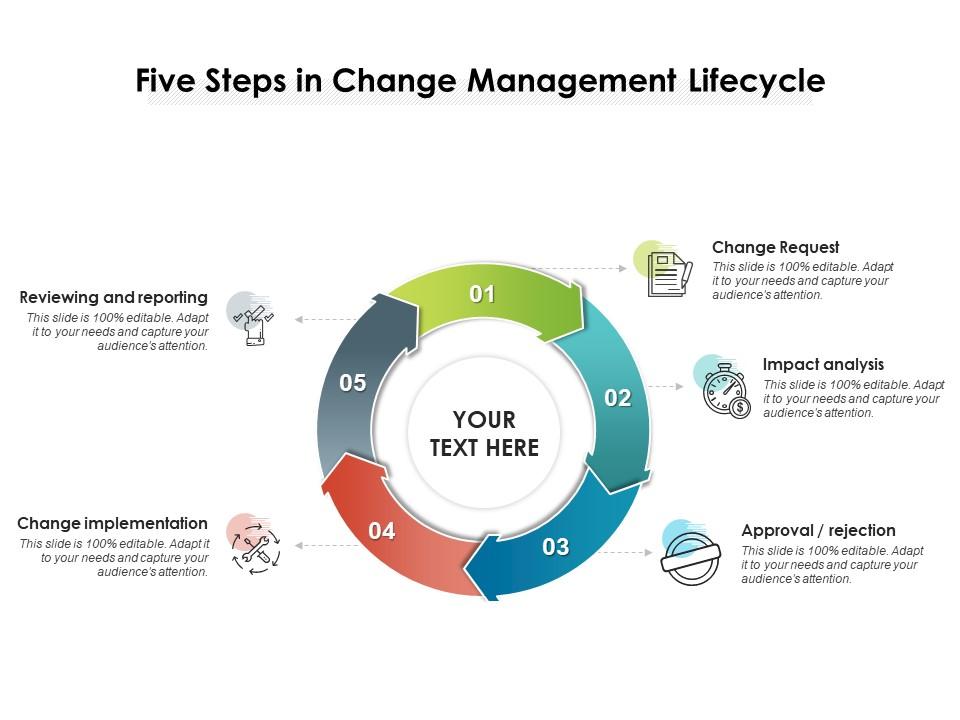
Template 2: Five Steps in Change Management Lifecycle
Map every critical stage of business transformation planning with this sharp, five-step framework. The intuitive cyclic structure shows precisely how each change phase connects to the next. Visual clarity drives immediate audience comprehension of even the most complex change management process. Extensive customisation flexibility lets you align every element to your organisation's specific methodology. Build compelling change management lifecycle presentations for leadership briefings and stakeholder workshops with ease. Transform your change management presentations today. Download this dynamic template now and unlock flawless cycle visualisation.
Download this PowerPoint Template
Template 3: Change Management Lifecycle Overview PPT Summary
Communicating the full scope of a change initiative in one slide is harder than it sounds. This PPT template is built for change managers who need a clean, high-level overview without losing the audience in detail. It works well as an opening slide in a business transformation planning deck. Use it to orient executives before walking into the phases. The template is 100% editable and customizable.
[product_image id=1777575]
Template 4: Change Management Strategy Implementation Lifecycle
Deliver a complete six-phase change management strategy implementation with precision and clarity. This slide captures the full arc—from identifying the need through preparing, designing, executing, sustaining, and monitoring outcomes. Each stage anchors your organizational change narrative with a logical, credible structure. The flexible design accommodates review and feedback loops, keeping your implementation plan audit-ready. Use this to present end-to-end change management lifecycle frameworks to executives and program sponsors. Transform your organisational change presentations today. Download this dynamic template now and unlock strategic implementation clarity.

Download this PowerPoint Template
Template 5: Change Management Lifecycle Key Phases PPT
Structured phase presentation drives audience confidence in any change initiative. This deck captures all key phases of the change management lifecycle in a visually engaging format. Each phase section is designed to communicate urgency, sequence, and ownership without cluttering the slide. Bold visual design ensures your change management methodology commands the room. Deliver polished change management phases reviews for steering committees and project sponsors. Transform your key-phase presentations today. Download this dynamic template now and unlock presentation-ready lifecycle clarity.
[product_image id=1825992]
Template 6: Change Management Framework Collection Quality Control Professional PPT Demonstration
QC and change management rarely live on the same slide—but they should. This deck is for practitioners who need to show how a change management framework connects to quality controls across the lifecycle. It suits compliance leads, process improvement teams, and change analysts running parallel workstreams. Real governance conversations need this kind of cross-functional structure. The template is 100% editable and customizable.
[product_image id=1777574]
Template 7: Organizational Change Management Lifecycle Icon
Visual icons do real work in change management presentations—they anchor phases and reduce cognitive load fast. This PPT preset gives practitioners a clean, icon-based representation of the organizational change management lifecycle. Use it as a navigation element in longer decks or as a standalone phase map. It's especially useful when presenting change management phases to mixed audiences unfamiliar with the process. The template is 100% editable and customizable.

Download this PowerPoint Template
Template 8: Change Management Tools and Techniques PPT Example
Change management tools rarely get their own focused slide—but they should. This PPT template is built for practitioners who need to present the toolkit behind their approach, not just the phases. It works well in change management training sessions or methodology briefings for new project teams. Covering tools alongside techniques gives the audience a practical picture, not just a process map. The template is 100% editable and customizable.
[product_image id=1529669]
Template 9: Understanding Change Management Lifecycle in Organizations PPT Slides
Understanding how the change management lifecycle actually operates inside an organisation is the starting point for any real change initiative. This deck is built for practitioners walking a leadership team or HR group through how change moves from concept to embedded practice. It fits naturally into an organizational change management onboarding or awareness session. Real comprehension before execution saves significant rework later. The template is 100% editable and customizable.
[product_image id=1768755]
Template 10: Five Levels of Change Management Maturity Explained Clearly PPT Presentation
Maturity models are useful precisely because they show where an organisation actually is, not where it thinks it is. This PPT template maps five levels of change management maturity clearly, giving change leads and HR directors a credible benchmarking tool. Use it in leadership reviews or capability planning sessions to anchor honest conversations about change readiness. Knowing your level determines what change management best practices to prioritise next. The template is 100% editable and customizable.
[product_image id=1651434]
Template 11: Lifecycle of Change Management in Organizations PPT Template
Anchor every change initiative in a clear, repeatable cycle with this structured lifecycle framework. The intuitive design maps the full change management process, capturing how cyclic implementation drives sustainable outcomes. Each stage flows naturally into the next, reinforcing the logic of your organisational change strategy. Extensive flexibility lets you tailor content to specific programs, sectors, or timelines. Build compelling change management lifecycle presentations for governance reviews and program kick-offs with confidence. Transform your lifecycle presentations today. Download this dynamic template now and unlock complete cycle clarity.

Download this PowerPoint Template
Template 12: Lessons Learned and Recommendations PPT Summary
Closing a change initiative without capturing what actually happened is a missed opportunity. This deck gives change managers and project leads a structured format for presenting lessons learned and formal recommendations. It's the slide that turns a completed program into institutional knowledge. Use it in post-implementation reviews or to brief the next change cohort before they start. Transform your post-implementation presentations today. Download this dynamic template now and unlock structured retrospective clarity.
[product_image id=1542357]
Template 13: Key Steps for Change Management Success PPT Example
Success in change management comes down to the steps—done in the right order, with the right people. This PPT template is built for change leads who need to present a crisp, credible success roadmap to sponsors or program boards. It covers the key actions without overloading the slide with process detail. Use it alongside a Kotter's change model implementation conversation to give the audience both the theory and the steps. The template is 100% editable and customizable.
[product_image id=1745936]
Template 14: Tools and Techniques for Effective Change Management PPT
The tools and techniques behind a change effort are often invisible to stakeholders—but they're what make execution credible. This PPT preset is built for change analysts and program managers who need to show the methods driving their approach. It works well in methodology briefings, change management training sessions, or capability reviews. Naming the tools builds confidence that the change control process is structured, not improvised. The template is 100% editable and customizable.
[product_image id=1663172]
Template 15: Comprehensive Change Management Process Overview PPT Demonstration
A clear process overview is the one slide every change deck needs but rarely has. This PPT template gives practitioners a comprehensive view of the change management process in a single, structured layout. It suits both initial planning sessions and progress updates to leadership. Use it to show how activities connect across phases without losing the audience in operational detail. The template is 100% editable and customizable.
[product_image id=1538607]
Template 16: Steps to Implement Successful Change Management Plans PPT Graphics
Turn ambiguous transformation goals into a concrete, executable change management action plan. This deck drives sharp visual communication of every implementation step required for program success. The striking design captures audience attention and keeps stakeholders focused on key milestones and owners. Flexible content areas let you map change management best practices directly to your organisation's unique rollout. Build compelling successful change management plan presentations for program sponsors and project leads. Transform your implementation presentations today. Download this dynamic template now and unlock structured change execution.
[product_image id=1735679]
Template 17: Case Studies and Proof of Concept Results PPT Graphics
Data from real change programs is the most persuasive thing in any stakeholder briefing. This deck gives change leads and strategy teams a structured format for presenting case studies and POC results side by side. It translates program evidence into clear, decision-ready visuals for executive audiences. Use it when making the case for change investment or for scaling a pilot across the organisation. Transform your evidence-based presentations today. Download this dynamic template now and unlock compelling proof-of-concept storytelling.
[product_image id=1540042]
Template 18: Change Management Lifecycle in Business
Business context changes everything about how a lifecycle is communicated. This PowerPoint slide is built for practitioners presenting the change management lifecycle specifically within a business operations or commercial context. The five-stage cyclic structure fits briefings for business unit leaders, operations teams, or cross-functional program groups. It keeps the process grounded in business outcomes rather than abstract methodology. The template is 100% editable and customizable.

Download this PowerPoint Template
Template 19: Change Management Lifecycle Process with Activities and Deliverables
Activities and deliverables rarely sit together on one slide—which is exactly why this PPT template is useful. It maps five stages—define, measure, analyse, improve, and control—against the specific outputs expected at each point. Change assessment and results assessment sit alongside the process, giving stakeholders a complete accountability picture. Use it in program governance reviews or change impact analysis sessions where clarity on deliverables matters. The template is 100% editable and customizable.

Download this PowerPoint Template
Master Every Stage of Change with SlideTeam
SlideTeam's PowerPoint templates are the best in the industry for presenting the change management lifecycle with clarity and authority. These content-ready slides cover every phase—from change readiness assessment to post-implementation review—saving hours of build time. Use these PowerPoint slides to align leadership, engage stakeholders, and document progress at every stage. Deploy these ready-made frameworks to drive employee change adoption and ensure your transformation lands.
FAQs on Change Management Lifecycle
What are the core phases that define a change management lifecycle, and how do they interconnect?
Most change management lifecycle models share four to six core phases: assess, plan, implement, and sustain. The assess phase identifies the need and scope. Planning sets the roadmap, roles, and communication approach. Implementation executes the change with active stakeholder support. Sustain embeds the change into normal operations. Each phase produces outputs that the next phase depends on—skipping one creates gaps that surface as resistance or failure later.
How does leadership alignment influence the success of each stage in the change management lifecycle?
Leadership alignment determines whether each phase gets the resources, decisions, and visibility it needs. Without it, the assess phase produces findings that go nowhere. The plan phase produces documents nobody acts on. During implementation, misaligned leaders send conflicting signals that stall adoption. Leaders don't need to manage every detail—they need to be visibly consistent and decisive at each stage transition, so teams trust the direction.
What distinguishes a change management lifecycle from a simple change management process?
A change management process is a set of steps for handling a single change. A lifecycle is broader—it covers the full arc from initial trigger to long-term embedding, including feedback loops and maturity reviews. The process asks 'how do we do this change?' The lifecycle asks 'how do we run change well, repeatedly, as an organisational capability?' The lifecycle treats each change as a learning event, not just a task.
How can organizations identify when a change initiative has truly completed its lifecycle versus merely paused?
A completed lifecycle shows three clear signs: the new way of working is the default, not the exception; support structures like coaching and oversight have been removed without performance drop; and outcomes match the original success metrics. A paused initiative typically still has workarounds in place, KPIs unmet, or teams defaulting to old behaviours under pressure. Measure actual behaviour, not just activity completion.
What role does stakeholder mapping play during the early phases of a change management lifecycle?
Stakeholder mapping in the early phases identifies who holds influence, who is most impacted, and who is likely to resist. That data shapes the communication plan, the sequencing of engagement, and where leadership attention is needed. Without it, change teams treat all stakeholders the same way and miss the groups whose resistance will matter most. Map early, update often—stakeholder positions shift as the initiative progresses.
How do feedback loops function within a change management lifecycle to prevent initiative failure?
Feedback loops catch problems before they become failures. Structured check-ins after each phase—through surveys, team reviews, or adoption metrics—surface resistance, confusion, or missed dependencies early. Without them, issues compound silently until implementation stalls. The key is acting on the feedback, not just collecting it. Build a review trigger at each phase gate so the team is required to respond, not just report.
What metrics should organizations track across each phase of the change management lifecycle?
Track change readiness scores before planning begins. During implementation, monitor adoption rates, training completion, and resistance incidents by team. Post-implementation, measure process compliance, KPI movement against baseline, and employee confidence scores. Across all phases, track stakeholder engagement activity against plan. These metrics tell you whether the change is landing—not whether the project is on schedule, which is a different question entirely.
How does organizational culture either accelerate or obstruct progress through the change management lifecycle?
Culture accelerates change when employees already trust leadership, expect transparency, and see past changes delivered well. In that environment, each phase moves faster because resistance is lower and communication is credible. Culture obstructs when there's a history of initiatives that started but didn't finish, or where accountability is unclear. Before planning a lifecycle, assess the cultural baseline honestly—it sets the realistic pace for every subsequent phase.